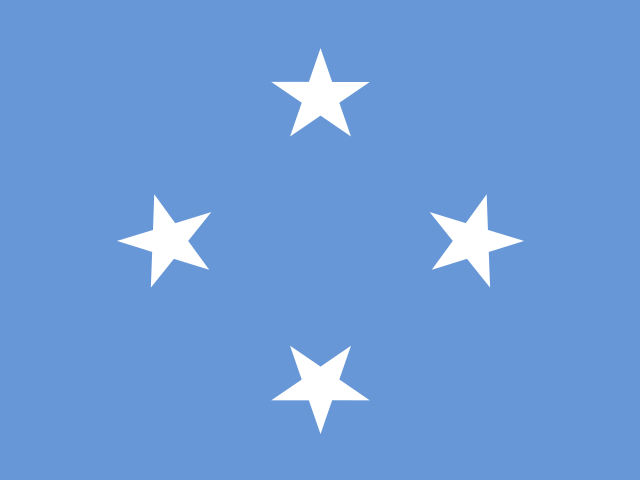
The Flag of Micronesia
Oceania · Adopted 30 November 1978
The Federated States of Micronesia adopted its flag on 30 November 1978, close to eight years before Micronesian voters and the US Congress finalized the free-association arrangement that took effect in 1986 and formally ended the trusteeship period. The design is a direct, deliberate descendant of the flag of the Trust Territory of the Pacific Islands, the United Nations trusteeship the US administered from 1947 covering Micronesia, Palau, and the Marshall Islands together — that trust-territory flag used the same pale blue field but carried six white stars, one for each of its administrative districts.
When the Federated States of Micronesia formed as its own political entity out of four of those districts — Chuuk, Kosrae, Pohnpei, and Yap — the new flag simply reduced the star count from six to four, one star per state, while keeping the same light blue field the trust territory had used. It is a rare case of a newly sovereign nation's flag being an edited-down version of the colonial administrative flag that preceded it, rather than a deliberate break from it.
The light blue itself was originally chosen for the trust-territory flag specifically to echo the pale blue used on the flag of the United Nations, a visual signal of the territory's status as a UN trusteeship rather than a straightforward colony — a design lineage most Micronesians and visitors are unaware of today, since the UN trusteeship ended decades ago and the color now simply reads as a reference to the surrounding Pacific Ocean.
The four stars are arranged in a simple centered cross pattern rather than any geographic or constellation-based layout, a deliberately plain, non-hierarchical design intended to represent the four states as formal equals within the federation, even though they differ enormously in population, land area, and language — Chuuk alone accounts for roughly half the country's total population, while Kosrae is the smallest and most linguistically uniform of the four states.
Micronesia's federated structure itself, unusual among small Pacific nations, grew directly out of the trust-territory administrative districts: rather than centralizing power the way most newly independent states did, the 1979 constitution preserved substantial autonomy for each of the four states, including separate state legislatures and, in the case of Yap and Chuuk in particular, strong continued roles for traditional chiefly authority alongside the national government.
The flag has never been redesigned since 1978, and unlike several of its Pacific neighbors it has not faced any serious public push to change it — its plain, symmetrical four-star design has instead become a point of quiet continuity through the trusteeship-to-independence transition, still displayed alongside the flags of all four individual states at government buildings across the federation.
Because Micronesia's free-association arrangement gives Washington defense responsibility over the country in exchange for financial support and lets Micronesian citizens live and work in the US without a visa, the national flag is frequently flown alongside the Stars and Stripes at official functions, a pairing the Marshall Islands and Palau also maintain with the US under their own, separately negotiated versions of the same basic arrangement.
Micronesia's four states remain culturally distinct enough that flag ceremonies at the national level often sit alongside separate, older state-level symbols and traditions — Yap in particular retains a strong living tradition of stone money (rai), giant carved limestone discs used historically in ceremonial exchange, a custom with no equivalent anywhere else in the federation and one that predates the flag, the trusteeship, and the modern federal structure by centuries.
College of Micronesia-FSM, the country's main tertiary institution with campuses across all four states, and the national government's continued reliance on US federal grant funding under the Compact — funding scheduled for periodic renegotiation roughly once per generation — are both practical, ongoing expressions of the same US relationship the flag's light-blue, UN-trusteeship-derived color quietly traces back to nearly eight decades of external administration before self-government began.
Micronesia's flag law sets its proportions at 10:19, the same non-standard ratio used by the United States flag and by the Marshall Islands' flag — a shared detail among the former trust-territory successor states that traces to the American bunting conventions in use throughout the trusteeship period rather than to any coordinated post-independence agreement between the three now-separate governments. The four stars are specified as equal in size and spaced at equal distances from the flag's center point, reinforcing the design's intended message of formal parity between Chuuk, Kosrae, Pohnpei, and Yap regardless of their real differences in size and population.
The US and the Federated States of Micronesia signed a 20-year renewal of their Compact of Free Association funding package in 2023, worth several billion dollars over its term, after a multi-year renegotiation that ran in parallel with similar renewals for Palau and the Marshall Islands; all three amended Compacts were bundled together and passed by the US Congress as part of a single funding bill, underscoring how closely the three former trust-territory nations' financial arrangements with Washington remain linked even though each maintains its own separate flag, government, and foreign policy.
Cut to 10:19, not 3:5
- Flag cut to 10:19 — At 10:19 this is longer and shallower than any common stock size, and the four stars are placed against that field, so a standard cut moves them as well as changing the shape.
As an Amazon Associate we earn from qualifying purchases made through these links, at no extra cost to you.
Often confused with
- Somalia — an unrelated country on the opposite side of the world that happens to use an almost identical pale blue field — Somalia's flag carries a single large white five-pointed star centered on the field, while Micronesia's carries four smaller stars arranged in a cross, but the shared UN-blue tone means the two are sometimes confused in quick visual quizzes. Compare side by side →
Micronesia at a glance
- Capital
- Palikir
- Population
- 112,000 (2024)
- Currency
- United States Dollar (USD)
- Language(s)
- English (official, federal level); Chuukese, Pohnpeian, Kosraean, and Yapese recognized regionally within their respective states
Population figure as of 2024, source: UN World Population Prospects (2024 revision). See methodology for how facts are sourced and kept current.