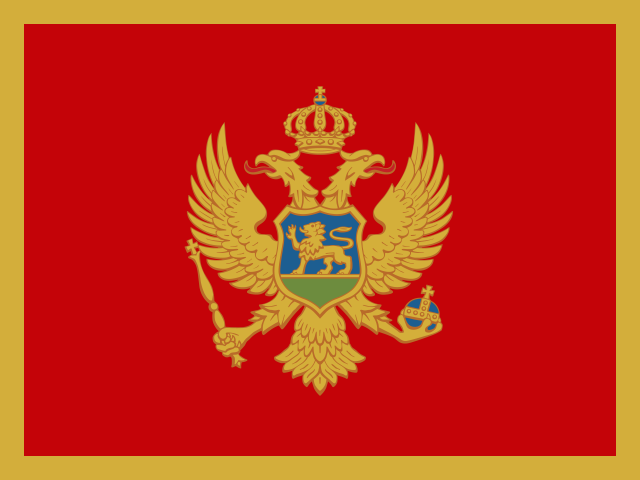
The Flag of Montenegro
Europe · Adopted 13 July 2004
Montenegro's current flag was adopted on 13 July 2004 — chosen deliberately for the anniversary of the 1878 Congress of Berlin, which formally recognized Montenegro as an independent state for the first time — while Montenegro was still technically part of the state union of Serbia and Montenegro, two years before the 2006 independence referendum made it a fully separate country again. That timing meant Montenegro adopted its modern national flag before it had fully re-established the sovereignty the flag was designed to evoke, a sequence that reflects how closely tied the flag's design was to the referendum campaign then underway.
The design revives, closely though not identically, the flag used by the independent Kingdom of Montenegro under King Nikola I in the decades before the First World War: a red field bordered by a golden fringe, centered on a gold coat of arms. That royal-era flag had been discarded twice over — first when Montenegro was absorbed into the Kingdom of Serbs, Croats and Slovenes after 1918, and then more thoroughly during the socialist Yugoslav period, when Montenegro, as one of Yugoslavia's six republics, flew a plain red flag with a gold-bordered red star in the canton, following the shared Yugoslav republican template rather than any distinct Montenegrin symbolism.
The coat of arms at the center of the current flag combines two separate emblems with two separate historical roots. The golden double-headed eagle, wings spread and crowned, descends from the arms of the medieval Nemanjić dynasty and the wider Byzantine-influenced heraldic tradition that Serbia's coat of arms also draws on — the two countries' eagles are visually close cousins precisely because both trace back to the same Nemanjić and Byzantine lineage, not because either copied the other in modern times. On the eagle's breast sits a golden lion, walking on green ground, a symbol tied specifically to the medieval principality of Zeta, the historical predecessor state that occupied much of modern Montenegro's territory before the Ottoman period.
A crown surmounts the whole coat of arms, a detail retained from the royal-era original despite Montenegro today being a parliamentary republic rather than a monarchy — the crown is treated as a historical and dynastic reference rather than a claim to restore the monarchy, similar to how several other European republics keep crowned emblems on coats of arms without any active royal government behind them.
Montenegro's independence in 2006 was decided by referendum with turnout and a yes-vote margin that cleared the 55% threshold the European Union had set as a condition for recognizing the result as legitimate, ending the state union with Serbia that had itself replaced the former Federal Republic of Yugoslavia. The flag adopted two years earlier needed no further change once full sovereignty was confirmed; it simply continued as the flag of a now fully independent state rather than a semi-autonomous republic within a union.
Because Montenegro's eagle and Serbia's eagle share the same dynastic ancestry, the two coats of arms are sometimes confused by people unfamiliar with either country's heraldry, though the flags built around them look nothing alike — Serbia's national flag is a red-blue-white horizontal tricolor with no red field or gold border, while Montenegro's is a solid red field with the emblem centered and a golden fringe running the full perimeter, a framing device Serbia's flag does not use at all.
The flag is flown at government buildings throughout the country and features prominently around Statehood Day on 13 July, the same date chosen for the flag's 2004 adoption, commemorating both the 1878 Berlin recognition and the start of the 1941 anti-fascist uprising in Montenegro during the Second World War.
The exact specifications of the 2004 flag — the width of the golden fringe relative to the field, the precise proportions of the eagle and lion within the coat of arms — were set out in detail in the law that created it, a level of legislative precision common among flags adopted or readopted around the turn of the 21st century, when digital reproduction made exact color and geometry specifications far more practical to enforce than they had been for flags fixed by 19th-century royal decree.
During the 1990s, while Montenegro remained part of the Federal Republic of Yugoslavia alongside Serbia, it used a plain red flag with no emblem at all rather than either the socialist-era star flag or the eventual 2004 design — a brief, largely symbol-free interim period between the fall of communism and the country's decision to formally revive its royal-era emblem, reflecting the genuine uncertainty at the time over whether Montenegro would ultimately pursue full independence or remain permanently bound to Serbia.
Montenegrin diaspora communities, particularly in the United States and Argentina, kept the pre-communist royal flag design in limited cultural and church use throughout the socialist Yugoslav decades, much as many other Eastern European émigré communities preserved pre-communist national symbols abroad — meaning the 2004 revival was drawing on a design tradition that had survived continuously outside Montenegro even during the years it was unavailable for official use inside the country.
The flag has a fringe by design
- Fringed flag — The gold border is part of the specification, with its width set against the field, rather than the optional ceremonial fringe added to other flags; an unfringed version is incomplete here.
As an Amazon Associate we earn from qualifying purchases made through these links, at no extra cost to you.
Often confused with
- Serbia — shares the same double-headed eagle heraldic tradition, since both coats of arms descend from the Nemanjić dynasty, but Serbia's national flag is an unrelated red-blue-white horizontal tricolor rather than Montenegro's solid gold-bordered red field. Compare side by side →
Montenegro at a glance
- Capital
- Podgorica
- Population
- 627,000 (2024)
- Currency
- Euro (EUR) — adopted unilaterally, Montenegro is not an EU member
- Language(s)
- Montenegrin (official); Serbian, Bosnian, Albanian, and Croatian in official use
Population figure as of 2024, source: UN World Population Prospects (2024 revision). See methodology for how facts are sourced and kept current.