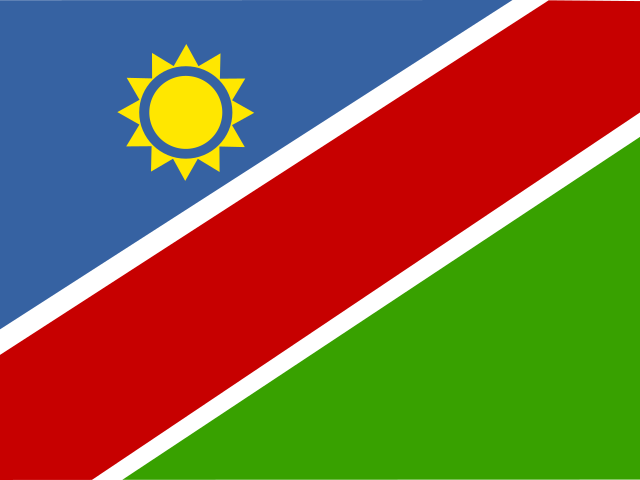
The Flag of Namibia
Africa · Adopted 21 March 1990
Namibia's flag was raised for the first time at the exact moment the country became independent, at midnight on 21 March 1990, ending 75 years of South African administration that had itself followed three decades of German colonial rule as South West Africa. The design was chosen through a national process launched in 1989 as independence approached: more than 800 submissions were received, and a small selection committee — working to avoid favoring any single political party's existing colors in a country where the flag would have to represent a population still deeply divided by the recent liberation struggle — merged elements from several of the strongest entries rather than picking one outright winner.
The result is a diagonal design split by a red band edged in white, running from the lower hoist to the upper fly, with a green triangle in the lower fly corner and a blue triangle in the upper hoist corner bearing a golden sun with twelve triangular rays. Blue represents the sky, the Atlantic Ocean along Namibia's coast, and rainfall — a resource so precious in one of the driest countries in sub-Saharan Africa that the state emblem also references it directly. Green represents vegetation and agricultural resources, red represents the country's people and their heroism and determination to build a fair, egalitarian society, and white represents peace and national unity.
The golden sun is read most directly as a symbol of life and energy, an especially pointed image in a nation whose landscape includes the Namib Desert, one of the oldest and driest deserts on Earth, where the sun is both a defining physical feature of the environment and, in the flag's symbolism, a source of hope and endurance rather than only hardship.
The choice of red, green, and blue was not arbitrary politically: those same three colors, in different arrangements, had long been associated with SWAPO (the South West Africa People's Organisation), the liberation movement that had fought South African rule since the 1960s and became the governing party at independence. Rather than simply adopting SWAPO's own party flag as the national one — a move that would have alienated other political groups involved in the transition, including parties that had contested the 1989 pre-independence election as SWAPO's rivals — the design committee folded those colors into a new diagonal arrangement distinct from any single party's existing banner, adding the sun as a unifying element tied to the land itself rather than to any faction.
Namibia's constitution, adopted in February 1990 just weeks before independence, fixed the flag's design and proportions in law from day one, giving the country no earlier national flag of its own to have replaced — unlike most other African states, Namibia never flew an interim post-independence flag that was later redesigned, because independence and the current flag arrived simultaneously.
The flag is flown prominently every Independence Day on 21 March and Heroes' Day on 26 August, the latter commemorating the start of the armed liberation struggle in 1966, and it appears on Namibian currency, government buildings, and the uniforms of national sports teams as one of the country's most visible unifying symbols in the decades since independence.
Namibia's national coat of arms, adopted alongside the flag in 1990, reinforces the same desert-and-life symbolism directly: it depicts a pair of oryx (gemsbok) as supporters, a fish eagle atop the crest, and a Welwitschia mirabilis plant — a desert species found almost nowhere else on Earth and capable of living well over a thousand years — set against a background of sand dunes, tying the flag's golden desert sun to a broader set of state imagery drawn specifically from Namibia's arid landscape rather than generic African wildlife or plant motifs.
Because Namibia's transition to independence was negotiated under UN Security Council Resolution 435 and overseen by a UN peacekeeping mission (UNTAG) through 1989–1990, the flag's design process itself took place under a degree of international observation unusual for a newly independent state, with the outcome — a genuinely new, non-partisan design rather than an existing party or colonial-era flag — often cited as a small but concrete symbol of the broader negotiated, rather than purely military, path Namibia took to independence compared with some other African liberation struggles.
Namibia had, in fact, flown two other flags in the decades before 1990 without ever being fully independent under either: the flag of German South West Africa before 1915, and later the flag of South Africa itself, which administered the territory as a de facto fifth province for decades, including years after the United Nations formally revoked South Africa's mandate over the territory in 1966 — meaning the 1990 flag was Namibia's first-ever flag genuinely designed for and by Namibians as an independent nation, rather than one imposed or inherited from an external administering power.
Namibia's 1989 pre-independence election, held under UN supervision to choose the constituent assembly that would draft the new constitution, saw SWAPO win a majority but fall short of the two-thirds threshold needed to write the constitution unilaterally, forcing genuine cross-party negotiation on the country's founding documents and symbols — a political reality that reinforced the design committee's choice to build a flag distinct from any single party's own colors rather than simply flying SWAPO's banner as the new national one.
A diagonal that must reach the corners
- Garden flag — The red diagonal is specified in law from the outset and runs corner to corner, which is a geometry small double-sided garden flags reproduce well because there is no fine emblem to lose.
As an Amazon Associate we earn from qualifying purchases made through these links, at no extra cost to you.
Often confused with
- South Africa — also uses a converging, non-rectangular band arrangement in multiple colors, but South Africa's flag is a horizontal Y-shape in six colors with no sun and no diagonal split, a visually distinct design despite both flags reading as unusually geometric among African national flags. Compare side by side →
Namibia at a glance
- Capital
- Windhoek
- Population
- 3.1 million (2024)
- Currency
- Namibian Dollar (NAD), pegged to and used alongside the South African Rand
- Language(s)
- English (official); Oshiwambo, Afrikaans, and other local languages widely spoken
Population figure as of 2024, source: UN World Population Prospects (2024 revision). See methodology for how facts are sourced and kept current.