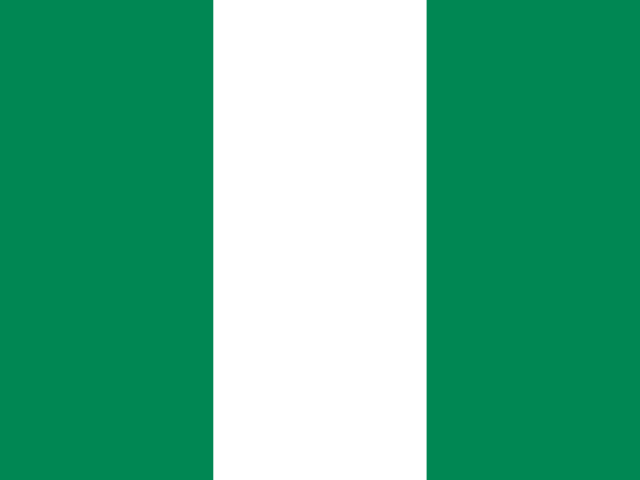
The Flag of Nigeria
Africa · Adopted 1 October 1960
Nigeria's green-white-green vertical tricolor was the winning entry in a genuine open national design competition, launched by the colonial government in 1959 ahead of independence, that drew roughly 3,000 submissions from across the country and, reportedly, from Nigerians living abroad. The winner was Michael Taiwo Akinkunmi, a young Nigerian student studying in London at the time, whose design was selected and formally adopted, with one modification, in time to be raised for the first time at independence on 1 October 1960.
That one modification is one of the more concrete design-committee stories among African independence-era flags: Akinkunmi's original submission included a red sun with rays spread across the center of the white band, but the selection committee removed it before adoption, leaving the plain, unadorned green-white-green design that has been flown ever since. The result is one of relatively few national flags with no emblem, crest, or other central device at all — a deliberate simplicity that stands out against most of its West African neighbors, many of which carry stars, animals, or other symbols on their tricolors.
The two colors carry meanings that are widely taught and generally agreed upon within Nigeria: green represents the country's agricultural wealth and its forests, referencing Nigeria's role as a major agricultural producer at independence, while white in the center band represents peace and unity — values given particular weight in a newly independent federation bringing together hundreds of distinct ethnic groups and three (later more) regions under a single national government for the first time.
Nigeria's flag has not been redesigned since 1960, remaining constant through the country's transition from a parliamentary system to a series of military governments beginning with the first coup in January 1966, the devastating 1967–1970 Nigerian Civil War (the Biafran War), and the eventual return to civilian democratic rule in 1999 — a striking continuity given how much the state's political structure and even its internal regional boundaries changed across those decades.
The flag's simplicity has occasionally drawn comparison to other plain-green-and-white designs internationally, though few share Nigeria's exact vertical-band arrangement; more often, Nigeria's flag is discussed in comparison with neighboring West African tricolors that use the same broad palette of colors associated with the region's mid-20th-century independence movements but arrange them horizontally or add central emblems Nigeria's design deliberately lacks.
Nigerian law governs the flag's use formally through the National Honours Act and related regulations, specifying its 1:2 ratio and prescribing respectful handling and display, with public flag ceremonies concentrated around Independence Day on 1 October and, since Nigeria's return to civilian rule, Democracy Day, observed on 12 June since 2019 (moved from a previous 29 May date) to commemorate the annulled 1993 election widely seen as Nigeria's clearest attempted democratic transition before 1999.
Michael Taiwo Akinkunmi, the flag's designer, reportedly received a modest cash prize and, decades later, wider public recognition for his role, including being flown to Abuja for official 50th-anniversary independence celebrations in 2010; his design remains one of the relatively few African independence-era flags whose individual creator's identity is well documented and publicly credited rather than attributed only to an anonymous government committee.
Nigeria's coat of arms, adopted separately in 1960 and modified in 1979, uses a black shield crossed by a white Y-shape representing the confluence of the Niger and Benue rivers, flanked by two horses and topped by a red eagle — imagery that, unlike the flag itself, does carry an explicit central emblem, making the plain, symbol-free flag something of a deliberate contrast to the more elaborate coat of arms used alongside it on official documents and currency.
The 1959 design competition that produced the flag took place before Nigeria had even formally decided on its post-independence government structure, and the winning tricolor was carried forward essentially unchanged through the country's transition from a British-style parliamentary federation at independence in 1960 to a republic in 1963, and through every subsequent restructuring of Nigeria's federal states, which grew from three regions at independence to thirty-six states by the 1990s — a level of internal reorganization the flag's simple, non-regional design never had to account for.
Because the flag carries no reference to any of Nigeria's more than 250 ethnic groups or its roughly even Muslim-Christian population split, its plainness is sometimes described by Nigerian commentators as a genuine asset rather than a limitation: a flag built around any specific ethnic or regional emblem would have been far harder to agree on in 1959 than the deliberately neutral green-white-green design that was ultimately chosen.
Nigeria is Africa's most populous country by a wide margin, and its flag is correspondingly one of the most recognized on the continent internationally, appearing prominently at events ranging from Olympic ceremonies to the country's globally popular Afrobeats music scene, whose leading artists have frequently incorporated the green-white-green colors into stage design and merchandise as a marker of national pride distinct from any single region or ethnicity within the country. The flag also flies over Nigeria's large diaspora communities in the UK, US, and elsewhere, where it is a recurring fixture at Independence Day celebrations organized by expatriate associations each 1 October.
A 1:2 cut with equal thirds
- Flag cut to 1:2 — The three vertical bands are equal thirds of a field specified at 1:2, so the ratio is not cosmetic here: a shorter cut narrows every band by the same amount and the white centre stops reading as a third.
As an Amazon Associate we earn from qualifying purchases made through these links, at no extra cost to you.
Often confused with
- Mali — is sometimes confused with Nigeria at a glance because both are vertical tricolors from the same West African independence era, but Mali's bands are green-yellow-red rather than green-white-green, and Mali has no white band at all, making the two easy to distinguish once colors are compared directly. Compare side by side →
Nigeria at a glance
- Capital
- Abuja
- Population
- 232.7 million (2024)
- Currency
- Nigerian Naira (NGN)
- Language(s)
- English (official); Hausa, Yoruba, and Igbo widely spoken among hundreds of indigenous languages
Population figure as of 2024, source: UN World Population Prospects (2024 revision). See methodology for how facts are sourced and kept current.