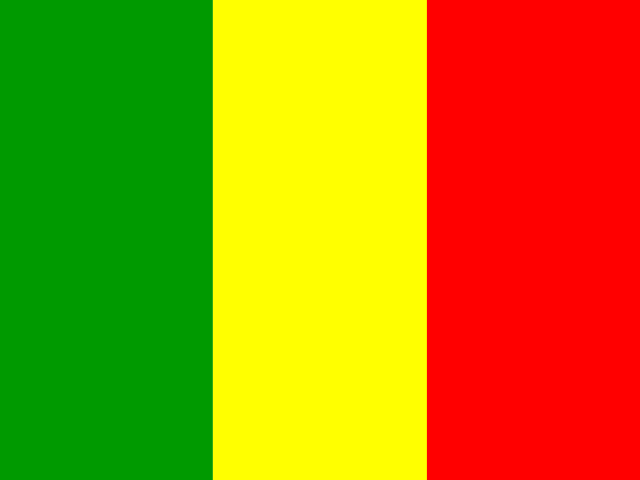
The Flag of Mali
Africa · Adopted 1 March 1961
Mali's green-yellow-red vertical tricolor was formally adopted on 1 March 1961, after the short-lived Mali Federation — a union of French Sudan and Senegal that had briefly shared a flag featuring a black kanaga figure in its central yellow band — collapsed within months of its own 1960 independence when Senegal seceded from the federation. French Sudan, left on its own, renamed itself the Republic of Mali (after the medieval Mali Empire) and dropped the kanaga figure from the shared federation flag, keeping only the plain three-color bands as its new national symbol.
The kanaga figure's removal was not a minor cosmetic tweak but a response to real controversy: the symbol, associated with Dogon ancestral and cosmological traditions, had drawn objections at the time from some Muslim leaders and citizens who felt it inappropriately privileged one ethnic group's spiritual imagery as a national symbol in a religiously and ethnically diverse country, and its removal in 1961 reflected a deliberate choice to keep the new flag symbolically neutral among Mali's many ethnic and religious communities rather than favor any single tradition.
Mali's first president, Modibo Keïta, was an ardent pan-Africanist, and the plain green-yellow-red bands — chosen in direct emulation of Ghana's pioneering 1957 pan-African color scheme, the same source that inspired neighboring Guinea's flag a few years earlier — were meant to signal Mali's alignment with the continent-wide independence and unity movement of the era rather than to represent narrowly Malian symbolism alone.
Officially, green is said to represent the country's fertile land and hope, yellow the purity of the country's mineral wealth and the Sahara sun, and red the blood spilled in the struggle for independence — an interpretation broadly consistent with how the same three colors are read across several other West African states that adopted them in the same period, though Malian civic tradition also links the colors more specifically to the memory of the medieval Mali Empire's wealth and the nation's Sahelian geography.
Flip Mali's bands around and you land on neighboring Guinea's flag, a coincidence of shared design lineage rather than imitation: Bamako's designers reversed the order to green-yellow-red rather than Guinea's red-yellow-green, but both governments were working from the identical Ghanaian template within a few years of each other, so the near-mirror result reflects a common source, not one country copying the other.
Mali's flag has remained unchanged since 1961 through one of the more turbulent political records in the Sahel: Modibo Keïta's 1968 overthrow, Moussa Traoré's subsequent 23-year authoritarian rule, the 1991 pro-democracy uprising that ended it, the 2012 Tuareg rebellion and coup that split the country's north from government control for a period, the years of French and UN military intervention that followed, and the further coups of 2020 and 2021 that installed the current military-led transitional government — none of it has touched the national flag design itself.
The medieval Mali Empire the modern republic named itself after was, at its height in the 14th century under Mansa Musa, one of the wealthiest states in the world, built on gold and salt trade routes across the Sahara — a history Malian civic education leans on heavily to frame the flag's yellow band as a link not just to the desert sun but to that older empire's legendary riches, giving Mali's flag a historical reference point that reaches back seven centuries before the 1961 adoption date itself.
Mali's most recent upheaval has been especially severe: the 2012 Tuareg-led rebellion in the north, quickly overtaken by jihadist groups linked to al-Qaeda, prompted a French military intervention in January 2013 that pushed the militants back from major towns, but instability has persisted for over a decade since, and the military governments that took power in back-to-back 2020 and 2021 coups have since pivoted away from France toward Russian security cooperation, including the Wagner Group and its successor Africa Corps — a dramatic geopolitical realignment that, again, the unchanged national flag has simply flown above.
Bamako's transitional military authorities, led since 2021 by Colonel Assimi Goïta, also formally withdrew Mali from the West African regional bloc ECOWAS in 2024 alongside similarly governed Burkina Faso and Niger, forming a rival Alliance of Sahel States — a significant reshaping of Mali's regional alliances carried out entirely without touching the green-yellow-red tricolor that has represented the country in every regional and international forum, old or new, since 1961.
Mali marks its Independence Day separately from the flag's own 1961 adoption: the country declared independence from France on 22 September 1960, while still nominally part of the collapsing Mali Federation, so the tricolor flown on independence day itself was still the federation's kanaga-bearing banner rather than the plain bands adopted the following March — meaning Mali's national holiday and its national flag actually commemorate two different dates six months apart. The flag reappeared as a visible symbol of restored state authority during Operation Serval, the French-led military campaign launched in January 2013: as French and Malian troops retook Konna, Gao, and finally Timbuktu from jihadist control that January and February, soldiers and residents raising the green-yellow-red tricolor over recaptured town halls became one of the operation's most widely circulated images, a moment Malian state media has continued to reference since as a marker of the north's return to government control, however incomplete that control has proven in the years since.
Not Guinea's flag reversed
- Flag with a marked hoist — The page explains this design and Guinea's are the same three colours in opposite order, so the edge you hang is the difference between the two. A clearly finished header removes the ambiguity.
As an Amazon Associate we earn from qualifying purchases made through these links, at no extra cost to you.
Often confused with
- Guinea — is Mali's flag in mirror image: Mali reads green-yellow-red outward from the hoist, Guinea reads red-yellow-green. Both governments settled on the palette within a few years of each other while looking to Ghana's 1957 example, so the three colors coincide even though neither country copied the other's ordering. Compare side by side →
- Senegal — Mali's former federation partner uses the same three colors with a central star added, a direct echo of the shared Mali Federation flag the two briefly used together in 1959-1960 before the federation's collapse. Compare side by side →
Mali at a glance
- Capital
- Bamako
- Population
- 23.3 million (2024)
- Currency
- West African CFA Franc (XOF)
- Language(s)
- French (official, with Bambara widely spoken); Bambara promoted as a national language
Population figure as of 2024, source: UN World Population Prospects (2024 revision). See methodology for how facts are sourced and kept current.