The Flag of Sierra Leone
Africa · Adopted 27 April 1961
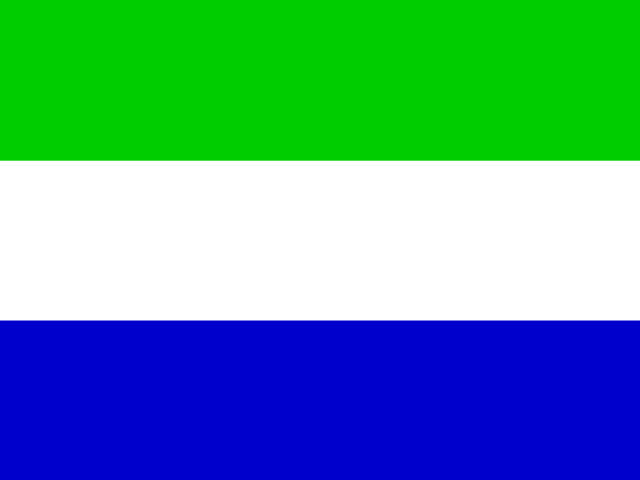
Sierra Leone's flag was adopted on 27 April 1961, the same day the country became independent from Britain, and it has remained unchanged since — a horizontal tricolor of green, white, and blue, simple in construction and, unlike many of its West African neighbors, carrying no emblem, star, or other central device at all.
The country's name itself, Sierra Leone, meaning 'Lion Mountains' in a blend of Portuguese and Spanish, was given by Portuguese explorer Pedro de Sintra in 1462, and the connection between the flag's green band and this naming history is a real one that Sierra Leonean civic explanations draw directly: green represents the country's mountains and agriculture, tying the flag's top band back to the same forested, hilly coastal terrain that gave the territory its name nearly five centuries before independence.
White, the middle band, represents unity and justice, values given particular emphasis at independence in a territory whose population included both indigenous groups from the interior and the descendants of freed and formerly enslaved people resettled around Freetown from the late 18th century onward — two population groups with different histories that the new nation's founding symbolism explicitly sought to bring together under shared civic values.
The blue band at the bottom is explained in Sierra Leonean civic materials as representing the country's hope that Freetown's natural harbor — one of the largest and deepest natural harbors in the world — would help Sierra Leone contribute meaningfully to global trade and international peace, a specific, almost aspirational reading tied directly to the geography of the capital rather than to the sea or sky in general terms the way blue is used on many other flags.
Sierra Leone's flag survived a difficult stretch of the country's post-independence history essentially unaltered, including a series of coups in the 1960s through 1990s and the devastating civil war that ran from 1991 to 2002, fought partly over control of the country's diamond-mining regions — the flag remained the same recognized national symbol throughout a period when many of the country's other institutions were in open crisis or collapse.
The flag flies prominently each Independence Day, 27 April, and its plain, unadorned tricolor design, with no coat of arms or emblem, is occasionally noted by vexillologists as a rarity among sub-Saharan African flags, most of which carry at least one central symbol; Sierra Leone's design relies entirely on its three colors and their meanings to carry the flag's national symbolism.
Sierra Leone's coat of arms, adopted separately at independence in 1961, does carry more explicit imagery — a lion, representing the country's 'Lion Mountains' name, alongside a torch symbolizing learning, since Freetown had by the mid-20th century become a notable regional center of English-language higher education in West Africa, and palm trees representing the country's agricultural economy — giving the flag's plain colors a matching, more detailed emblem used on official documents and currency even though the emblem never appears on the flag itself.
The diamond-rich region around Kono in eastern Sierra Leone became central to the country's 1991–2002 civil war, with control over diamond mines funding the Revolutionary United Front insurgency; the conflict's association with so-called 'blood diamonds' drew sustained international attention and contributed to the 2003 Kimberley Process certification scheme intended to curb trade in conflict diamonds — a grim chapter in the same national history the flag's blue band's aspirational reference to global peace sits somewhat uneasily against.
Sierra Leone's 1961 constitution, adopted at independence under Prime Minister Sir Milton Margai, fixed the flag's design in law alongside the country's initial parliamentary system of government, a system that lasted only until Sierra Leone's first military coup in 1967 — the flag itself, however, was never treated as part of the political instability that followed, remaining the unquestioned national symbol through the one-party rule of the All People's Congress from 1978, multiple further coups in the late 1990s, the civil war, and the eventual return to stable multiparty democracy after 2002.
The country's official color specifications describe the green as representing not just mountains generally but specifically the country's forests and agricultural produce, including palm oil, coffee, and cocoa, all significant export crops at independence, giving the top band a more concretely economic reading alongside its geographic one tied to the 'Lion Mountains' name.
Sierra Leone marked the bicentenary of the 1807 British abolition of the transatlantic slave trade with events in 2007 specifically honoring Freetown's historical role as a resettlement site for freed and recaptured Africans, a history the national flag's white band, symbolizing unity between descendants of settlers and indigenous groups, is explicitly meant to gesture toward even though the flag predates that particular commemorative framing by decades. Sierra Leone's national football team, nicknamed the Leone Stars, and its flag colors have become an increasingly visible symbol of post-war national recovery at continental competitions since the 2000s, part of the country's broader effort to rebuild a positive international image after the civil war.
Three plain bands and nothing else
- Desk flag with base — With no emblem anywhere on the cloth, this design loses nothing at desk size, which is not true of most of its West African neighbours' flags.
As an Amazon Associate we earn from qualifying purchases made through these links, at no extra cost to you.
Often confused with
- Nigeria — is also a plain, emblem-free tricolor from the same independence era, but Nigeria's flag is a vertical green-white-green design with no blue at all, while Sierra Leone's is a horizontal green-white-blue arrangement, making the two easy to distinguish once both color and orientation are compared. Compare side by side →
Sierra Leone at a glance
- Capital
- Freetown
- Population
- 8.8 million (2024)
- Currency
- Sierra Leonean Leone (SLE)
- Language(s)
- English (official); Krio widely spoken as a lingua franca alongside Mende, Temne, and other national languages
Population figure as of 2024, source: UN World Population Prospects (2024 revision). See methodology for how facts are sourced and kept current.