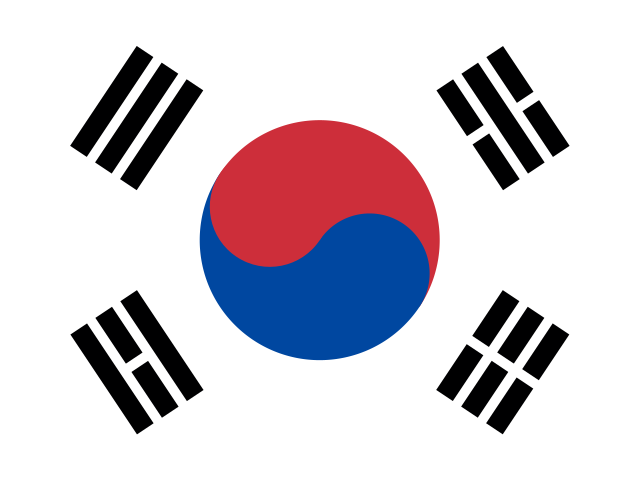
The Flag of South Korea
Asia · Adopted 15 January 1950 (proportions standardized; design dates to 1883)
The Taegukgi is one of the few national flags built directly on a philosophical diagram rather than a heraldic or revolutionary emblem. Its central red-and-blue swirl, the taeguk, is the same yin-yang symbol found across East Asian cosmology, representing the balance of opposing but interdependent forces — here read specifically as eum and yang, negative and positive, night and day, the ceaseless motion of a universe that never settles into one fixed state. Korea did not import this symbol as decoration; the taeguk had already been carved into Silla-dynasty relics and Joseon-era gates centuries before it was ever put on a flag, so choosing it as the flag's core image was a deliberate reach into an existing visual vocabulary rather than an invention.
The flag itself is much younger than the symbol. It was first used in 1882–1883 by the Joseon Dynasty as Korea began opening diplomatic relations with foreign powers under pressure from Japan, the United States, and European treaty powers, and King Gojong formally proclaimed it the national flag in 1883. Diplomat and reformist Bak Yeong-hyo is generally credited with finalizing the specific design sent on a mission to Japan that year, though the exact authorship and the flag's precise prior history are debated among Korean historians, since informal taeguk banners appear to have circulated even before the official 1883 proclamation.
The four black trigrams in the corners are drawn from the I Ching (Book of Changes), an ancient Chinese divination text whose trigram system had long been absorbed into Korean intellectual and religious life. Each trigram is a stack of three broken or unbroken lines: geon (three unbroken lines) in the upper hoist stands for heaven, gon (three broken lines) in the lower fly stands for earth, gam (broken-unbroken-broken) in the upper fly stands for water, and ri (unbroken-broken-unbroken) in the lower hoist stands for fire. Together the four are traditionally read as representing not just these four elements but paired virtues and the four cardinal directions and seasons — a cosmological frame around the taeguk's balance of yin and yang rather than a random decorative choice.
Japan's annexation of Korea in 1910 banned the Taegukgi outright, and for 35 years flying it was an act of resistance rather than routine patriotism; the flag was carried by the Korean independence movement in exile and by protesters during the March 1st Movement of 1919, cementing its status as a symbol of national survival rather than state bureaucracy by the time liberation came in 1945.
After Korea split into North and South in 1945 and the South formally established its government in 1948, the Taegukgi was retained as the national flag, and the government standardized its exact proportions, colors, and trigram placement by presidential decree on 15 January 1950 — the version still flown today. North Korea, by contrast, abandoned the taeguk entirely in 1948 in favor of a red star on a red-white-blue field modeled more on Soviet and socialist iconography, a split that means the two Koreas' flags now share no visual vocabulary at all despite sharing a peninsula and, until 1945, a single flag.
White, the field the taeguk and trigrams sit on, is described in Korean sources as representing purity, peace, and the traditional Korean fondness for white clothing (Koreans were historically nicknamed the 'white-clad people'), a color association distinct from the political or religious readings white carries on many other national flags.
The Taegukgi is protected under South Korea's Flag Act, which specifies exact construction geometry, the Pantone-equivalent shades of red and blue, and rules for display and disposal (worn flags are meant to be burned rather than discarded as trash), a level of legal formality that reflects both the flag's philosophical density and its history as a once-banned symbol of resistance.
Because the taeguk symbol itself appears throughout East Asian art, temple architecture, and other national contexts, casual observers sometimes assume South Korea's flag is simply a version of a shared regional symbol; in fact no other national flag combines the taeguk with the I Ching trigrams in this specific arrangement, making the Taegukgi visually distinct at the level of overall composition even though its central motif is ancient and widely shared.
The taeguk's exact color pairing — a red upper swirl and blue lower swirl divided by an S-curve rather than the more familiar black-and-white yin-yang seen in Chinese Taoist iconography — is itself a specifically Korean adaptation. Korean court and folk art had used red-and-blue taeguk motifs on drums, gates, and ceremonial objects for centuries before 1883, so the flag's designers were drawing on an already-established local color convention rather than inventing a new palette to distinguish the Korean version from its Chinese philosophical source.
South Korean schoolchildren are taught the trigram meanings as part of standard civic education, and the four trigrams are commonly memorized together with their paired opposite qualities: geon and gon as heaven and earth, gam and ri as water and fire, a structure meant to convey balance and complementary opposition running through the whole design, not just within the central taeguk swirl itself. This layered symbolism — cosmological balance in the center, elemental and directional balance in the corners — is part of why the Taegukgi is frequently cited in vexillology as one of the more philosophically dense flags in active use anywhere in the world, alongside flags like Turkmenistan's for a very different kind of visual complexity.
The flag briefly took on additional emotional weight during the 1988 Seoul Summer Olympics, when its display alongside the flags of dozens of other nations for the first time on Korean soil was widely covered domestically as a marker of the country's arrival as a modern, internationally respected state only decades removed from war and poverty — a symbolic moment Korean media coverage still occasionally references when discussing the flag's modern significance.
Four different trigrams, one per corner
- Double-sided flag — Each corner carries a different arrangement of broken and unbroken bars, so a single-layer flag swaps them left for right when seen from behind and the four corners no longer read correctly.
As an Amazon Associate we earn from qualifying purchases made through these links, at no extra cost to you.
Often confused with
- Japan — both feature a red-and-white palette and a circular central emblem, but Japan's Hinomaru is a plain solid red disc with no trigrams or swirl — a much simpler design entirely. Compare side by side →
South Korea at a glance
- Capital
- Seoul
- Population
- 51.7 million (2024)
- Currency
- South Korean Won (KRW)
- Language(s)
- Korean (official)
Population figure as of 2024, source: UN World Population Prospects (2024 revision). See methodology for how facts are sourced and kept current.