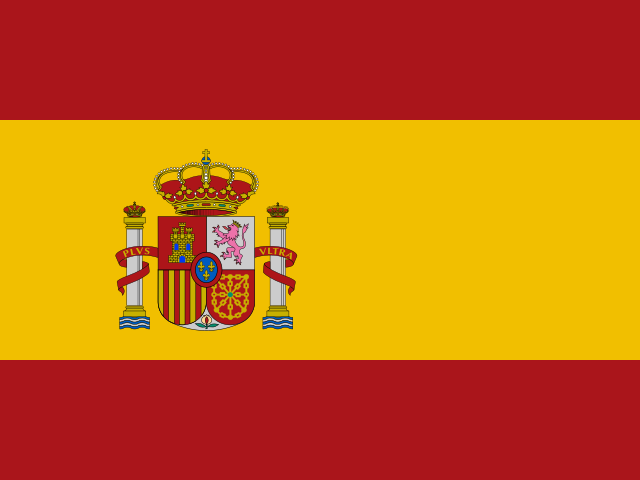
The Flag of Spain
Europe · Adopted 19 December 1981 (current coat of arms); red-yellow-red pattern dates to 1785
Spain's red-yellow-red flag has a documented origin that is far more mundane than the folk stories sometimes told about it: on 28 May 1785, King Charles III signed a royal decree adopting the pattern specifically as a naval ensign, after a commission reportedly reviewed dozens of candidate designs and concluded that the existing plain white flag used by the Spanish navy was too easily confused, at a distance and in poor visibility, with the flags of other European powers that also used white as a base color. The red-yellow-red combination, with the central yellow band twice the width of each red band, was chosen above all for how distinctly it read on the horizon, not for any symbolic meaning attached at the time.
That naval-visibility origin is worth stating plainly because a different, unrelated legend sometimes gets attached to Spain's flag in popular retellings — a story about blood-red stripes recalling wounds or sacrifice. That legend genuinely belongs to a different flag entirely: the Senyera, the red-and-gold striped flag of Catalonia, carries a medieval origin story in which a dying count's bloodied fingers were dragged across a golden shield to create its four red stripes on gold. Spain's national flag and Catalonia's regional flag share a red-and-gold palette and are sometimes visually and narratively conflated as a result, but they are historically unrelated symbols with separate origin stories, and Spain's 1785 naval decree makes no reference to blood or battle at all.
The coat of arms positioned off-center toward the hoist carries the flag's genuine layered national symbolism: a shield quartered with the historic arms of Castile (a castle), León (a lion), Aragon (vertical red-and-gold stripes), and Navarre (a chain pattern), with a small pointed section for the pomegranate of Granada, the last Muslim-ruled kingdom on the Iberian peninsula, conquered in 1492. Flanking the shield are the twin Pillars of Hercules, representing the Strait of Gibraltar, wrapped with a banner reading 'Plus Ultra' ('further beyond') — a motto originally referring to the New World territories that Spanish exploration opened up. The shield is topped by the royal crown and, since Spain's return to constitutional monarchy, three gold fleurs-de-lis mark the ruling House of Bourbon.
The stripes have stayed red-yellow-red almost continuously since 1785, but the arms in the center have changed with nearly every major shift in Spanish government: the Second Spanish Republic (1931–1939) abandoned the red-yellow-red pattern entirely in favor of a purple-yellow-red tricolor, purple representing the historic Crown of Castile's republican associations; Francisco Franco's dictatorship, after winning the Spanish Civil War, restored red-yellow-red but replaced the arms with an eagle displayed (the so-called 'Eagle of Saint John'), a symbol drawn from Catholic-monarchist imagery rather than the older quartered shield.
The current coat of arms was adopted on 19 December 1981, roughly six years after Franco's death and three years after Spain's 1978 democratic constitution, replacing the Francoist eagle with the modern quartered-shield-and-pillars design — a deliberate move by the restored constitutional monarchy to break visually from the dictatorship-era symbol while keeping the same red-yellow-red field that had, by then, been continuously associated with the Spanish state for nearly two centuries.
Spain's flag law fixes the state and war-ensign proportions and the exact positioning of the arms, and — unusually among European states — requires the coat of arms on every official use of the flag, with no plain-tricolor civil version legally sanctioned for government buildings the way several other European countries permit; ordinary citizens, however, commonly fly the plain red-yellow-red tricolor without the arms, which remains legal for private and civilian use.
Because red-yellow bands are not a widely repeated pattern among the world's national flags, Spain's flag is rarely mistaken for another sovereign country's — the closer visual overlaps tend to be with Spain's own historic regional and colonial-era flags, including several Latin American flags whose independence-era designers deliberately broke from Spanish colors specifically to signal separation from the former colonial power.
The 1785 commission process itself is documented in Spanish naval archives as having tested a range of striped patterns at sea, with reports noting that plain white and other pale designs then common among European navies were difficult to identify at range in the low light and haze conditions typical of naval engagements; the bold red-yellow-red arrangement, with its wide central band, was judged the most visible against both sky and water, which is the specific, mundane engineering reason the pattern won out over more heraldically motivated alternatives.
Spain's national holiday, Fiesta Nacional de España, falls on 12 October, commemorating Columbus's 1492 arrival in the Americas rather than any flag-specific anniversary, and the flag features prominently in the day's military parade in Madrid — one of the few days each year when the state flag's full coat of arms is displayed at the scale and formality the 1981 law envisioned for official occasions.
Catalonia's push for independence in the 2010s, culminating in a disputed 2017 referendum and unilateral declaration that the Spanish government did not recognize, brought the Senyera and the Spanish flag into direct, visible political contrast across Catalonia specifically — balconies and public buildings in the region became sites of competing flag displays, an episode that likely reinforced rather than resolved the popular tendency to link Spain's national colors with Catalonia's separate striped flag and its very different medieval legend.
A yellow band of double width
- Proportion-accurate flag — The centre band is twice the depth of each red one, a proportion chosen for legibility at distance, and a flag cut in even thirds loses exactly the quality it was designed for.
As an Amazon Associate we earn from qualifying purchases made through these links, at no extra cost to you.
Often confused with
- Andorra — a small neighboring state whose flag uses a vertical blue-yellow-red tricolor with its own coat of arms — not a close visual match, but Andorra's yellow band and central arms are sometimes confused with Spain's by travelers unfamiliar with either flag, given Andorra's location wedged between Spain and France. Compare side by side →
Spain at a glance
- Capital
- Madrid
- Population
- 47.7 million (2024)
- Currency
- Euro (EUR)
- Language(s)
- Spanish (official nationwide); Catalan, Basque, and Galician co-official in their respective regions
Population figure as of 2024, source: UN World Population Prospects (2024 revision). See methodology for how facts are sourced and kept current.