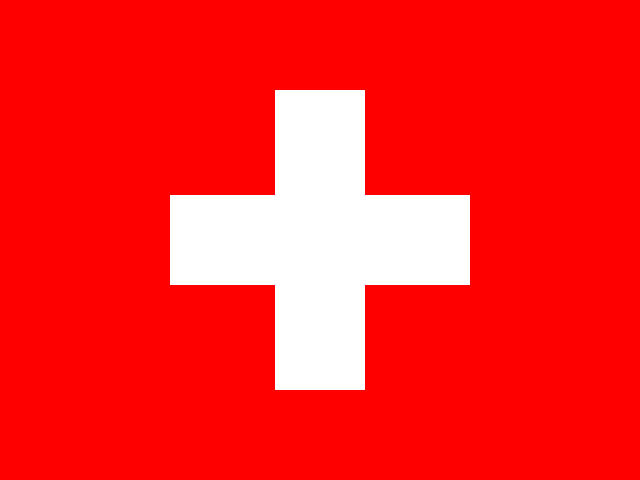
The Flag of Switzerland
Europe · Adopted 12 December 1889 (proportions fixed by federal decree); cross emblem in use since the 14th century
Switzerland's flag is one of only two square national flags flown by any sovereign country, the other being Vatican City's, and its central image — a white couped cross, meaning its arms do not reach the flag's edges — sitting on a red field traces back to the battle standards used by the cantons of the Old Swiss Confederacy as early as the 14th century; a white cross is recorded on Swiss forces' banners at the Battle of Laupen in 1339, worn as a field sign to distinguish Confederate troops from their opponents rather than as a formally designed national emblem in the modern sense.
That battlefield symbol accumulated status gradually over the following five centuries as the loose confederation of cantons developed toward the unified federal state it became in 1848, but it was not legally standardized until 12 December 1889, when the Swiss Federal Assembly passed a decree fixing the exact proportions of the cross's arms — each arm one-sixth longer than it is wide — and formally confirming red and white, with the cross confined to a square field, as the federal flag.
Switzerland's neutrality, formally recognized by the European powers at the Congress of Vienna in 1815 and maintained (with narrow historical exceptions) ever since, is closely tied to why the Swiss cross became internationally recognizable beyond Switzerland's own borders: Henry Dunant, the Swiss businessman who witnessed the aftermath of the 1859 Battle of Solferino and went on to found the International Committee of the Red Cross in 1863, chose an emblem that inverted Switzerland's own flag — a red cross on a white field rather than a white cross on red — as a direct tribute to Dunant's home country and its tradition of armed neutrality, which the founders of the Red Cross hoped would make the emblem read as protective and non-combatant on any battlefield in Europe.
The Swiss flag most people picture — square, red field, white couped cross — is specifically the national and state flag; Switzerland's ships and some other official uses fly a rectangular version instead, since square flags are impractical for maritime signaling and international shipping conventions generally expect rectangular ensigns, a distinction most Swiss citizens are unaware of because the square version is what appears on buildings, vehicles, and everyday civic use.
Individual Swiss cantons predate the federal flag by centuries and kept their own separate coats of arms and banners even after 1848 federal unification — Bern's bear, Geneva's half-eagle-half-key design, and Zürich's blue-and-white halved field are still flown alongside the federal cross throughout the country, reflecting Switzerland's continued emphasis on cantonal identity within the federal structure rather than a fully centralized national symbolism.
Because the Swiss cross has become globally associated with neutrality, precision, and (through the Red Cross connection) humanitarian aid, it appears on unrelated commercial branding worldwide far more often than most national flags do — a form of recognition Switzerland has occasionally pushed back against through trademark protections on the specific white-cross-on-red symbol for commercial use, distinct from its free use as the actual national flag.
The precise geometric proportions of the Swiss cross — arms one-sixth longer than they are wide, set on a square field — were the subject of genuine technical debate during the 1889 standardization process, since earlier informal Swiss flags in military and civic use had varied considerably in how 'squat' or 'elongated' the cross arms appeared; the federal decree's specific ratio was chosen deliberately to sit between those competing older styles rather than simply codifying whichever version happened to be most common at the time.
Switzerland's international humanitarian standing, closely bound up with the Red Cross emblem's visual debt to the national flag, is reinforced by Geneva's role as headquarters for the International Committee of the Red Cross and for numerous United Nations agencies — a concentration of humanitarian and diplomatic institutions that Swiss neutrality, dating formally to 1815, is often credited with making possible, since a genuinely non-aligned host state offered international organizations a politically neutral base during both World Wars and the Cold War that followed.
Switzerland briefly considered joining the League of Nations and, much later, the European Union, but voters have repeatedly rejected EU membership in national referendums, most notably in 1992 when Swiss voters narrowly declined to join the European Economic Area — a pattern of preserving formal independence from larger political blocs that mirrors, in modern form, the same instinct toward armed neutrality the white cross on red has symbolized since the medieval Confederacy first used it on the battlefield.
Switzerland's direct-democracy system means the flag and its associated national symbols occasionally surface directly in referendum campaigns, where the cross has been used across the political spectrum on campaign posters for causes ranging from immigration restriction to EU-accession advocacy — a use that has periodically drawn criticism from Swiss vexillological and civic groups arguing the national symbol should stay above party-political campaigning, though no legal restriction on that kind of use exists.
One of only two square flags
- Square flag — Almost every listing sells this printed onto a standard oblong, which stretches the couped cross sideways; a flag cut square is the one the page is describing.
- Rectangular boat ensign — The page notes the square shape is impractical at sea and that an oblong version exists for shipping, so a boat is the one place the rectangular cut is the correct article rather than a compromise.
As an Amazon Associate we earn from qualifying purchases made through these links, at no extra cost to you.
Often confused with
- Vatican City — the only other square national flag, though the resemblance stops at the shape — Vatican City's is split gold-and-white with the papal tiara and crossed keys, sharing no color or symbol with Switzerland's red-and-white cross. Compare side by side →
Switzerland at a glance
- Capital
- Bern
- Population
- 8.9 million (2024)
- Currency
- Swiss Franc (CHF)
- Language(s)
- German, French, Italian, and Romansh (all official)
Population figure as of 2024, source: UN World Population Prospects (2024 revision). See methodology for how facts are sourced and kept current.