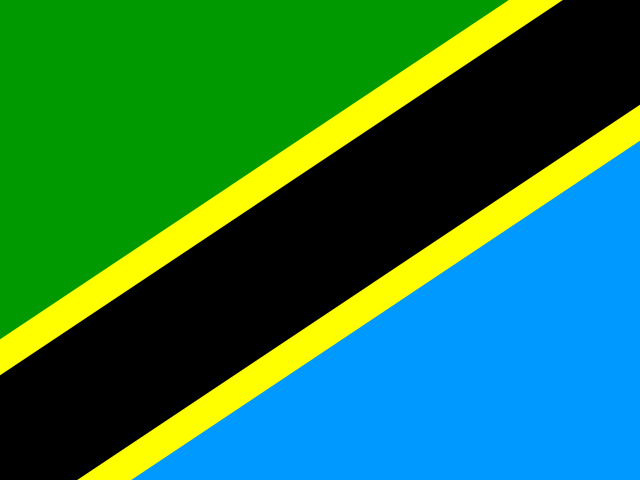
The Flag of Tanzania
Africa · Adopted 30 June 1964
Tanzania's flag is a merger flag in a literal sense: the country itself is a union, formed on 26 April 1964 when mainland Tanganyika, independent since 1961, joined with the islands of Zanzibar, independent since only weeks earlier that same year following a revolution that overthrew the Zanzibari sultanate. The new flag, adopted a few months later on 30 June 1964, was built by combining elements of the two territories' own recent flags rather than designing something from nothing — Tanganyika's 1961 flag had been a green-black-green horizontal tricolor representing the mainland's fertile land and its people, while Zanzibar's short-lived post-revolution flag had used blue, black, and green to represent the surrounding ocean, the islands' people, and their own land.
Rather than stacking those into more horizontal bands, the designers used a diagonal split — a black band running corner to corner, edged in narrow gold stripes, with green filling the upper-left triangle and blue filling the lower-right. The diagonal itself carries no separate symbolism beyond visually fusing the mainland and island flags into a single new design rather than simply layering one territory's colors over the other's, which is part of why Tanzania's flag stands out as one of relatively few African national flags built around a diagonal rather than horizontal or vertical stripes.
Green represents the country's land and agriculture, still the livelihood of a majority of Tanzanians; black stands for the Swahili-speaking people of both the mainland and the islands, a population bridged by a shared language across territories that colonial administrations had treated separately for decades; and blue represents the country's extensive coastline on the Indian Ocean as well as its three great lakes — Victoria, Tanganyika, and Nyasa — which together give Tanzania more lake-facing border than almost any other African nation. The narrow gold fimbriations separating the bands stand for the country's mineral wealth, including the diamond deposits historically mined at Mwadui and, more recently, tanzanite, a gemstone found commercially nowhere else on Earth outside a small area near Mount Kilimanjaro.
The flag has not changed since 1964, even though the country's political structure has evolved considerably since then — Tanzania remains formally a union of mainland and islands, with Zanzibar retaining its own semi-autonomous government, president, and legislature, and periodically its own flag flown alongside the national one on the islands for local government purposes, though the diagonal union flag remains the sole flag recognized for the country as a whole internationally.
Tanzania's diagonal design is sometimes noted alongside South Africa's Y-shaped flag as one of only two current African national flags built around a converging band rather than parallel stripes, though the resemblance is purely structural — South Africa's flag was adopted thirty years later, in 1994, to symbolize the convergence of previously divided groups after apartheid, an entirely separate origin from Tanzania's territorial-merger story.
Ratio and construction details for the flag were fixed by the 1964 Union government and have not been revised; the flag is flown daily at government buildings on both the mainland and Zanzibar, and features prominently in Union Day observances each 26 April, the anniversary of the Tanganyika-Zanzibar merger rather than the later date the flag itself was formally adopted.
Zanzibar's own government retained a separate flag of its own for domestic use on the islands even after the union, reflecting the semi-autonomous status Zanzibar has kept within the union structure since 1964 — a status that has occasionally produced political friction, including periodic calls from Zanzibari politicians for greater autonomy or, at the more extreme end, for reconsidering the union itself, though the national diagonal flag has never been part of those disputes; it is not treated as a mainland-only symbol the way some union arrangements elsewhere have produced contested state flags.
The tanzanite referenced by the flag's gold fimbriations was not even known to exist as a distinct gemstone until 1967, three years after the flag's adoption, when it was discovered near Mount Kilimanjaro in the Merelani Hills — the only commercially significant deposit of the stone ever found anywhere on Earth — so while the gold stripes were chosen in 1964 to represent mineral wealth broadly, tanzanite itself became one of the specific resources most commonly cited in connection with that symbolism only after the fact, as the gemstone grew into a significant export in the following decades.
Tanzania's coat of arms, adopted in a form similar to the earlier Tanganyikan crest but revised for the union in 1964, depicts a torch above a shield showing a cross-section of Mount Kilimanjaro, waves representing the Indian Ocean and the Great Lakes, and crossed axe and hoe symbolizing labor and agriculture, flanked by a man and a woman — a considerably more literal, image-based statement of national identity than the flag's abstract color-and-diagonal design, and the two symbols are used in different official contexts, with the coat of arms reserved mainly for government seals and formal state documents rather than everyday display.
Julius Nyerere, who led Tanganyika to independence and became the union's first president, was closely involved in shaping the country's early national symbols as part of his broader push for a unifying post-independence Tanzanian identity built around Swahili language and his Ujamaa policy of collective, self-reliant village agriculture — a policy whose emphasis on land and rural labor lines up closely with the flag's green stripes, even though the flag's design itself predates Ujamaa's formal rollout as government policy later in the 1960s.
A diagonal with yellow fimbriations
- Sewn-diagonal flag — The black diagonal is edged with two thin yellow lines, and a diagonal seam is where flags pucker; a stitched, squarely cut diagonal is the thing to look at in the photographs.
As an Amazon Associate we earn from qualifying purchases made through these links, at no extra cost to you.
Often confused with
- South Africa — is the only other current African flag built around a converging diagonal band rather than parallel stripes, though the two designs are unrelated — South Africa's 1994 Y-shape symbolizes post-apartheid unity, thirty years after Tanzania's diagonal was chosen to merge Tanganyika's and Zanzibar's separate flags. Compare side by side →
Tanzania at a glance
- Capital
- Dodoma
- Population
- approximately 67.4 million (2024)
- Currency
- Tanzanian Shilling (TZS)
- Language(s)
- Swahili and English (official); Zanzibar's House of Representatives also conducts some business in Swahili exclusively
Population figure as of 2024, source: UN World Population Prospects (2024 revision). See methodology for how facts are sourced and kept current.