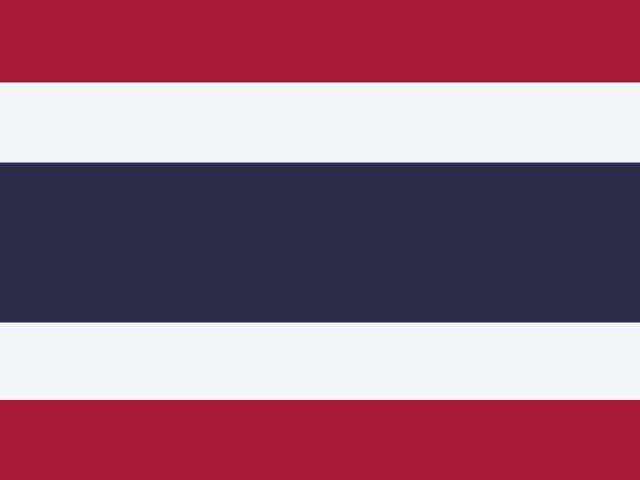
The Flag of Thailand
Asia · Adopted 28 September 1917
Thailand's flag, the Trairanga ('tricolor'), replaced a design that had lasted more than a century: a plain red field bearing a white elephant, used as the kingdom's flag (then called Siam) from the early 19th century. King Rama VI (Vajiravudh) ordered the change in 1917, reportedly after seeing an elephant-flag flown upside down during a visit to a provincial town — since the white elephant faced a specific direction, an inverted flag looked like an ordinary red banner rather than a recognizable state symbol, a practical embarrassment the king wanted to design out of the flag altogether.
The replacement went through a brief intermediate stage: Rama VI first introduced a red-white-red horizontal tricolor in September 1917, but almost immediately revised it further, adding a wider blue stripe through the center to create the five-band red-white-blue-white-red design still used today, formalized within the same month. The blue stripe's addition is generally linked to Thailand's alignment with the Allied powers during World War I, since red-white-blue was the shared color scheme of Britain, France, Russia, and the United States at the time, and Siam had just entered the war on the Allied side in July 1917 — making the color choice a deliberate diplomatic signal as much as an aesthetic one.
The five stripes carry a widely taught tripartite meaning: red represents the nation and the blood of those who defended it, white represents the purity of Buddhism (the country's dominant religion), and blue represents the monarchy — with the thick central blue band being twice the width of any other stripe specifically so the color representing the king would visually dominate the flag, a hierarchy of stripe width that is itself part of the symbolism rather than incidental to it.
This nation-religion-monarchy framing (chat-satsana-phra-mahakasat) is one of Thailand's most consistently repeated civic formulas, appearing across coinage, official rhetoric, and school curricula as the three pillars of Thai identity, and the flag's stripe structure is frequently taught as a direct visual encoding of that same three-part formula rather than a coincidental color scheme.
The elephant flag it replaced had itself gone through changes: earlier Siamese flags were reportedly plain red with no emblem at all, and the white elephant was added under King Rama II in the early 19th century, later gaining a howdah (ceremonial seat) under Rama IV before being dropped entirely in the 1916–1917 redesigns, showing that Thailand's flag history includes several transitional versions rather than a single clean jump from elephant to tricolor.
Thailand's flag has not changed since 1917, giving it more than a century of continuous use — an unusual span of stability in a region where many neighboring states' flags have been redesigned multiple times amid decolonization, revolution, or regime change, and one Thai officials sometimes point to as reflecting the continuity of the constitutional monarchy itself, which (coups and constitutional changes notwithstanding) has persisted in some form since well before the flag's 1917 redesign.
Flag Day, 28 September, marks the anniversary of the 1917 adoption and is observed with official flag-raising ceremonies, and Thai law includes specific protocols for flag display, including rules against allowing the flag to touch the ground and prescribed folding procedures used when lowering it at day's end.
Thailand's status as the only Southeast Asian nation never formally colonized by a European power is frequently cited in Thai civic education alongside the flag's history, since Rama VI's 1917 redesign and the earlier elephant flag both represent choices made by an independent Siamese monarchy negotiating its own symbols on its own terms — in contrast to many neighboring flags, which were designed during or immediately after a colonial administration's departure rather than by a continuously sovereign government.
Thai households and businesses are widely expected to display the flag on significant national occasions, and public buildings raise and lower it daily according to set times, a level of routine, everyday flag visibility that visitors often note as more pervasive than in many other countries, reflecting the flag's tight symbolic linkage to the still-revered monarchy represented by its central blue stripe.
Thailand's constitutional monarchy has passed through multiple coups and constitutional rewrites since 1932, when a bloodless revolution ended the country's centuries of absolute monarchy and introduced constitutional governance under King Rama VII; despite the frequency of these political upheavals, which have produced roughly twenty constitutions and interim charters since 1932, none altered the 1917 flag design itself, underscoring how the flag's symbolism has remained tied to enduring national institutions — nation, religion, and monarchy — rather than to any specific government or constitutional arrangement in power at a given moment.
Under Thai law, insulting or defacing the flag can carry criminal penalties, and the same broad legal framework that protects the monarchy from insult (lese-majeste laws, among the strictest in the world) extends a comparable seriousness to flag protocol, reflecting how directly the flag's central blue stripe is understood to represent the monarchy rather than the state in a more abstract, impersonal sense.
A centre band of double width
- Sewn five-band flag — The blue centre band is twice the width of each of the four others, which is the proportion a stitched flag holds at the seams and a loosely printed one drifts away from.
As an Amazon Associate we earn from qualifying purchases made through these links, at no extra cost to you.
Often confused with
- Costa Rica — shares a five-band red-white-blue horizontal structure, but Costa Rica's order is blue-white-red-white-blue with a wide red center rather than Thailand's red-white-blue-white-red with a wide blue center — the color that dominates is swapped. Compare side by side →
Thailand at a glance
- Capital
- Bangkok
- Population
- 71.6 million (2024)
- Currency
- Thai Baht (THB)
- Language(s)
- Thai (official)
Population figure as of 2024, source: UN World Population Prospects (2024 revision). See methodology for how facts are sourced and kept current.