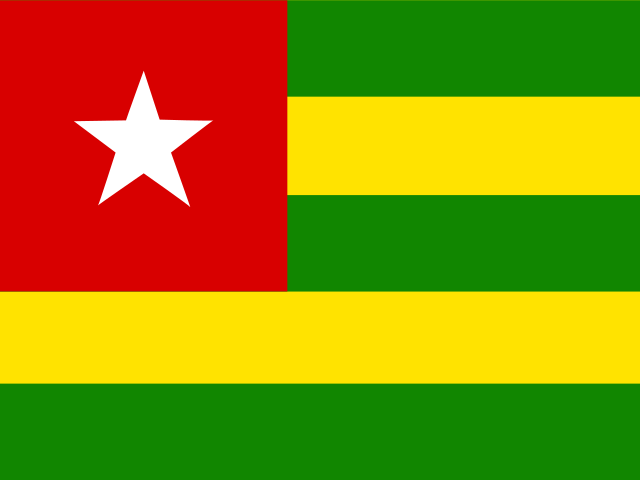
The Flag of Togo
Africa · Adopted 27 April 1960
Togo's flag was designed by Paul Ahyi, a Togolese artist who would go on to become one of the country's most prominent cultural figures, and it was adopted on 27 April 1960, the day Togo gained independence from France after four decades as a League of Nations mandate and then a UN trust territory administered by the French. Ahyi's design departed sharply from the tricolor patterns many neighboring former French colonies adopted at independence, opting instead for five alternating horizontal stripes of green and gold with a red square in the upper hoist corner holding a single white five-pointed star.
The five stripes were chosen to correspond to the country's administrative regions at the time of independence, a rare instance of a flag's stripe count being tied directly to internal administrative geography rather than to a symbolic number like the points of a star or the pillars of a religion. Green represents agriculture and hope for the country's future; gold represents both mineral wealth — Togo has historically exported phosphate, mined mainly near Kpémé on the coast — and the value of labor more broadly.
The red square carries the country's more solemn symbolism: red for the blood of those killed pursuing independence, and specifically for the 1958 death of Sylvanus Olympio's political allies and the broader unrest of the late-1950s independence movement, though sources vary on exactly which episodes are meant to be evoked. The white star inside the red field stands for purity and for the hope embodied in the new nation, a pairing of red field and white star that Togo shares in rough concept, though not in exact layout, with a small number of other West African flags from the same independence era.
Togo's flag is most often compared to Liberia's, since both place a star inside a red canton in the upper hoist against a field of horizontal stripes — but the resemblance is really only structural. Liberia's flag uses eleven red-and-white stripes and a blue canton behind its star, a design deliberately modeled on the flag of the United States by the freed American slaves who founded Liberia in the 19th century, an entirely different color palette and an entirely different founding story from Togo's mid-20th-century anti-colonial independence movement.
The flag has not been redesigned since 1960 despite Togo's often turbulent post-independence political history, including the 1963 assassination of Olympio, the country's first president, in a coup, and the four-decade rule of Gnassingbé Eyadéma that followed a second coup in 1967 — successive governments retained the Ahyi design without alteration even as they otherwise reshaped the state considerably.
Paul Ahyi remained active in Togolese cultural life for decades after designing the flag, later founding an art movement and receiving national honors; his flag design is one of relatively few in Africa whose individual designer is confidently and specifically documented rather than attributed to a committee or left unclear.
Togo's independence in April 1960 came several months before most of France's other sub-Saharan African colonies achieved theirs later that same year — a cluster of independence dates in 1960 later remembered across the region as the 'Year of Africa' — which gave Togo's flag some of the earliest visibility of the wave of new post-colonial designs unveiled that year, alongside those of Senegal, Mali, Madagascar, and more than a dozen others adopted within months of each other.
Togo's flag colors have also taken on contested political meaning domestically in recent decades: opposition protest movements challenging the long Gnassingbé family rule, which has controlled the presidency continuously since 1967 between father and son, have at times used green, gold, and red items or ribbons deliberately drawn from the national flag's own palette during demonstrations, treating the official state colors as a shared national symbol available to protesters as much as to the government they were demonstrating against.
The five administrative regions the flag's five stripes were originally meant to represent — broadly corresponding to today's Maritime, Plateaux, Centrale, Kara, and Savanes regions running north to south along the country's narrow, elongated territory — have themselves been reorganized and renamed more than once since 1960, meaning the flag's stripe count has stayed fixed at five even as the specific administrative map it was originally tied to has shifted over the decades, leaving the number more symbolic today than a precise, current match to Togo's internal boundaries.
Togo's narrow, elongated shape, stretching roughly 550 kilometers from its short Atlantic coastline in the south to its northern border with Burkina Faso, is itself a legacy of the 1919 partition of German Togoland between Britain and France, a colonial-era boundary drawn largely along administrative convenience rather than along the territory of any single pre-colonial kingdom or ethnic group, a geography the flag's five stripes were later asked to visually represent as a unified whole.
The portion of German Togoland placed under British administration after 1919, running along the western side of the partition line, was governed as part of the neighboring Gold Coast and eventually voted in a 1956 UN-supervised plebiscite to join the newly independent Ghana rather than to unite with French Togoland — meaning that present-day Togo's flag represents only the French-administered eastern portion of the original German colony, a history most Togolese civic accounts of the flag do not dwell on but that explains why an Ewe-speaking population today straddles both Togo and Ghana on either side of a border neither group chose.
A red canton over five stripes
- Flag with an appliqued canton — The red square in the upper hoist overlaps the top stripes rather than sitting between them, so it is applied as a separate panel; a canton that does not align with the stripe edges behind it is a badly cut flag.
As an Amazon Associate we earn from qualifying purchases made through these links, at no extra cost to you.
Often confused with
- Liberia — counts one stripe for each of the eleven signers of Liberia's 1847 Declaration of Independence, a founding-document tally with no equivalent in Togo's regionally-counted five stripes. Compare side by side →
Togo at a glance
- Capital
- Lomé
- Population
- approximately 9.5 million (2024)
- Currency
- West African CFA Franc (XOF)
- Language(s)
- French (official); Ewe and Kabiye are the country's two constitutionally recognized national languages
Population figure as of 2024, source: UN World Population Prospects (2024 revision). See methodology for how facts are sourced and kept current.