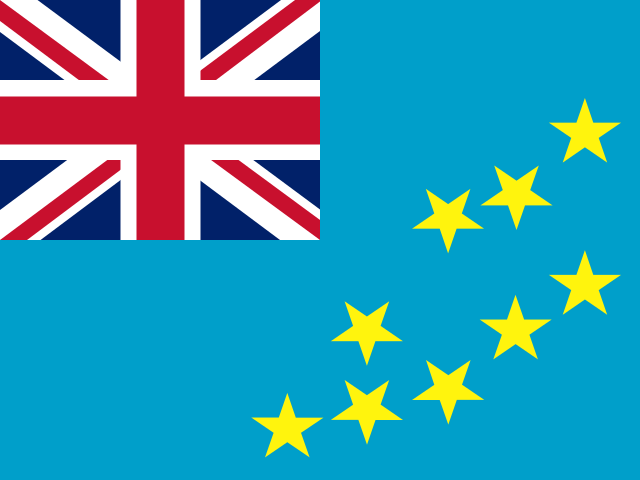
The Flag of Tuvalu
Oceania · Adopted 1 October 1978 (independence day); briefly replaced 1995–1997, then restored 11 April 1997
Tuvalu adopted its flag on 1 October 1978, the day it became independent from Britain, having split from the Gilbert Islands (which became Kiribati the following year) after a 1974 referendum in which the ethnically Polynesian Ellice Islanders voted overwhelmingly to separate from the ethnically Micronesian Gilbertese-majority colony they had shared administration with — a rare case of a Pacific colony dividing along ethnic and linguistic lines before either half reached independence.
The design places a light blue field, again representing the Pacific Ocean, behind a Union Jack canton, and on the fly nine yellow five-pointed stars arranged not in a decorative pattern but in the actual geographic layout of Tuvalu's nine islands and atolls relative to one another — a genuinely literal, to-scale map built into the flag's design rather than a purely symbolic star count, distinguishing it from most other star-based Pacific flags.
Tuvalu is one of only a few Pacific nations whose flag was actually changed and then changed back. In 1995, the government led by Prime Minister Kamuta Latasi replaced the flag with a new design that removed the Union Jack and replaced it with the national emblem, arguing that the colonial symbol no longer suited an independent nation nearly two decades after independence. The change proved unpopular, and following a change of government the original 1978 design, Union Jack included, was formally restored on 11 April 1997.
The reversal is often cited in Pacific vexillology discussions as a rare, clearly documented example of a Union Jack removal being deliberately undone by popular and political pressure, rather than the more common pattern elsewhere in the region of the colonial symbol simply never being seriously challenged in the first place.
Tuvalu has become one of the most prominent global symbols of climate vulnerability among small island states: its highest point sits only about 4.6 meters above sea level, and its former Prime Minister famously delivered a televised speech to the 2021 UN Climate Change Conference (COP26) while standing knee-deep in seawater to dramatize the country's exposure to sea-level rise, an image that circulated internationally and tied Tuvalu's public identity closely to the climate crisis its flag itself does not depict.
In 2023, Tuvalu signed the Falepili Union with Australia, a bilateral treaty whose most widely reported provision creates a dedicated visa pathway letting up to 280 Tuvaluans a year settle permanently in Australia as conditions on the islands deteriorate — one of the first formal international agreements of its kind explicitly built around slow-onset climate displacement rather than emergency disaster relief, negotiated by a nation of roughly 11,000 people with almost no leverage beyond the moral weight of its situation.
Tuvalu has also pursued a more unusual, longer-shot response to the same threat: in 2022 the government began building a 'digital nation' project, aiming to preserve a legally recognized copy of Tuvalu's government, culture, and territory in virtual form should the physical islands eventually become uninhabitable — a genuinely novel legal and diplomatic experiment with no clear precedent, reflecting how directly existential the sea-level-rise question has become for a country whose highest point is only a few meters above the waves.
Tuvalu's nine islands are themselves a mix of true atolls and raised coral islands, and only eight of the nine were traditionally inhabited at the time of independence, which is part of why the flag's nine stars are sometimes explained slightly differently depending on the source — some accounts describe them simply as the nine islands, others specifically as the eight inhabited islands plus Niulakita, settled more recently by people originally from Niutao.
The flag has remained unchanged since its 1997 restoration, and Tuvalu continues to mark 1 October, Independence Day, as its central national and flag-related holiday each year.
The nine stars correspond, going roughly northwest to southeast, to Nanumea, Nanumaga, Niutao, Nui, Vaitupu, Nukufetau, Funafuti (the capital atoll), Nukulaelae, and Niulakita — a real, checkable geographic sequence rather than an arbitrary count, which is part of why Tuvalu's flag is often cited in vexillology discussions as one of the more literally cartographic national flags in use anywhere. Tuvalu's flag law also sets its proportions at 1:2, a notably elongated ratio shared with the United Kingdom's own flag and several other former British territories, rather than the roughly 2:3 or 3:5 ratios most other nations use.
Tuvalu has separately become one of the more unusual examples of a small state converting a symbolic asset into direct national revenue: its country-code top-level domain, .tv, happens to match the abbreviation for television, and since licensing the rights to a Canadian-then-US registry beginning in 1998 the government has drawn a meaningful and recurring share of its budget from royalties paid by television and streaming-related websites worldwide using the domain — an arrangement with no connection to the flag's own design but one that, like the Falepili Union and the digital-nation project, reflects how a nation of roughly 11,000 people has repeatedly had to find unconventional solutions to sustain itself.
A 1:2 cut with nine stars
- Flag cut to 1:2 — The stars are laid out to match the islands' actual positions across a field specified at 1:2, so a shorter cut squeezes that arrangement out of shape as well as changing the outline.
As an Amazon Associate we earn from qualifying purchases made through these links, at no extra cost to you.
Often confused with
- Fiji — shares the light-blue field and Union Jack canton common to former British Pacific colonies, but Fiji's fly carries a colonial-era shield with a St George's cross and agricultural motifs, while Tuvalu's carries nine plain yellow stars arranged to mirror the actual geographic layout of its nine islands. Compare side by side →
Tuvalu at a glance
- Capital
- Funafuti
- Population
- 11,000 (2024)
- Currency
- Australian Dollar (AUD), alongside the Tuvaluan dollar in coin form
- Language(s)
- Tuvaluan and English (both official)
Population figure as of 2024, source: UN World Population Prospects (2024 revision). See methodology for how facts are sourced and kept current.