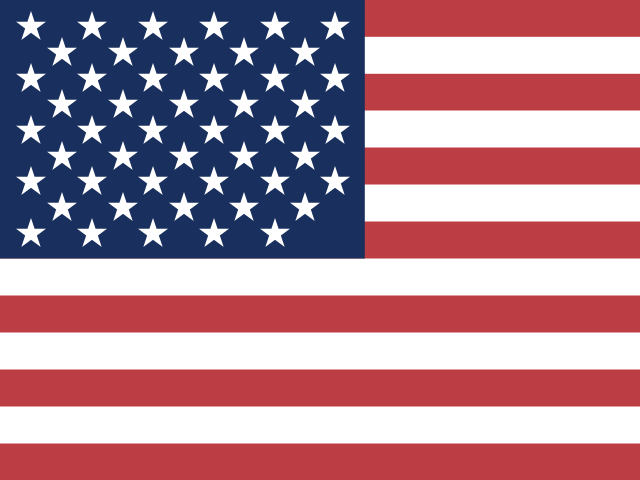
The Flag of United States
North America · Adopted 4 July 1960 (current 50-star version); pattern established by the Flag Act of 1777
The United States' flag traces its basic pattern — alternating red and white horizontal stripes with a field of stars on a blue canton — to the Flag Resolution passed by the Continental Congress on 14 June 1777, which specified thirteen stripes and thirteen stars, "a new constellation," representing the thirteen original colonies that had declared independence the year before. The resolution's brief wording left the exact star arrangement unspecified, which is why surviving flags from the earliest years of American independence show stars arranged in circles, rows, and other patterns rather than a single fixed layout.
The popular legend crediting Philadelphia seamstress Betsy Ross with sewing the first American flag, at George Washington's personal request, comes almost entirely from a single source: her grandson William Canby, who presented the claim to the Historical Society of Pennsylvania in 1870, nearly a century after the events he described, based on family testimony rather than contemporary documentation. Historians generally regard the story as unproven rather than disproven — there is no 1776-era paper trail confirming it — and a rival, better-documented claim credits New Jersey statesman and Declaration of Independence signer Francis Hopkinson, who billed Congress in 1780 for design work on "the flag of the United States," though Congress never paid the claim and the extent of his actual contribution to the specific star-and-stripe design is also debated among historians.
The stripes represent the thirteen original colonies collectively, and while no single Congressional resolution definitively fixed the meaning of the colors, red, white, and blue have long been popularly explained — following language used by Charles Thomson, secretary to the Continental Congress, in describing the Great Seal in 1782 — as symbolizing valor and hardiness (red), purity and innocence (white), and vigilance, perseverance, and justice (blue), an interpretation widely repeated in American civic education though it was written about the seal specifically rather than the flag by that same 1782 document.
The flag's design has changed more times than any other country's currently in use, precisely because it was built to grow: the Flag Act of 1794 added a 14th and 15th star and stripe to reflect Vermont's and Kentucky's admission to the Union, but by 1818 Congress recognized that adding a stripe for every new state was unsustainable and passed a new Flag Act fixing the stripe count permanently at thirteen, representing the original colonies for good, while establishing that a new star would be added for each new state, effective the following 4 July. That 1818 compromise is the reason the modern flag still carries only thirteen stripes despite the union having grown to fifty states.
Counting the original 1777 flag, the United States has flown 27 official versions of its flag as new states joined the Union, more official redesigns than any other nation's currently-serving flag has undergone, though nearly all of these changes altered only the star count and arrangement rather than the overall design concept. The current 50-star version, marking Hawaii's 1959 admission as the 50th state, became official on 4 July 1960 and is now the longest-serving version in the flag's history, having remained unchanged for over six decades.
The specific 50-star grid arrangement — nine rows alternating five and six stars — was designed by Robert G. Heft, then a 17-year-old Ohio high school student, as a class project in 1958, submitted in anticipation of Alaska's and Hawaii's expected statehood; his design was one of thousands of submissions received by the federal government and was selected, according to accounts Heft gave later in life, after he lobbied his own congressman directly to advocate for it, an unusually well-documented origin story compared with the flag's murkier 18th-century beginnings.
Because Alaska and Hawaii both joined the Union within a single year of each other (1959), the flag briefly carried a 49-star version for exactly one year — 4 July 1959 to 3 July 1960 — before the 50-star design took over, one of the shortest-lived official versions in the flag's entire history, alongside the similarly short-lived 1791–1795 fifteen-star, fifteen-stripe flag that preceded the 1818 stripe-fixing reform.
The flag's canton of stars, echoed in the crescents and star motifs found on many national flags worldwide for entirely different historical reasons — a pattern our sister site SymbolHubs traces across cultures in its own symbol-meaning coverage — sits at the center of detailed federal flag-etiquette law, the U.S. Flag Code, first adopted in 1942, which governs display, folding, and retirement of the flag, though the Code is understood by federal courts to be advisory rather than criminally enforceable against private citizens under free-speech protections established in the Supreme Court's 1989 Texas v. Johnson decision on flag burning.
The informal nickname "Old Glory," now used interchangeably with the formal flag, is traced to a specific 19th-century sea captain, William Driver, who reportedly gave the name to a flag he flew from his ship starting in 1831 and later defended from Confederate seizure during the Civil War by hiding it — a documented individual origin story, unlike the more disputed Betsy Ross legend, that has since become general shorthand for the flag as a whole across American popular usage.
Sewn stripes and embroidered stars
- Sewn-and-embroidered flag — The page notes the star arrangement was left loose for years and only later fixed; on a sewn flag the stars are stitched individually and the stripes are separate panels, which is why they outlast printed ones outdoors.
As an Amazon Associate we earn from qualifying purchases made through these links, at no extra cost to you.
Often confused with
- Liberia — was deliberately modeled on the American flag by settlers connected to the American Colonization Society in the 1820s, and still shares the red-and-white striped field, though Liberia's canton carries a single white star rather than fifty. Compare side by side →
United States at a glance
- Capital
- Washington, D.C.
- Population
- 345 million (2024)
- Currency
- United States Dollar (USD)
- Language(s)
- English (de facto national language; no official language at the federal level)
Population figure as of 2024, source: UN World Population Prospects (2024 revision). See methodology for how facts are sourced and kept current.