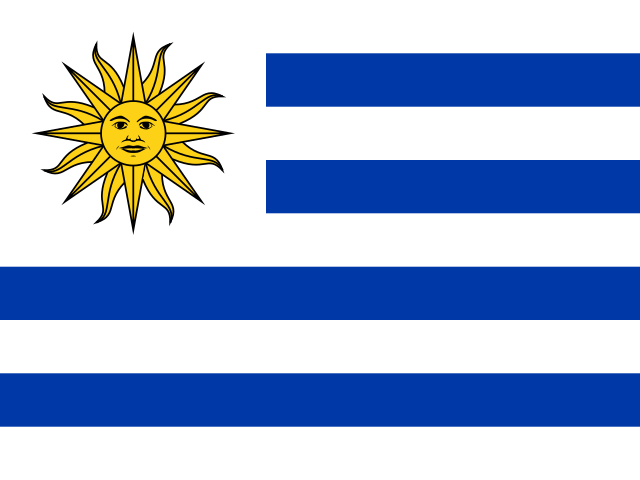
The Flag of Uruguay
South America · Adopted 12 July 1830 (present nine-stripe design)
Uruguay's flag carries nine horizontal stripes — five blue, four white, alternating from top to bottom — and each stripe corresponds to one of the nine original departments Uruguay was divided into at independence in the 1820s. That's a genuinely literal piece of symbolism rather than a decorative pattern: the number nine wasn't chosen for visual balance, it was chosen because there were exactly nine administrative departments to represent when the flag law was passed, even though Uruguay has since subdivided into nineteen departments without anyone revisiting the flag to match.
In the canton — the upper-left corner — sits the Sun of May (Sol de Mayo), a golden sun with a human face rendered in profile, surrounded by alternating straight and wavy rays. This is the same sun used on Argentina's flag, and that's not a coincidence of independent invention: both nations trace the symbol to the same event, the May Revolution of 1810 in Buenos Aires, when the sun is said to have broken through overcast skies over the crowds gathered outside the city's cabildo, an omen contemporaries read as favoring the revolutionary cause. Uruguay's own path to independence ran through the United Provinces of the Río de la Plata (the state that became Argentina) before it broke away as a separate nation in the 1820s, which is why the shared sun symbol reflects genuine common history rather than mere imitation.
The flag went through several stripe counts before settling on nine. Earlier versions flown during Uruguay's fight for independence in the 1820s used different numbers of blue-and-white bands, and it was a law passed on 12 July 1830 — shortly after Uruguay's constitution took effect — that fixed the current nine-stripe, single-sun design as definitive. That 1830 law has never been revoked or substantially altered since.
Blue and white as Uruguay's national colors were themselves inherited from the broader Río de la Plata revolutionary movement rather than invented specifically for Uruguay, which is again why they echo Argentina's own sky-blue-and-white palette so closely even though the two flags' overall patterns — Argentina's three horizontal bands versus Uruguay's nine stripes — look quite different once you look past the shared canton symbol.
Uruguay's flag law also specifies exact proportions and the precise shade of blue to be used, a level of formal precision typical of flags codified in the early 19th century by governments eager to project institutional legitimacy soon after independence, when establishing clear, legally defined national symbols was itself a political priority.
The flag is flown nationwide on Independence Day, 25 August, marking Uruguay's 1825 declaration against Brazilian rule (Uruguay had been annexed by the Empire of Brazil in the early 1820s before winning full separation), and on Flag Day, observed the second Sunday of June, when Uruguayan schoolchildren traditionally take a civic oath of allegiance to the flag.
Uruguay's independence movement had its own separate banner before the current national flag existed: José Gervasio Artigas, the federalist leader regarded as the founding father of Uruguayan independence, used a sky-blue, white, and red diagonal-striped flag during his campaigns in the 1810s. That Artigas flag was never adopted as the national flag, but it survives today as a recognized historical and civic symbol, still flown by some Uruguayan institutions and political movements alongside, not instead of, the official nine-stripe design.
The 33 Orientales, the small band of exiles who crossed back into Uruguayan territory from Argentina in April 1825 to launch the campaign that led to independence, are commemorated with their own numeral in Uruguayan civic tradition, and their crossing — traditionally associated with a flag bearing the slogan 'Libertad o Muerte' (Liberty or Death) — is treated as a distinct symbolic predecessor to the nine-stripe flag formalized a few months later.
Uruguayan law specifies the exact number and order of stripes with enough precision that manufacturing errors are considered a genuine civic lapse rather than a trivial mistake — the requirement that the flag begin and end with a blue stripe, with white stripes only in between, is a detail school civics lessons cover specifically because it's the easiest part of the design for an inattentive flag-maker to get wrong.
Because Uruguay's Sol de Mayo canton is visually identical to Argentina's, the two flags are sometimes displayed interchangeably by mistake at international sporting events and conferences outside South America, an error Uruguayan diplomatic missions have had to correct often enough that it's become something of a familiar, low-stakes irritant in bilateral cultural exchanges between the two countries rather than a serious diplomatic issue.
Uruguay briefly considered dropping the shared sun canton altogether in the debates leading up to the 1830 flag law, with some legislators arguing for a design that would set the new country apart more sharply from Argentina, but the proposal to keep the Sol de Mayo ultimately won out on the grounds that the shared revolutionary heritage was a source of regional pride rather than something Uruguay needed to visually distance itself from.
A sun with alternating rays
- High-resolution printed flag — The sun in the canton has a face in profile and rays that alternate straight and wavy, which is two kinds of fine detail inside one small disc.
As an Amazon Associate we earn from qualifying purchases made through these links, at no extra cost to you.
Often confused with
- Argentina — shares the exact same Sun of May emblem, tracing to the same 1810 revolutionary event, but Argentina's flag uses three plain horizontal bands rather than Uruguay's nine alternating blue-and-white stripes. Compare side by side →
Uruguay at a glance
- Capital
- Montevideo
- Population
- 3.4 million (2024)
- Currency
- Uruguayan Peso (UYU)
- Language(s)
- Spanish (official)
Population figure as of 2024, source: UN World Population Prospects (2024 revision). See methodology for how facts are sourced and kept current.