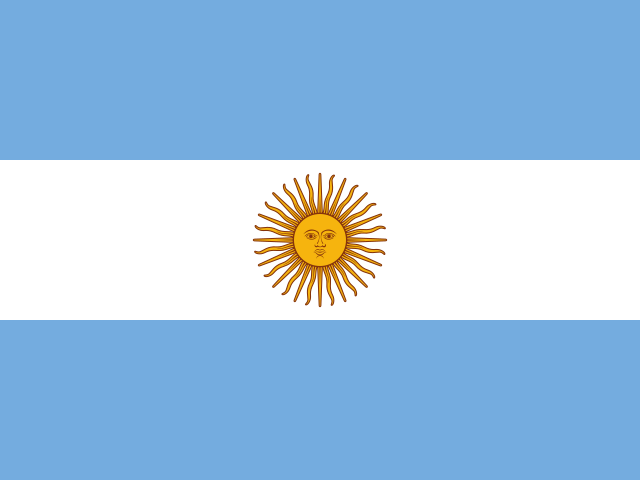
The Flag of Argentina
South America · Adopted 25 February 1818 (sun added); stripes first flown 27 February 1812
Argentina's flag traces to 27 February 1812, when Manuel Belgrano, a lawyer-turned-general who had helped organize the revolutionary army fighting Spanish rule, raised a pale blue-and-white banner over a battery on the Paraná River near Rosario, ahead of the formal declaration of independence that would not come until 1816. Belgrano is said to have drawn the colors from the cockade — the small circular badge worn on hats and lapels — that revolutionary supporters had adopted in Buenos Aires in 1810, itself sky-blue and white, though the exact origin of why those two colors were chosen for the cockade in the first place is not settled: competing accounts point to the Bourbon dynasty's livery colors, to the sky over Buenos Aires on the morning of the May Revolution, and to Marian devotional imagery, and Argentine sources themselves do not agree on a single explanation.
The government in Buenos Aires initially reprimanded Belgrano for raising an unauthorized flag before independence had even been declared, worried it would provoke Spain prematurely, and it took until 1816, after the Congress of Tucumán formally declared independence, for the sky-blue-and-white banner to gain official recognition as a national flag at all. The sun was a later addition: the Buenos Aires provincial government ordered a golden sun disc added to the center of the flag in February 1818, and that sun-bearing version — not the plain triband Belgrano first raised — is the one that has represented Argentina as a nation ever since.
The sun itself, known as the Sun of May (Sol de Mayo), is rendered with a human face and thirty-two alternating straight and wavy rays, and its design draws on the Inca sun god Inti, invoking the pre-Columbian civilizations of the Andes as part of Argentina's claimed heritage rather than only its Spanish colonial past. It commemorates the May Revolution of 25 May 1810, the week Buenos Aires's criollo elite ousted the Spanish viceroy and set the territory on the path toward full independence six years later — a sun said to have broken through overcast skies over the city that day, according to the popular telling, though like much of the flag's early history that detail rests on tradition rather than firm documentation.
The two color fields carry a simpler, more contested symbolism than the sun: sky blue for the clear Argentine sky and white for purity or peace are the readings most commonly taught, though because no official 1812 or 1816 decree spelled out a fixed meaning for the colors, later writers have supplied various explanations after the fact, and Argentina's government has never legislated one canonical interpretation the way some other nations have.
For decades after 1818 the exact shade of blue was left informal, and 20th-century governments intervened more than once to standardize it: a 1938 decree fixed the flag's proportions and shade, and a further law in 1985 specified a lighter "celeste" (sky blue) after complaints that the color in wide use had drifted toward a darker navy over the preceding decades — the current official tone is meant to evoke the pale blue of a clear midday sky rather than a deep ocean blue.
Argentina uses two versions of essentially the same flag: the plain sky-blue-white-sky-blue triband, called the bandera de ceremonia in its unadorned civil form, is flown by ordinary citizens and civilian institutions, while the sun-bearing version is reserved for government buildings, military use, and official ceremonies — a two-tier system that traces directly back to the 1818 decree adding the sun only to the state's official banner rather than to the flag as flown generally by the public.
Belgrano's own flag, and by extension the modern Argentine flag, is honored every 20 June, Flag Day, marking the anniversary of his death in 1820 rather than the date he first raised it — a choice that ties the holiday to his memory as its creator specifically, and Rosario, the city where he first raised the flag, hosts the National Flag Memorial (Monumento a la Bandera), a large monument complex completed in 1957 that functions as the flag's closest thing to a national shrine.
Belgrano himself is an unusual figure to have designed a national flag: trained as a lawyer in Spain, he spent his early career as an economist and journalist advocating for free trade and agricultural reform in the Río de la Plata region before the 1810 revolution pulled him into military command, a role he had no formal training for and reportedly accepted reluctantly. He went on to lead Argentine forces at Tucumán and Salta before his health broke down, and he died in 1820 largely impoverished, having spent much of his own salary and a diplomatic mission's funds on outfitting troops and, according to one often-repeated account, on founding four schools in the northern provinces — making the modern reverence for him as the flag's creator somewhat removed from the difficult circumstances of his own final years.
Law 23,208, passed in 1985 during the early return to civilian government after Argentina's last military dictatorship, is the statute that fixed the current sky-blue tone and formally distinguished the ceremonial civil flag from the sun-bearing state flag in the terms still used today; it followed a period in which flag manufacturers and provincial governments had used noticeably inconsistent shades of blue, some drifting close to a deep navy that critics said no longer resembled a clear sky at all. Argentine flag protocol built on that law is strict by regional standards — schools conduct formal flag oaths (Promesa de Lealtad a la Bandera) for fourth-grade students each year, typically timed near Flag Day, a civic ritual most Argentines can recall from their own childhoods.
A sun with a face on it
- High-resolution printed flag — The centre carries a sun drawn with human features and alternating straight and wavy rays, which is the sort of detail a low-resolution print turns into a plain gold disc.
As an Amazon Associate we earn from qualifying purchases made through these links, at no extra cost to you.
Often confused with
- Uruguay — borrowed the identical sun disc in 1828 as a direct nod to Belgrano, but sets it against nine alternating white-and-blue stripes standing for Uruguay's original nine departments, a stripe count Argentina's own design has never carried. Compare side by side →
- Guatemala — uses a similar blue-white-blue triband layout, but the resemblance is coincidental rather than historical — Guatemala's blue is darker and its central emblem is a quetzal-and-rifles coat of arms, not a sun. Compare side by side →
Argentina at a glance
- Capital
- Buenos Aires
- Population
- 45.8 million (2024)
- Currency
- Argentine Peso (ARS)
- Language(s)
- Spanish (official; de facto national language)
Population figure as of 2024, source: UN World Population Prospects (2024 revision). See methodology for how facts are sourced and kept current.