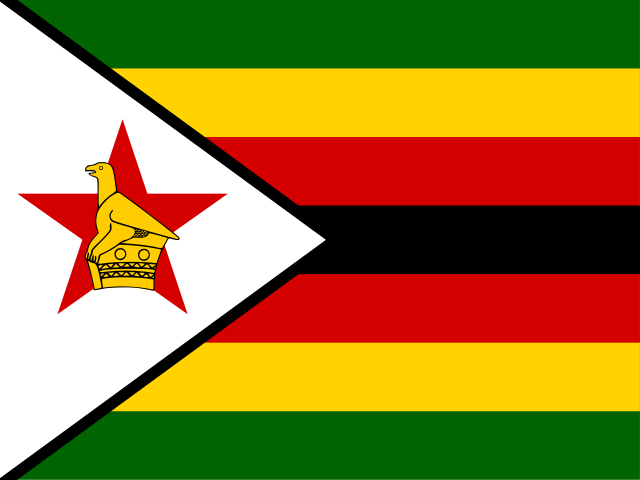
The Flag of Zimbabwe
Africa · Adopted 18 April 1980
Zimbabwe's flag was adopted on 18 April 1980, the day the country achieved internationally recognized independence, replacing not one but a rapid succession of earlier flags flown over the same territory in barely five years: the white-minority Rhodesian government's flag under Ian Smith's 1965 Unilateral Declaration of Independence, then a brief transitional flag used during 1979 under the short-lived 'Zimbabwe Rhodesia' government that failed to win international recognition, before the Lancaster House Agreement of late 1979 finally set terms for a genuine transition to majority rule and independence under the new name Zimbabwe.
The design uses seven horizontal stripes — green, gold, red, black, red, gold, green, arranged symmetrically — with a white triangle at the hoist bearing a red five-pointed star and, centered inside that star, a small gold rendering of the Zimbabwe Bird. Green represents agriculture and the land, gold represents the country's mineral wealth, red represents the blood shed during the liberation war fought against Smith's government from 1964 to 1979 — a conflict widely known within Zimbabwe as the Second Chimurenga, invoking an earlier, First Chimurenga uprising against colonial rule in the 1890s — and black represents the country's majority Black population and its heritage.
The white triangle stands for peace, and the red star was, at independence, an explicit nod to the socialist and pan-African liberation politics of ZANU, the party that led the new government under Robert Mugabe — a piece of overt Cold War-era ideological symbolism that several other African liberation-movement flags from the same period share in some form, even where the specific party politics behind each differ.
The Zimbabwe Bird at the flag's center is the country's most historically loaded symbol: it is modeled on a set of soapstone bird sculptures excavated from the Great Zimbabwe ruins, the stone-walled complex built by a Shona-speaking kingdom between roughly the 11th and 15th centuries in the country's south, whose scale — the largest stone structure in sub-Saharan Africa built before the modern era — colonial-era Rhodesian authorities long refused to credit to African builders, promoting alternative theories crediting Phoenicians or other non-African peoples instead, a colonial-era distortion decisively rejected by archaeological consensus well before independence.
Eight original soapstone birds are known to have been recovered from Great Zimbabwe, and the country's own name is drawn from the same site — 'Zimbabwe' derives from the Shona dzimba dzemabwe, roughly 'houses of stone' — making the flag's central emblem and the nation's name draw on the identical historical source, a direct and deliberate link the post-independence government made explicit in choosing both.
The flag has not been redesigned since 1980, even through Zimbabwe's severe economic and political turbulence in the 2000s and 2010s, including hyperinflation that peaked around 2008 and the 2017 removal of Robert Mugabe after nearly four decades in power; it remains the flag used by the current government under Emmerson Mnangagwa without modification.
The red star's overt tie to ZANU's own party symbolism at the moment of independence has made it a point of occasional criticism from opposition politicians and commentators in the decades since Zimbabwe became a more genuinely contested multi-party system from the late 1990s onward, with some arguing a national flag should not carry an emblem so closely associated with one political movement's founding ideology; no government since 1980 has proposed formally acting on that criticism, and the star remains unchanged.
The Zimbabwe Bird itself has a complicated post-independence history beyond the flag: of the eight original soapstone birds recovered from Great Zimbabwe, several were removed from the country during the colonial period, including one taken to Cecil Rhodes's private collection in South Africa; most have since been returned to Zimbabwe and are displayed at the Great Zimbabwe site and in Harare, but the birds' removal and gradual repatriation over the 20th century is itself part of why the emblem carries such heavy symbolic weight on the flag, standing for reclaimed national heritage as much as for the ancient kingdom that carved the originals.
UNESCO added Great Zimbabwe to its World Heritage list in 1986, six years after independence — formal international recognition arriving for a site whose very name the new country had already adopted for itself in 1980, a rare instance of a nation naming itself after an archaeological site rather than the other way around, and one that makes Zimbabwe's flag, capital, currency, and national identity all trace back to the same single 11th-to-15th-century ruin in the country's south.
The seven-stripe pattern, while visually distinctive, places Zimbabwe's flag in loose company with several other post-independence African flags built around symmetrical, mirrored stripe arrangements rather than simple ascending or repeating bands, a design approach that became more common among African states adopting flags in the 1970s and 1980s than it had been among the earlier wave of independence-era flags in the 1950s and 1960s.
The 1979 Lancaster House talks that finally produced the framework for Zimbabwe's independence brought together Ian Smith's government, and the two rival guerrilla movements that had fought the liberation war, Robert Mugabe's ZANU and Joshua Nkomo's ZAPU, in London negotiations that ran for months before agreement — the 1980 flag that emerged afterward reflects mainly ZANU's own visual language and star symbolism rather than a merged or negotiated design incorporating ZAPU's separate identity, a detail that mirrors the uneven balance of power between the two liberation movements that persisted into the new country's post-independence politics.
The bird inside the star
- Embroidered-emblem flag — A small gold bird sits inside a red star inside a white triangle, three shapes nested at decreasing size; that innermost figure is the first thing lost to a coarse print or a small format.
As an Amazon Associate we earn from qualifying purchases made through these links, at no extra cost to you.
Often confused with
- Mozambique — shares the red-black-green-gold palette from the same regional liberation-movement tradition, but Mozambique's flag is a diagonal tricolor with a hoist triangle bearing a rifle, hoe, and book rather than Zimbabwe's symmetrical seven-stripe horizontal design and Zimbabwe Bird. Compare side by side →
Zimbabwe at a glance
- Capital
- Harare
- Population
- approximately 16.7 million (2024)
- Currency
- Zimbabwe Gold (ZiG), introduced April 2024 alongside continued use of the US dollar and other foreign currencies
- Language(s)
- 16 officially recognized languages under the 2013 constitution, including English, Shona, and Ndebele, with Shona the most widely spoken
Population figure as of 2024, source: UN World Population Prospects (2024 revision). See methodology for how facts are sourced and kept current.