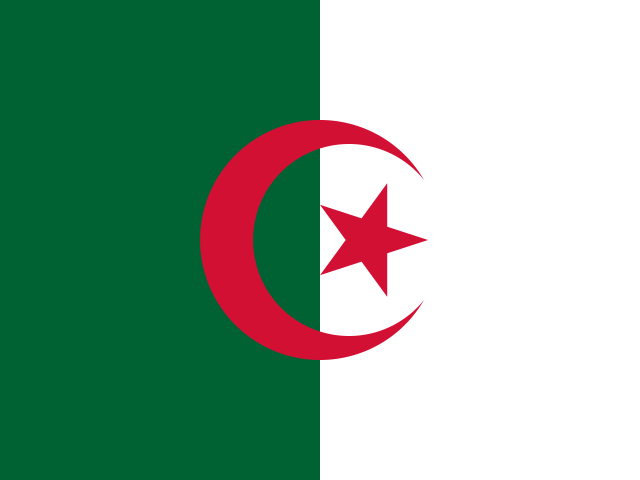
The Flag of Algeria
Africa · Adopted 3 July 1962
Algeria's flag became official on 3 July 1962, the day the country's independence from France was formally recognized, but the design itself is older than the state it now represents. It was carried as the banner of the FLN (Front de Libération Nationale) throughout the 1954–1962 War of Independence, and Algerians had already been flying versions of it in exile and in underground resistance cells for years before a single ceremony made it law. Émigré Algerian communities in Switzerland and elsewhere in Europe reportedly stitched and flew early versions of the design as early as the 1920s, decades before the war that would make it official.
National tradition traces the pattern further back still, to a flag associated with Emir Abdelkader, the 19th-century resistance leader who fought French colonization in the 1830s and 1840s and is regarded as a founding figure of the modern Algerian state. Historians disagree on how literally that attribution should be taken — no surviving 1830s flag matches the modern design exactly, and the details of Abdelkader's actual battle standards are thinly documented. But the story matters politically: it lets the independence-era flag claim descent from anti-colonial resistance rather than presenting itself as a symbol invented from scratch in 1962, and Algerian schoolchildren are taught the Abdelkader lineage as settled history.
The two color fields carry meanings that Algerians themselves generally agree on, even if the exact wording varies by source. Green, filling the hoist half, is read as a reference to Islam and to the country's Amazigh (Berber) and Arab identity. White, filling the fly half, stands for purity and peace. The red crescent and five-pointed star centered across the boundary between the two colors are also Islamic symbols, but the red is specifically tied to the blood spilled by the roughly one and a half million Algerians estimated to have died during the war for independence — a casualty figure, disputed by some historians as inflated for political effect but still central to national memory and taught in schools as the human cost of liberation.
One detail distinguishes Algeria's crescent from the Ottoman-style crescents seen on flags like Turkey's or Tunisia's: the horns of the Algerian crescent are drawn noticeably more open, curving further apart, which vexillologists sometimes note as a deliberate visual break from the Ottoman tradition the region had lived under for three centuries, rather than a simple copy of it. The five points of the star are meant to represent the five pillars of Islam, a symbolic detail shared with several other Muslim-majority nations' flags even where the rest of the design differs completely.
The flag has not been redesigned since 1962. Algeria's 1963, 1976, and 1989 constitutions each re-affirmed the same design without altering it, and the 1963 Fundamental Law made the ratio, colors, and symbol placement legally precise — down to the exact shade of green and the geometry of the crescent — rather than leaving it a matter of custom. That stability stands out among post-independence African and Arab states, many of which cycled through several flag designs in their first decades as governments changed; Algeria's has outlasted single-party rule, civil conflict in the 1990s, and multiple constitutional overhauls unchanged.
Algerian law treats the flag with unusual formality for a national symbol: desecrating it is a criminal offense, and its display is tightly regulated at official events, a legacy of both the flag's role as a hard-won symbol of the independence struggle and of the state's broader tendency to codify national symbols precisely rather than leave them to informal tradition.
Because the crescent-and-star motif recurs across many Islamic-world flags for genuinely different historical reasons in each country, Algeria's flag is sometimes casually lumped in with Pakistan's, Turkey's, or Mauritania's in popular discussion — despite each having arrived at a similar symbol independently, through its own 19th- or 20th-century political history rather than a shared design tradition.
The flag's construction ratio is fixed by law at 2:3, and government specifications describe the exact Pantone-equivalent shades of green and red to be used on official versions, a level of precision typical of flags formalized in the mid-20th century rather than inherited informally from earlier centuries. The crescent and star are always rendered in the same red as used symbolically for the war dead, never in gold or white, which helps distinguish Algeria's flag at a glance from the many other crescent-and-star designs used across North Africa and the Middle East.
Algeria's flag is flown daily above government buildings, schools, and diplomatic missions, and it played a highly visible role again during the Hirak protest movement that began in February 2019, when demonstrators carried it by the thousands through the streets of Algiers as a shared symbol of national unity that transcended the specific political demands of any one faction within the protests. Independence Day, 5 July, and Revolution Day, 1 November, are the two occasions when official flag ceremonies are most prominent nationwide.
Holding the specified green outdoors
- Colourfast outdoor flag — This page makes the point that the shade is not left to the maker: a cheaply pigment-printed flag drifts toward grey-green within a season outdoors, so look for dyed rather than surface-printed cloth.
As an Amazon Associate we earn from qualifying purchases made through these links, at no extra cost to you.
Often confused with
- Mauritania — shares the green field, red accents, and a crescent-and-star motif, but Mauritania's crescent and star are gold on solid green with red border stripes added in 2017 — a different color pairing and layout entirely. Compare side by side →
- Pakistan — also pairs a green field with a white section and a crescent-and-star, but Pakistan's white is a narrow vertical hoist stripe rather than a full half, and the crescent sits sideways rather than upright. Compare side by side →
Algeria at a glance
- Capital
- Algiers
- Population
- 46.8 million (2024)
- Currency
- Algerian Dinar (DZD)
- Language(s)
- Arabic and Tamazight (official); French widely used in administration and business
Population figure as of 2024, source: UN World Population Prospects (2024 revision). See methodology for how facts are sourced and kept current.