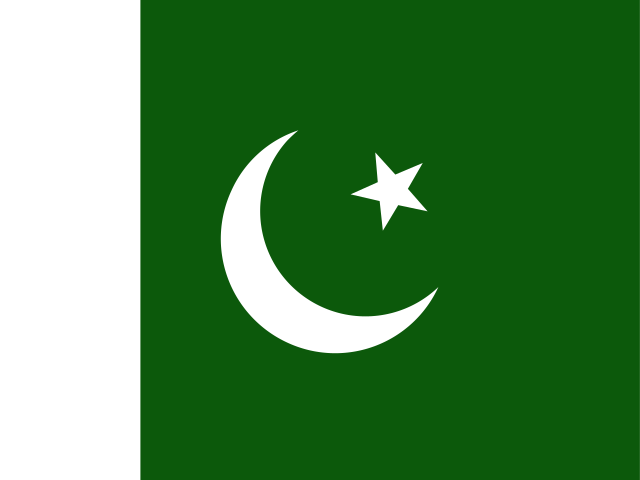
The Flag of Pakistan
Asia · Adopted 11 August 1947
Pakistan adopted its national flag on 11 August 1947, just three days before independence from Britain took effect at midnight on 14–15 August, in a session of the Constituent Assembly presided over by Muhammad Ali Jinnah, the country's founder and first Governor-General. The design was based directly on the flag of the All-India Muslim League, the political party Jinnah led that had campaigned for a separate Muslim-majority state carved out of British India — a solid dark green field bearing a white crescent and five-pointed star, which had already served as the movement's banner for years before independence made it a national symbol.
The one significant change made for the national version was the addition of a white vertical stripe along the hoist side, occupying roughly a quarter of the flag's width. Jinnah is widely credited with insisting on this addition specifically to represent the religious minorities — Hindus, Christians, Sikhs, Parsis, and others — who would become citizens of the new Muslim-majority state, a deliberate signal that the flag of an officially Islamic republic was still meant to represent non-Muslim citizens as well.
The green field is read as representing Islam and the Muslim majority of Pakistan's population, while the crescent is popularly associated with progress and the star with light and knowledge, an interpretation favored in Pakistani civics education over a purely religious reading, even though the crescent-and-star motif itself carries centuries of Islamic and Ottoman-era symbolic association across the wider Muslim world. Readers curious how the same crescent-and-star pairing carries different specific meanings from one country's flag to the next — Turkey's, Algeria's, Tunisia's, and Pakistan's all arrived at it through different national histories — can find that broader symbol history covered in more depth on our sister site SymbolHubs.
Pakistan's flag has not been redesigned since 1947, giving it more than seven and a half decades of continuous use through the country's separation from East Pakistan in the 1971 war that created independent Bangladesh, repeated periods of military rule, and multiple changes of civilian government — a stability in the flag itself that contrasts with the country's often turbulent political history since independence.
The flag's exact proportions, the ratio of the white stripe to the green field, and the precise shade of green are fixed by law, and Pakistani flag regulations specify strict rules for its display, including that it must never touch the ground and must be flown at half-mast only on officially designated days of national mourning.
Because Pakistan's flag shares its basic green-field-with-crescent vocabulary with several other Muslim-majority nations' flags, it is sometimes casually grouped with Turkey's, Algeria's, or Mauritania's in general discussion of Islamic flag symbolism, despite each having reached broadly similar imagery through entirely separate 19th- and 20th-century political histories rather than one shared design tradition.
Pakistan's flag is flown daily above government buildings, schools, and diplomatic missions worldwide, and it is especially prominent on Independence Day, 14 August, and Pakistan Day, 23 March, which marks the 1940 Lahore Resolution calling for a separate Muslim state — the political foundation the 1947 flag was designed to represent from its very first use.
The All-India Muslim League, whose banner the national flag is based on, was itself founded in 1906 in Dhaka — then part of a unified British India, and later, after 1947, the capital of East Pakistan before that wing of the country separated to become independent Bangladesh in 1971. The flag Pakistan flies today therefore has a design lineage that runs, geographically, back through a city that is no longer part of Pakistan at all, a detail rarely discussed but a direct consequence of the 1947 partition and 1971 secession both reshaping the territory the flag represents.
One of the flag's most visible public displays happens daily at the Wagah border crossing with India, where a ceremonial retreat parade performed by Pakistan Rangers and India's Border Security Force each evening includes the formal, closely synchronized lowering of both countries' flags — a ritual that draws large crowds of spectators on both sides of the border and has become one of the most internationally recognized recurring flag ceremonies anywhere in South Asia.
Pakistani mountaineers have also carried the flag to the summit of K2, the world's second-highest peak and one located entirely within Pakistan's borders in the Karakoram range, and successful national summit expeditions are frequently marked by flag-raising ceremonies celebrated in domestic media as points of national pride distinct from, but often mentioned alongside, the flag's founding independence-era symbolism.
Pakistani flag regulations go further than most countries' in specifying not just color and proportion but material: the law requires flags used at official state functions to be made from khaddar, a coarse handspun and hand-woven cotton cloth that carried strong political meaning during the independence movement, when Mahatma Gandhi's swadeshi campaign promoted homespun khadi cloth across British India as a rejection of British textile imports — a symbolism the framers of Pakistan's flag law chose to carry over into the new state's own official cloth requirements rather than treating it as an exclusively Indian nationalist association. The design itself is generally credited to Syed Amir-uddin Kedwai, a Muslim League member whose flag concept for the party was adapted into the national design Jinnah presented to the Constituent Assembly in August 1947, though as with many flags designed amid the chaos of partition, some historical accounts describe the final 1947 version as a group effort within the League's leadership rather than the work of one clearly documented individual.
A hoist stripe of about a quarter
- Proportion-accurate flag — The white band at the hoist is specified at roughly a quarter of the width, which is a proportion you can check by folding the flag in half twice; a thin white sliver is the common fault.
As an Amazon Associate we earn from qualifying purchases made through these links, at no extra cost to you.
Often confused with
- Maldives — also pairs a green field with a white crescent, but the Maldives sets its crescent inside a smaller green rectangle bordered by red, without a star and without Pakistan's separate white hoist stripe. Compare side by side →
- Turkey — shares the crescent-and-star motif closely associated with the wider Islamic world, but Turkey's flag is red with a white crescent and star rather than green with a white crescent, star, and hoist stripe. Compare side by side →
Pakistan at a glance
- Capital
- Islamabad
- Population
- 247 million (2024)
- Currency
- Pakistani Rupee (PKR)
- Language(s)
- Urdu and English (official); Punjabi, Sindhi, Pashto, and other regional languages widely spoken
Population figure as of 2024, source: UN World Population Prospects (2024 revision). See methodology for how facts are sourced and kept current.