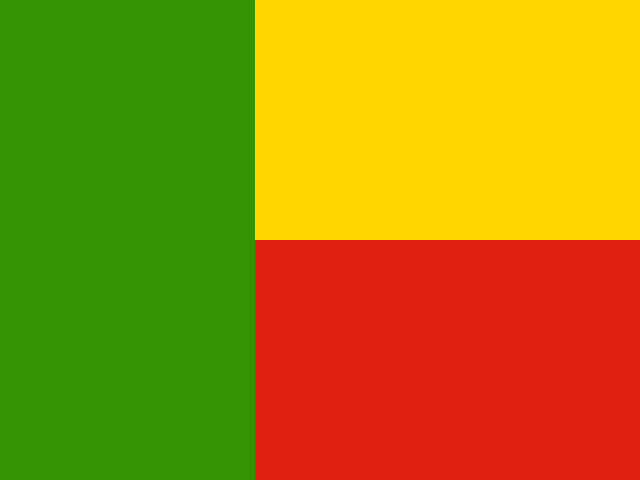
The Flag of Benin
Africa · Adopted 1 August 1990
Benin's current flag has a split history that makes it unusual among African flags: it was first adopted on 16 November 1959, ahead of independence from France in 1960, then formally set aside for 15 years, and finally restored by name in 1990 after the country's Marxist government fell — meaning the design flying over Benin today is not a post-independence creation but a revival of the original one.
The green-yellow-red combination was chosen at independence in direct reference to Ethiopia's flag, which by the late 1950s had become an informal template for pan-African symbolism because Ethiopia was the only African nation never colonized by a European power; newly independent states across the continent, including what was then called Dahomey, adopted variations on the same three colors as a deliberate statement of shared African identity.
In 1975, after a Marxist-Leninist government under Mathieu Kérékou renamed the country from Dahomey to the People's Republic of Benin, the tricolor was replaced with a plain green flag bearing a red star in the canton, matching the aesthetic other Marxist African and Soviet-aligned states adopted in the same period. That green-with-star flag flew for 15 years, through one-party rule and a socialist command economy.
When Kérékou's government agreed to multiparty elections and a new constitution in 1990 following a National Conference that peacefully dismantled single-party rule, the original 1959 tricolor was reinstated essentially unchanged, a symbolic signal that the country was returning to its pre-Marxist civilian identity rather than starting over with an entirely new symbol.
In the restored flag, green is described as representing hope and revival, yellow as representing the country's wealth — traditionally associated with the savannas of the north — and red as representing the courage of the ancestors who resisted colonization, a set of meanings largely carried over unchanged from the original 1959 design.
Benin marks 1 August, the date of full independence in 1960, as its national day, and the restored flag is central to those celebrations alongside 1990's 'Renouveau Démocratique' (Democratic Renewal) commemorations marking the end of Marxist rule.
The 1990 National Conference that led to the flag's restoration is itself widely studied as a model of peaceful democratic transition in Africa: unlike many neighboring states, Benin moved from single-party Marxist rule to multiparty democracy through negotiated conference rather than coup or civil war, and reinstating the pre-1975 flag unaltered was one of the conference's most visible symbolic acts.
Because the 1959 tricolor predates independence itself by roughly a year, it is one of a small number of African national flags that was designed and flown by a colonial-era territorial assembly rather than being created fresh at the moment of full sovereignty — a detail that gives Benin's flag a slightly different origin story from most of its regional neighbors, whose flags were designed specifically for independence day.
Benin's coat of arms, adopted alongside the restored flag in 1990, features two leopards, a ship recalling the Atlantic slave trade era, and the royal palace towers of Abomey, the historic seat of the Kingdom of Dahomey — symbols that root the country's identity in the pre-colonial Dahomey kingdom rather than solely in the 20th-century independence struggle.
The Kingdom of Dahomey, whose territory forms the core of modern Benin, was one of West Africa's most militarily organized pre-colonial states and one of the region's largest participants in the transatlantic slave trade before its conquest by France in the 1890s, a history the country now confronts directly through initiatives like its official 'Route des Esclaves' memorial route between Abomey and the coastal town of Ouidah.
Because the flag's meaning is tied so explicitly to the Ethiopia-derived pan-African palette rather than to symbols unique to Dahomey or Benin specifically, some Beninese commentators have periodically noted that the flag alone tells relatively little of the country's own distinct pre-colonial history compared with the far more detailed and locally rooted imagery on its coat of arms.
Benin's 1990 return to the tricolor was echoed elsewhere in Francophone Africa around the same period, as several states that had adopted single-party or Marxist-era flags in the 1970s and 1980s reverted to earlier independence-era designs once multiparty politics returned in the early 1990s, making Benin an early and often-cited example within that regional wave of symbolic restorations.
Yellow's association with the savanna wealth of northern Benin is sometimes explained further as a reference to the region's cotton production, which remains Benin's largest export crop and a dominant part of the northern regional economy that the color is meant to evoke.
Benin's flag law specifies the same 2:3 proportion common across French-influenced former colonies, a ratio inherited administratively from the French tricolor tradition even though Benin's own layout — a green vertical block beside horizontal yellow-over-red stripes — bears little visual resemblance to the French flag itself.
Independence Day ceremonies each 1 August are held nationwide with formal flag-raising events, and Benin's government additionally marks 11 December as the anniversary of the 1975 declaration of the Marxist People's Republic — a noticeably more muted commemoration today than the widely celebrated 1990 return to multiparty rule and the tricolor's restoration.
Getting the hoist band on the right edge
- Flag with a sewn header and grommets — A vertical band at the hoist only looks right if the cloth is hung from that edge, and a proper canvas header with grommets is what fixes which edge meets the pole.
As an Amazon Associate we earn from qualifying purchases made through these links, at no extra cost to you.
Often confused with
- Guinea — uses the same three pan-African colors but arranged as vertical bands (red-yellow-green) rather than Benin's green hoist block beside horizontal yellow-over-red stripes. Compare side by side →
- Mali — shares the green-yellow-red palette in a plain vertical tricolor, though Mali orders the stripes green-yellow-red left to right, distinct from Benin's block-and-stripes layout. Compare side by side →
Benin at a glance
- Capital
- Porto-Novo
- Population
- 13.7 million (2024)
- Currency
- West African CFA Franc (XOF)
- Language(s)
- French (official); Fon, Yoruba, and other indigenous languages widely spoken
Population figure as of 2024, source: UN World Population Prospects (2024 revision). See methodology for how facts are sourced and kept current.