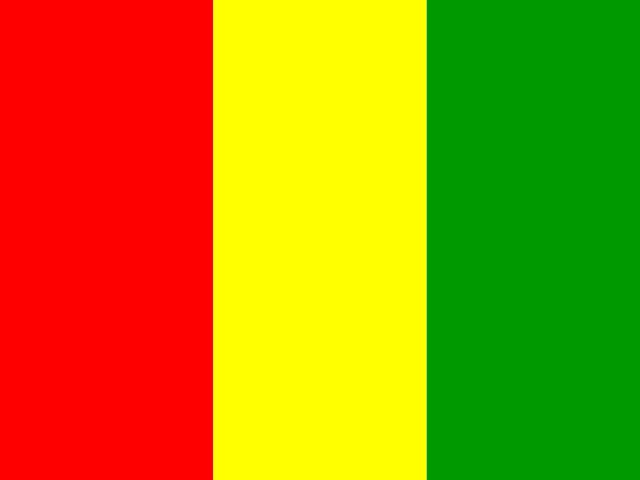
The Flag of Guinea
Africa · Adopted 10 November 1958
Guinea's red-yellow-green vertical tricolor went up within days of the country's break from France, one of the fastest and most defiant independence transitions of the whole decolonization wave. In a September 1958 referendum, Guinea was the only French African territory to vote against joining Charles de Gaulle's proposed Franco-African Community, choosing outright independence instead. France's response was punitive: departing administrators reportedly stripped offices of furniture, tore out phone lines, and destroyed records before leaving, and Guinea's first president, Ahmed Sékou Touré, is remembered for the line that the country preferred 'poverty in freedom to riches in slavery.' The flag adopted that November was the young republic's first independent symbol, chosen deliberately to break with any visual trace of the colonial tricolor it replaced.
The three colors were drawn directly from the pan-African palette popularized by Kwame Nkrumah's Ghana, which had become independent the year before and inspired Sékou Touré's own political vision of continental unity. Guinea, in fact, briefly pursued formal union with Ghana and later Mali in a short-lived pan-African confederation in the early 1960s, and its flag's coloring was part of that same ambition made visible — an intentional echo, not a coincidence.
Within Guinea, the three bands are also read as a civic creed rather than only a pan-African gesture, in the interpretation Sékou Touré's government promoted at the time of adoption: red stands for the sacrifice of those who fought for independence and for the ongoing labor of nation-building; yellow stands for the sun overhead and for the country's mineral wealth, most notably the bauxite reserves that make Guinea home to some of the largest deposits on Earth; and green stands for the country's dense vegetation and for the solidarity of the Guinean people across its Islamic majority and diverse ethnic groups.
Sékou Touré's one-party rule, which lasted until his death in 1984, kept the flag unchanged even as the regime grew increasingly repressive, with tens of thousands of Guineans fleeing into exile or disappearing into camps such as Camp Boiro, one of the era's most notorious detention sites and a name still associated with the government's crackdowns on real and suspected dissidents. The flag survived the 1984 military coup that followed his death, several subsequent changes of government, and Guinea's return to multiparty rule in the 1990s without any redesign — a rare thread of visual continuity through decades of political upheaval.
Guinea's tricolor sits at one end of a small family of West African flags that trace back to the same source. Ghana's black star and horizontal red-yellow-green bands, adopted in 1957, were the template Sékou Touré's generation of independence leaders looked to directly, and Guinea kept the three colors but rearranged them into vertical bands, a layout choice that made the flag instantly distinguishable from Ghana's while still signaling the same continental solidarity.
The flag remained in place through the 2008–2010 military transition following the death of Sékou Touré's eventual successor Lansana Conté, and again through the 2021 coup that removed president Alpha Condé — each change of government has altered Guinea's political leadership without touching the national flag itself, which has now outlasted every one of the country's constitutions since 1958.
Guinea's bauxite wealth, referenced in the flag's yellow band, has become increasingly central to the national economy since large-scale Chinese and Gulf-state mining investment expanded in the 2010s and 2020s, turning what was once a largely symbolic reference to mineral wealth into one of the country's most consequential real economic facts — Guinea now supplies roughly a quarter of the world's bauxite, the raw ore refined into aluminum, giving the flag's yellow stripe an unusually direct link to the country's present-day export economy rather than only its founding-era aspirations.
The most recent disruption to fly under this unchanged flag came in September 2021, when Colonel Mamady Doumbouya led a coup that removed President Alpha Condé, who had himself controversially pushed through a constitutional change in 2020 allowing him to seek a third term after two decades of on-and-off political dominance in the country. Doumbouya's transitional government has pledged an eventual return to civilian rule, and the same red-yellow-green tricolor first raised in 1958 has continued flying over Conakry's government buildings through the transition, unchanged by any of it.
Guinea's flag is built to a 2:3 ratio, and government specifications describe the red as closer to a deep vermilion than a bright scarlet, a shade choice that distinguishes it at a glance from the brighter reds used on some other West African tricolors sharing the same three-color family. Independence-era protocol required the flag to be raised each school morning accompanied by a civic pledge, a practice tied to Sékou Touré's broader program of building loyalty to the young state through daily ritual rather than through the flag's design alone.
The flag's colors extend into Guinea's sporting identity: the national football team, nicknamed the Syli Nationale after the local word for elephant, has worn kits built around the flag's red, yellow, and green since the country's earliest international matches, giving ordinary Guineans a second, everyday context — beyond government buildings and state ceremony — in which the 1958 tricolor's colors circulate as a marker of national identity.
A deep vermilion red
- Dyed-through flag — The page distinguishes this red from the brighter scarlets used nearby, which only survives if the colour is in the fibre; a printed red fades toward pink faster than any other flag colour outdoors.
As an Amazon Associate we earn from qualifying purchases made through these links, at no extra cost to you.
Often confused with
- Mali — uses the identical red-yellow-green trio in the identical vertical layout, just reversed — Guinea runs red-yellow-green from the hoist, Mali runs green-yellow-red — a direct consequence of both countries drawing on the same pan-African color example within a few years of each other. Compare side by side →
- Ivory Coast — shares the vertical-tricolor format and includes similar warm tones, but swaps in orange rather than red or yellow-red pairing, and the two flags are rarely confused up close despite the shared structure. Compare side by side →
Guinea at a glance
- Capital
- Conakry
- Population
- 14.2 million (2024)
- Currency
- Guinean Franc (GNF)
- Language(s)
- French (official); Fula, Susu, and Maninka widely spoken
Population figure as of 2024, source: UN World Population Prospects (2024 revision). See methodology for how facts are sourced and kept current.