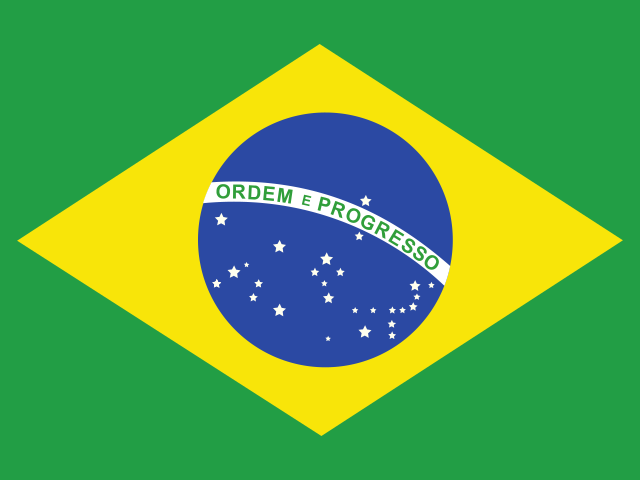
The Flag of Brazil
South America · Adopted 19 November 1889
Brazil's current flag was adopted on 19 November 1889, just four days after the military coup that deposed Emperor Pedro II and proclaimed the Republic on 15 November. The new government needed a flag fast, and rather than starting from nothing it kept the green field and yellow diamond of the old imperial banner while stripping out the emperor's coat of arms at the center and replacing it with a blue celestial globe crossed by a white band — a compromise that let the republic distance itself from monarchy without abandoning the color scheme most Brazilians already associated with their country.
Green and yellow were not chosen by the republic; they came from the 1822 imperial flag commissioned when Pedro I declared independence from Portugal, and even that flag borrowed its colors from family heraldry rather than inventing new symbolism. Green is traditionally traced to the House of Braganza, Pedro I's own royal house, and yellow to the House of Habsburg, the family of his wife, Empress Maria Leopoldina of Austria — meaning the colors now read internationally as quintessentially Brazilian actually originated as a nod to two European dynasties, a detail rarely mentioned outside of specialist vexillology.
The blue globe at the center is the flag's most technically unusual feature: it depicts the night sky over Rio de Janeiro exactly as it appeared at the moment the Republic was proclaimed, 8:30 a.m. on 15 November 1889 (rendered as a night sky for symbolic effect despite the actual morning hour), and it is drawn as if seen from outside the celestial sphere looking in, an astronomical convention that flips the constellations into mirror image relative to how an observer on the ground would actually see them. The prominent constellation is the Southern Cross (Crux), long used for navigation in the Southern Hemisphere and a natural choice for a country whose entire territory sits south of the equator.
The white band running across the globe carries the national motto "Ordem e Progresso" — Order and Progress — a phrase lifted directly from the French philosopher Auguste Comte's positivist motto "L'amour pour principe, et l'ordre pour base; le progrès pour but." Brazilian positivists, most notably Raimundo Teixeira Mendes, a former military engineering instructor and leading figure in Rio de Janeiro's Positivist Church, pushed hard for Comte's ideas to shape the new republic's symbols, and Teixeira Mendes worked directly with the painter Décio Villares on the flag's design, making the banner one of the more explicit cases of a specific 19th-century philosophical movement leaving its fingerprint on a national flag.
The stars scattered across the globe represent Brazil's states and the Federal District, and their count has changed repeatedly as the country's internal borders shifted — the 1889 flag carried 21 stars for the states existing at the time, and new states and territorial reorganizations pushed the number up through the 20th century until it reached 27 in 1992, when the newly created state of Tocantins (carved out of Goiás in 1988) brought the total to 26 states plus the Federal District. Each star's position is not arbitrary decoration: the constellations are mapped to roughly correspond to the geographic layout of the states and territories they represent, a system devised by the astronomer and positivist Manuel Pereira Reis for the original 1889 design.
One single star sits below the white band, separated from the rest of the globe's constellation field — originally placed there to represent the state of Pará, chosen for its position near the celestial equator in the mapping scheme, and later popularly reinterpreted after further state creations as standing in more generally for the Federal District and the seat of national government, though the star's original 1889 placement rule was about mapping Pará's geography rather than symbolizing the capital as such.
Brazil's flag law is detailed even by the standards of Latin American flags formalized with legal precision: Law No. 5,700 of 1971 fixed the current proportions (a ratio of 20:14 for the rectangle, with the diamond and globe sized by specific mathematical formulas relative to it), standardized the exact shade of green, yellow, blue, and white to be used, and set out flag protocol for government buildings, including a rule that the flag must be raised daily at public buildings and lowered at sunset unless illuminated.
Flag Day, 19 November, coincides exactly with the flag's adoption date and is marked nationally, though with less popular fanfare than Independence Day (7 September, marking Pedro I's 1822 break from Portugal) or the Republic Proclamation anniversary (15 November) that the flag itself commemorates — the flag's own holiday sits somewhat in the shadow of the events it was created to symbolize.
Because the green-and-yellow palette long predates the republic, Brazil's flag has stayed remarkably stable compared to those of many other Latin American nations that redesigned their symbols repeatedly after political upheavals; aside from the count of stars increasing as new states joined the federation, the core design approved in November 1889 — field, diamond, globe, motto, and constellation layout — has never been fundamentally altered in over 130 years.
Lettering that must not reverse
- Double-sided flag — A curved band of lettering crosses the globe, and text is the one element that is unmistakably wrong when a single-layer flag is viewed from behind. Two layers keep it readable from both sides.
As an Amazon Associate we earn from qualifying purchases made through these links, at no extra cost to you.
Often confused with
- Vietnam — the two share no historical connection, but Vietnam's plain red field with a central yellow star and Brazil's green-and-yellow field are sometimes confused by newer flag learners purely on the basis of both featuring a prominent yellow shape on a solid colored field. Compare side by side →
- Cameroon — also combines green and yellow with a central star device, but Cameroon's is a vertical green-red-yellow triband with a single yellow star on the red, a Pan-African palette with no historical link to Brazil's dynastic green-and-yellow. Compare side by side →
Brazil at a glance
- Capital
- Brasília
- Population
- 216.4 million (2024)
- Currency
- Brazilian Real (BRL)
- Language(s)
- Portuguese (official)
Population figure as of 2024, source: UN World Population Prospects (2024 revision). See methodology for how facts are sourced and kept current.