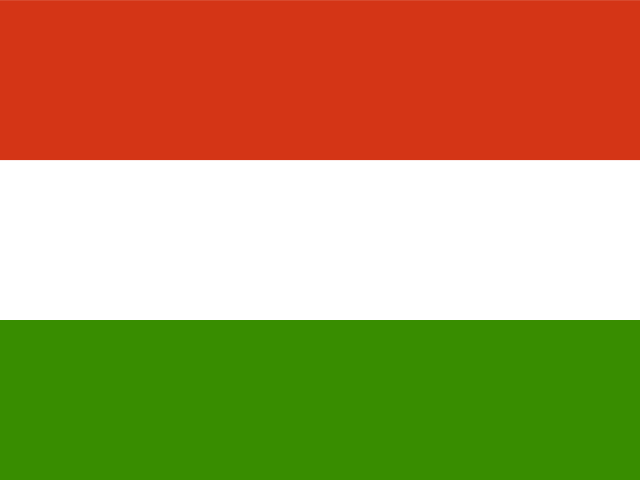
The Flag of Hungary
Europe · Adopted 23 May 1957 (proportions and colors trace to 1848; medieval origins for the color trio)
Hungary's red-white-green horizontal tricolor descends from the country's medieval coat of arms, which by the 15th century combined a red-and-white striped shield (the Árpád stripes, associated with Hungary's founding royal dynasty) with a green triple-mound topped by a crown — the three colors of that coat of arms were gradually abstracted into a plain tricolor flag over the following centuries, a slower and less deliberately 'designed' origin than many European tricolors that trace to a single specific revolutionary moment.
The tricolor took its modern horizontal form and rose to full national prominence during the Hungarian Revolution of 1848–49, when Hungarian reformers and nationalists rose against Habsburg Austrian rule seeking independence and a constitutional government; the plain red-white-green flag, without any royal crest or Habsburg symbol attached, became the banner of that uprising specifically because it represented Hungarian nationhood stripped of any reference to Habsburg authority — a deliberate rejection, through simple color choice, of the crowned coat-of-arms version tied to the Austrian-linked monarchy.
The 1848–49 revolution was ultimately crushed by combined Austrian and Russian imperial forces, but the plain tricolor survived as a national symbol through the following decades of the Austro-Hungarian Empire (1867–1918) and reemerged as the flag of independent Hungary after the empire's collapse at the end of the First World War, with the state's central coat-of-arms emblem added to or removed from the flag's center repeatedly over the following century depending on the government of the day.
Hungary's 20th century produced one of the more visually dramatic examples of a flag as a live protest symbol anywhere in Europe: during the Hungarian Revolution of 1956 against Soviet-backed communist rule, protesters cut the communist-era coat of arms (a hammer, wheat sheaf, and red star) out of the center of the state flag, carrying the plain tricolor with a visible hole where the emblem had been as an immediate, improvised, and unmistakable symbol of rejecting Soviet authority — an image that remains one of the most recognizable of the entire uprising and is still widely reproduced in Hungary today.
After the 1956 revolution was suppressed, the reconstituted communist government adopted a new, less overtly Soviet-styled coat of arms in 1957, but crucially chose — in a partial concession to how strongly Hungarians had reacted against having any state emblem on the flag at all — to drop the coat of arms from the flag itself and fly the plain red-white-green tricolor as the sole official state flag, the version that has remained in continuous use since, including after communism's end in 1989–90 and the writing of Hungary's post-communist and, later, 2011 constitutions.
Hungarian tradition assigns strength (red), fidelity or loyalty (white), and hope (green) as the individual colors' popular meanings, an association promoted especially since the 19th century, though — as with several older European tricolors whose colors originated from a coat of arms rather than a deliberately designed symbolic scheme — these specific meanings are a later civic gloss rather than the founding rationale for choosing those particular colors in the Middle Ages.
The flag's ratio and exact color shades are specified in Hungarian law, and the plain tricolor is distinguished from the ceremonial state flag, which adds Hungary's Holy Crown-topped coat of arms, used on more formal or governmental occasions rather than as the everyday civil flag.
Hungary's brief 1919 communist government, the short-lived Hungarian Soviet Republic under Béla Kun, flew its own plain red flag rather than the national tricolor during its few months in power that year, a period Hungarians generally treat as a separate, ideologically distinct episode from the tricolor's own continuous story rather than as an interruption to it, since the tricolor returned within the same year once that government collapsed.
Hungary's flag is displayed with particular ceremony on 15 March, commemorating the start of the 1848 revolution, and on 23 October, marking the 1956 uprising — the same anniversary photographed so memorably with its center cut out — both dates chosen specifically because each is tied directly to a moment when Hungarians rallied around the plain tricolor as a symbol of resistance to foreign or authoritarian rule.
Hungary's coat of arms — the version added to the more formal state flag rather than the plain civil tricolor — itself carries a layered history distinct from the flag's own: it combines the medieval Árpád stripes with a separate double cross on a green triple mound, and the exact form of that crest was itself a matter of genuine post-communist debate in 1989-90, when Hungarian lawmakers had to decide, in the transition away from the Soviet-style hammer-and-wheat-sheaf emblem, whether to restore a crowned or uncrowned version of the historic arms, ultimately settling on the crowned form despite Hungary having been a republic rather than a monarchy since 1946.
Photographs of the bullet-riddled, hole-punched 1956 tricolor remain among the most reproduced images of 20th-century Hungarian history, and a stylized version of that pierced flag has since become a semi-official visual shorthand for the uprising itself, appearing on commemorative stamps, monuments, and school textbook covers well beyond any single anniversary.
Three plain horizontal bands
- Stitched horizontal-band flag — The page is explicit that the flag carries no crest of any kind, so a listing showing a shield in the middle is selling something else, and the only accuracy left is in the band widths.
As an Amazon Associate we earn from qualifying purchases made through these links, at no extra cost to you.
Often confused with
- Italy — shares the same three colors but arranges them vertically rather than horizontally, and swaps the order — Hungary's is red-white-green top to bottom, while Italy's is green-white-red left to right, a common source of confusion for people who half-remember 'Hungary has an Italian-style flag.' Compare side by side →
- Bulgaria — uses the same horizontal white-green-red-adjacent color set but in a different arrangement (white-green-red rather than Hungary's red-white-green), an example of neighboring European states landing on overlapping but distinct tricolor recipes independently. Compare side by side →
Hungary at a glance
- Capital
- Budapest
- Population
- 9.6 million (2024)
- Currency
- Hungarian Forint (HUF)
- Language(s)
- Hungarian (official)
Population figure as of 2024, source: UN World Population Prospects (2024 revision). See methodology for how facts are sourced and kept current.