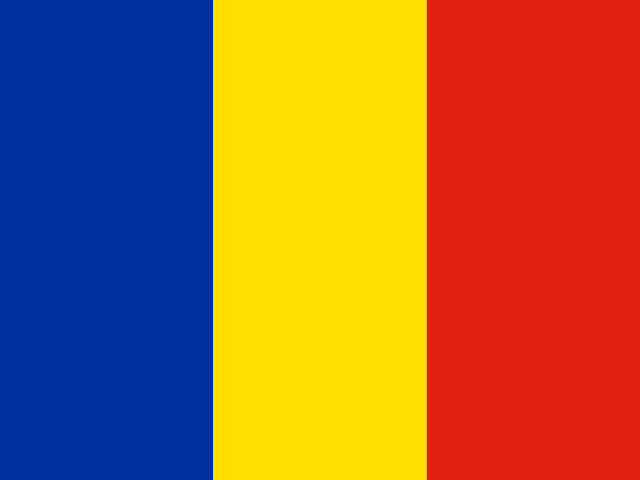
The Flag of Romania
Europe · Adopted 27 December 1989
Romania's blue-yellow-red vertical tricolor became official in its current, plain form on 27 December 1989, five days after Nicolae Ceaușescu's communist regime fell in the Romanian Revolution — one of the most direct and visually striking transitions of power symbolized by a flag anywhere in recent history. Protesters in Timișoara and Bucharest had literally cut the communist coat of arms out of the center of the existing state flag with scissors and knives as the revolution unfolded, carrying the resulting tricolor-with-a-hole through the streets; that improvised, punctured flag became one of the enduring images of the uprising before the new government formally adopted the plain tricolor, without any central emblem at all, as the country's flag days later.
The tricolor itself long predates 1989. Blue, yellow, and red first appeared together as a Romanian national symbol during the 1848 revolutions that swept much of Europe, when reformist movements in the historical principalities of Wallachia and Moldavia — the two territories whose 1859 union under Alexandru Ioan Cuza created the modern Romanian state — adopted the three colors as a shared symbol of national aspiration. A popular tradition holds that each color originally represented one of the historical Romanian principalities (Moldavia, Wallachia, and Transylvania), though as with many such tidy origin stories, that specific one-color-per-region reading is a later simplification rather than a documented 1848 design rule; what is well established is that blue-yellow-red as a set was already circulating as a revolutionary and unionist symbol decades before Romania's modern borders existed.
The communist state that ruled Romania from 1947 to 1989 kept the same blue-yellow-red field but added a state emblem to the center — a coat of arms featuring a sun rising over mountains and forests, industrial and agricultural symbols, and a red star, changed in its exact details several times as the regime's iconography evolved over four decades. Removing that emblem entirely in 1989, rather than replacing it with a new one, was itself a statement: the new government chose a plain tricolor specifically to avoid handing the country another centrally imposed symbol so soon after tearing the last one out by hand.
Romania's tricolor is functionally identical in color scheme and rough proportions to the flag of Chad, a resemblance so close that it has become one of the most frequently cited 'same flag, different country' pairs in vexillology, despite the two nations having no historical connection whatsoever — Chad adopted its flag in 1959 upon independence from France, developed independently of Romania's much older 19th-century tricolor tradition. The distinction usually cited is that Chad's blue is officially a slightly darker shade than Romania's, though the difference is subtle enough to be nearly imperceptible without the flags side by side, and it has periodically generated minor diplomatic notice — Chad's government lodged an informal complaint in 2004 after Romania used a similar tricolor design in an unrelated context, though no formal resolution or redesign followed from either side.
Romania's flag is also visually close to Moldova's, but for a genuinely different reason than the Chad coincidence: Moldova's tricolor uses the identical blue-yellow-red arrangement because most of modern Moldova was the Romanian region of Bessarabia before Soviet annexation in 1940, and Moldova's 1990 flag was a deliberate statement of that shared heritage. Spotting the difference comes down to a single detail: Moldova adds a golden eagle bearing an aurochs-head shield across its yellow stripe, while Romania's tricolor stays completely unadorned.
The precise legal shades of blue, yellow, and red, along with the flag's 2:3 proportions, were fixed by Law no. 75/1994, formalizing details that had been used consistently but not always precisely standardized in the years immediately after the 1989 revolution.
Romania's own communist-era predecessor state had already gone through several flag variants before 1989, changing the details of its central state emblem more than once as party leadership shifted — the sun-over-mountains emblem used in the flag's final Ceaușescu-era form was itself a replacement for an earlier, more explicitly Soviet-style coat of arms used in the years immediately following the 1947 abolition of the monarchy, meaning the tricolor that emerged unmarked in 1989 had actually carried at least three visibly different central emblems across four decades of communist rule before protesters cut the last one out entirely.
The flag flies nationwide and is especially prominent on National Day, 1 December, marking the 1918 union of Transylvania with the Kingdom of Romania, and on the anniversary of the 1989 revolution itself in late December, when the plain, unpunctured tricolor's origin as a literally cut-open communist flag remains part of the national memory of that week.
The blue that separates it from Chad's
- Dyed-through flag — The page says the two designs are functionally identical apart from shade, which makes the depth of the blue the only thing distinguishing them, and a pale printed blue removes even that.
As an Amazon Associate we earn from qualifying purchases made through these links, at no extra cost to you.
Often confused with
- Moldova — carries an eagle-and-shield emblem, drawn from a medieval principality seal, that Romania's own tricolor left off entirely when protesters cut its last state emblem out in 1989. Compare side by side →
- Chad — reads its own colors independently of Romania's — blue for sky and hope, yellow for the Sahara sun, red for the blood spent winning independence from France in 1960 — despite the near-identical field. Compare side by side →
Romania at a glance
- Capital
- Bucharest
- Population
- 19.0 million (2024)
- Currency
- Romanian Leu (RON)
- Language(s)
- Romanian (official)
Population figure as of 2024, source: UN World Population Prospects (2024 revision). See methodology for how facts are sourced and kept current.