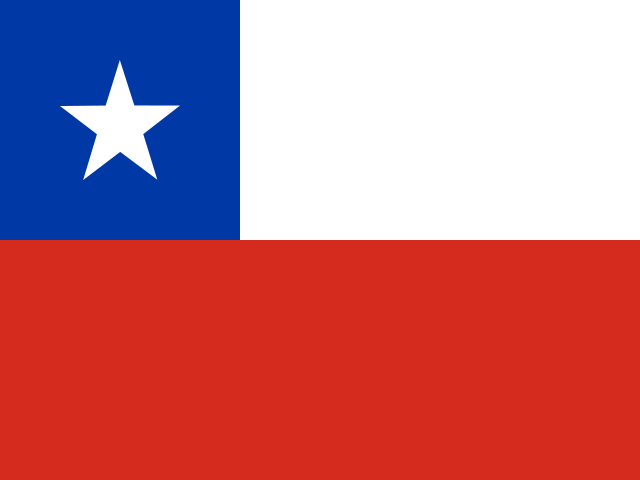
The Flag of Chile
South America · Adopted 18 October 1817
Chile's flag was adopted by decree on 18 October 1817, roughly a year after Spanish royalist forces were finally pushed back for good following the crossing of the Andes by the combined Chilean-Argentine Army of the Andes under José de San Martín and Bernardo O'Higgins. It was the third flag Chile had used in under a decade of revolutionary turmoil, following an earlier blue-white-yellow horizontal tricolor flown from 1812 during the short-lived period patriotic historians call the Patria Vieja, and a transitional flag used briefly after the 1814 royalist reconquest before Chile's independence movement regrouped in exile in Argentina.
The design is usually credited to José Ignacio Zenteno, O'Higgins's minister of war, who is said to have worked with input from Antonio Arcos, a Spanish-born military engineer who had defected to the patriot cause and had prior experience helping design military insignia; the exact division of credit between the two men is not settled in Chilean historical sources, and O'Higgins himself, as head of state, had final approval over the design that was adopted.
Two equal horizontal stripes, white over red, fill the bottom two-thirds of the flag, while a blue square in the upper hoist corner — sized to match the height of the white stripe — carries a single white five-pointed star. White is generally explained as representing the snow-capped peaks of the Andes that form Chile's eastern border for its entire length, and blue as the sky above them; red's meaning is usually given as honoring those who died fighting for independence from Spain, a reading taught in Chilean schools without a single fixed official wording, since no surviving 1817 decree spells out the color symbolism in binding legal language.
The single star is popularly called La Estrella Solitaria, the Lone Star, and it is described in Chilean civic tradition as guiding the nation toward progress and honor rather than representing any specific state, province, or historical event the way stars sometimes do on other national flags — a deliberately singular symbol for a country that, unlike federations such as Brazil or the United States, had no internal states to enumerate on its flag.
Chile's lone-star design predates the far more internationally famous Texas "Lone Star Flag" by about two decades: Chile adopted its star-bearing flag in 1817, while the Republic of Texas did not adopt its own blue-white-red lone-star banner until 1839. A popular story links the two directly, holding that a Texan or Texan-affiliated printer or soldier had seen or handled a Chilean flag and borrowed the lone-star motif for the Texan design; the claim circulates widely in both countries' flag folklore but is not backed by documented evidence connecting the two design processes, and most vexillologists treat it as an appealing but unproven legend rather than an established fact — the resemblance may just as easily be coincidental, since a single star on a colored field is a fairly natural heraldic choice that other flags, including Liberia's, arrived at independently.
Chile's flag is sometimes casually described in English-language sources as a near-copy of Texas's, when in fact the layout differs in a detail that matters heraldically: Chile's canton sits only in the upper hoist corner above two full-width stripes, while Texas's blue vertical band runs the entire height of the flag beside its own white-over-red horizontal stripes — a genuinely different structure that the shared "lone star" language tends to obscure in popular comparison.
Chile did not seriously alter the 1817 design after adoption, unlike many of its South American neighbors, which cycled through multiple full redesigns across the 19th century; small legal refinements followed instead, including decrees over the decades that fixed exact proportions (a 2:3 ratio, with the blue canton occupying one-third of the flag's width and the full height of the white stripe) and specified the precise shades of blue and red to be used on flags flown by the state.
O'Higgins, who approved the flag as Chile's first Supreme Director, had spent years in exile in Argentina after the 1814 royalist victory at the Battle of Rancagua before returning with San Martín's army to secure Chile's independence at the Battle of Chacabuco in February 1817 and, more decisively, at Maipú the following year — meaning the flag he approved in October 1817 was adopted in the interval between those two battles, while Chilean independence was still being actively fought for rather than already secured.
The Chilean flag carries strict protocol under national law: it is flown daily above government buildings and schools, desecration is a punishable offense, and 9 July is observed as the Day of National Flags (Día de las Glorias del Ejército and related civic observances involve the flag prominently), while the broader Fiestas Patrias around 18 September, marking the anniversary of the 1810 first governing junta, is when the flag is most visibly displayed by ordinary households across the country, often for the entire month of September rather than a single day.
Because red-white-blue with a star recurs on several unrelated flags worldwide, Chile's design is occasionally mixed up in casual conversation not only with Texas's but with other lone-star or star-and-stripe combinations entirely outside the Americas, even though the specific combination of proportions, canton placement, and single star Chile settled on in 1817 remains, among South American flags, essentially unique to Chile itself.
A canton one third across
- Geometry-accurate flag — The blue square covers a third of the length and only the depth of the white band, not the full height, which is precisely the detail that separates it from designs it gets compared with.
As an Amazon Associate we earn from qualifying purchases made through these links, at no extra cost to you.
Often confused with
- Liberia — also places a single white star inside a blue canton, but Liberia's canton sits on a field of eleven red-and-white stripes rather than Chile's plain white-over-red halves, and the two designs arose independently — Liberia's from American Colonization Society settlers in the 1820s, Chile's from its own 1817 independence-era decree. Compare side by side →
- Cuba — shares a red-white-blue palette and a single white star, but Cuba's star sits inside a red triangle at the hoist over five blue-and-white stripes, a completely different layout from Chile's two-stripe field with a star-bearing canton, and the resemblance is coincidental rather than historically linked. Compare side by side →
Chile at a glance
- Capital
- Santiago
- Population
- 19.6 million (2024)
- Currency
- Chilean Peso (CLP)
- Language(s)
- Spanish (official); Mapudungun and other Indigenous languages spoken by minorities
Population figure as of 2024, source: UN World Population Prospects (2024 revision). See methodology for how facts are sourced and kept current.