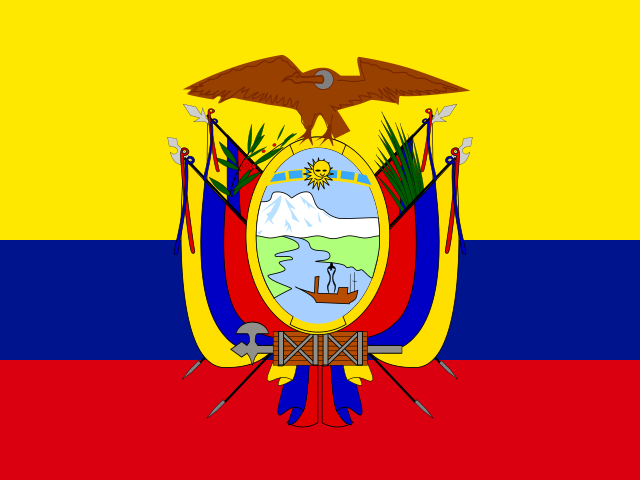
The Flag of Ecuador
South America · Adopted 26 September 1860 (tricolor readopted); 1900 (present coat of arms fixed)
Ecuador's relationship with its own flag has been unusually unsettled compared with its neighbors. When Gran Colombia broke apart in 1830, the new Ecuadorian state actually dropped the yellow-blue-red tricolor it had inherited and flew a blue-white-blue banner instead, a design echoing the sun flags used further south in Argentina and Chile. That blue-white-blue flag lasted only a handful of years before Ecuador reversed course and returned to the Miranda-derived tricolor its neighbors Colombia and Venezuela had kept, formally readopting it in 1860 after the Marcist Revolution of 1845 had already reintroduced yellow, blue, and red as the country's colors of choice.
Unlike Colombia and Venezuela, which both maintain a plain civil flag without state symbols for everyday citizen use, Ecuadorian law requires the national coat of arms to appear on every flag flown in the country, government or private. That is the single fastest way to tell Ecuador's flag apart from its two tricolor cousins at a glance: if there's no emblem in the center, it isn't Ecuador's flag.
The coat of arms itself is dense with specific national references rather than generic heraldry. A condor with outstretched wings sits at the top, representing both power and the Andean highlands the bird patrols. Below it, a steamship sails the Guayas River in front of Mount Chimborazo, Ecuador's highest peak — the steamship recalls the Guayas, the first steam-powered vessel built in South America, launched from Guayaquil in 1841. Above the whole scene, a golden sun is ringed by the zodiac signs for March through July, the months spanning the 1845 Marcist Revolution against the rule of General Juan José Flores, tying the emblem directly to a specific, dated political event rather than an abstract ideal.
The colors carry their own separately taught meanings: yellow for the fertility of Ecuador's agricultural land and its mineral wealth, blue for the sky and the two oceans bordering the wider Miranda-tricolor family of nations, and red for the blood of those who died fighting for independence — readings broadly similar to Colombia's and Venezuela's own traditions, since all three drew on the same 19th-century revolutionary vocabulary even as their flags diverged in detail.
Ecuador's coat of arms has itself been redesigned more than once since 1830, with the current version dating to a 1900 law under President Eloy Alfaro that fixed the condor, the sun, the steamship, and the surrounding fasces-and-laurel border in their present arrangement. Minor stylistic adjustments to the emblem's rendering followed in the 20th century, but the 1900 composition has held since.
Because Ecuador takes its name directly from the equator — the country straddles the line, and Quito itself sits only a short distance south of it — the flag is sometimes assumed to reference the equator symbolically. It doesn't; every element on it ties back to the 1845 revolution or to national geography rather than to Ecuador's namesake latitude.
The tricolor and its coat of arms are flown most visibly around Independence Day, 10 August, marking Quito's 1809 uprising against Spanish colonial rule — one of the earliest such declarations in Spanish South America, though full independence took another 13 years to secure.
Ecuadorian flag law also specifies stiff penalties for improper display or desecration, treating the flag with a level of legal formality that dates to the same reforms that fixed the coat of arms in 1900 — a period when Ecuador, like many young Latin American republics, was actively working to project settled national identity through precisely codified symbols rather than leave them to informal custom.
The blue-white-blue flag Ecuador briefly used between 1830 and roughly 1835 is largely forgotten outside specialist vexillology circles today, but it's a genuine reminder that Ecuador's commitment to the yellow-blue-red tricolor wasn't automatic after Gran Colombia's collapse — the country tried an entirely different design first and only returned to the Miranda-derived colors after the political and symbolic pull of the wider Bolivarian tradition, reinforced by the 1845 revolution, proved stronger than the appeal of a fresh start.
Ecuador's fixed 2:3 ratio and its requirement that the coat of arms appear on every flag, including those flown by private citizens outside their homes on national holidays, mean the emblem's fine detail — the condor's feathers, the ship's rigging, the individual zodiac signs ringing the sun — has to be rendered even on mass-produced flags sold for ordinary public use, a manufacturing demand that Colombia and Venezuela's plain civil flags don't share, since their everyday versions carry no emblem at all.
The Cenepa War of January–February 1995, a brief but intense border conflict with Peru over a disputed stretch of Amazonian frontier that both countries' maps had drawn differently for decades, saw Ecuador's flag flown prominently at military positions along the contested Cenepa River valley; the conflict ended in a ceasefire and was ultimately resolved through a 1998 peace treaty that fixed the border after more than 150 years of intermittent dispute between the two nations.
The arms go on every version
- Flag with the arms — Unlike its two neighbours with the same three bands, this flag is specified to carry the emblem on every version including the one flown at home, so a plain tricolour is not it.
As an Amazon Associate we earn from qualifying purchases made through these links, at no extra cost to you.
Often confused with
- Colombia — shares the same yellow-blue-red colors from the 1806 Miranda banner, but Colombia's civil flag omits any coat of arms while Ecuadorian law requires the emblem on every flag flown. Compare side by side →
- Venezuela — uses the same three colors but arranges them in closer-to-equal horizontal thirds and adds a row of stars across the blue band that Ecuador's flag has never carried. Compare side by side →
Ecuador at a glance
- Capital
- Quito
- Population
- 18.2 million (2024)
- Currency
- United States Dollar (USD) — Ecuador dollarized its economy in 2000
- Language(s)
- Spanish (official); Kichwa and Shuar hold official status for intercultural relations
Population figure as of 2024, source: UN World Population Prospects (2024 revision). See methodology for how facts are sourced and kept current.