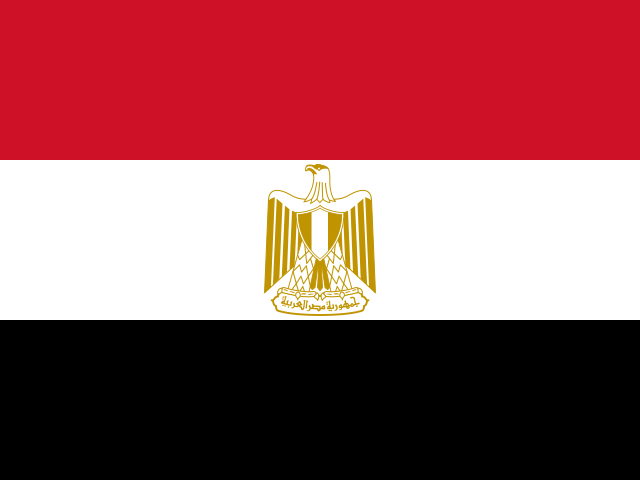
The Flag of Egypt
Africa · Adopted 4 October 1984
Egypt's current flag — red, white, and black horizontal bands with the Eagle of Saladin in gold centered on the white stripe — was adopted on 4 October 1984, but the red-white-black tricolor beneath it traces back to the 1952 Egyptian revolution that overthrew King Farouk and, before that, to the flag of the 1919 revolution against British rule, which used the same colors in a different arrangement with a crescent and three stars.
The red, white, and black tricolor is the pan-Arab palette, drawn from the flag of the 1916 Arab Revolt against Ottoman rule, and Egypt has used some version of this three-color scheme, in various combinations with green, a crescent, an eagle, or stars, on nearly every flag it has flown since the monarchy fell in 1952 — red for the struggle against British occupation and the monarchy, white for the bloodless nature of the 1952 revolution, and black for the era of oppression that revolution ended.
The Eagle of Saladin at the center is Egypt's own contribution to that shared pan-Arab palette, and its presence and exact rendering have shifted with Egypt's changing political unions: under the United Arab Republic (Egypt's 1958–1961 union with Syria) the flag carried two green stars instead of an eagle; after Egypt joined the short-lived Federation of Arab Republics with Libya and Syria in 1972, the flag switched to the golden Hawk of Quraish, a different heraldic bird tied to that federation; only in 1984, well after that federation had effectively dissolved, did Egypt return to the Eagle of Saladin specifically, a symbol referencing the 12th-century Muslim leader who founded the Ayyubid dynasty and is closely associated with Egyptian and broader Arab historical memory of resisting the Crusades.
The eagle holds a scroll in its talons bearing the country's official name in Arabic, and a shield on its chest carrying a smaller version of the flag's own color pattern — a self-referential detail found on relatively few national flags, where the emblem itself echoes the flag it sits on. Readers curious how eagle emblems get chosen elsewhere — the double-headed eagles of the Balkans, or the single eagles on flags from Mexico to Kazakhstan — can find a broader survey of eagle symbolism on our sister site SymbolHubs, which digs into the specific legends and empires behind each lineage.
Because Egypt has changed its central emblem multiple times since 1952 while keeping the same red-white-black base, the flag's history reads almost like a timeline of Egypt's shifting alliances within pan-Arab politics — from Nasser's UAR union with Syria, through Sadat's short-lived federation with Libya and Syria, to the more independent-minded emblem chosen under Hosni Mubarak in 1984 that has remained ever since, surviving the 2011 revolution and subsequent political upheaval without a redesign.
Because red-white-black tricolors with a central emblem recur across several Arab Revolt-descended flags, Egypt's flag is sometimes grouped visually with Yemen's, Syria's, or Iraq's in casual comparison, though each of those uses a different emblem or star arrangement — Egypt's gold eagle is its most immediately distinguishing feature among that family.
Egypt's pre-1952 flags looked entirely different: the Kingdom of Egypt (1922–1953) flew a green flag with a white crescent and three white stars, itself a successor to the flag of the earlier Sultanate and Khedivate of Egypt under nominal Ottoman suzerainty — meaning the modern red-white-black design represents a genuine and complete break from Egypt's monarchical-era flag tradition, not a modification of it.
The 1958–1961 United Arab Republic period is particularly significant to Egyptian flag history because it briefly extended beyond Egypt's own borders: Syria adopted the same red-white-black-with-two-stars flag as a full political merger with Egypt under Gamal Abdel Nasser, and even after the union dissolved in 1961 following a Syrian military coup, Egypt kept flying the two-star UAR flag alone under its official name 'United Arab Republic' for several more years, only formally renaming itself the Arab Republic of Egypt and shifting to the Hawk of Quraish in 1971–1972.
Egypt's national flag law specifies the exact placement and proportions of the Eagle of Saladin relative to the three horizontal bands, and the flag is flown at half-mast during official periods of national mourning, most visibly and recently following the deaths of former presidents and other state occasions, a formal protocol overseen by Egypt's Ministry of Defense given the flag's military as well as civilian ceremonial roles.
Revolution Day, 23 July, commemorating the 1952 overthrow of the monarchy that set Egypt on the path to its current red-white-black tricolor tradition, remains one of the flag's most prominent annual public occasions, alongside 25 January, marking the start of the 2011 uprising that ended Hosni Mubarak's three-decade presidency without triggering any change to the flag itself.
Egypt's flag is manufactured to a 2:3 construction ratio, and government specification places the Eagle of Saladin at a fixed proportional size relative to the white band it sits on, ensuring the emblem remains legible even at the smaller scale used on vehicle plates, military uniforms, and diplomatic stationery — a level of technical precision the government has maintained consistently since the design's 1984 codification under President Hosni Mubarak.
Egypt's status as the most populous Arab nation and one of the founding members of the Arab League in 1945 has repeatedly put its flag at the symbolic center of pan-Arab politics, from the UAR merger with Syria through Cairo's long-running role hosting Arab League headquarters (interrupted only during a 1979–1989 suspension after Egypt's peace treaty with Israel, when the League's seat moved temporarily to Tunis) — a controversy that, notably, did not touch the flag's own design even as it isolated Egypt diplomatically within the Arab world for a decade.
The eagle on both faces
- Double-sided flag — The page describes an emblem whose position and proportions are fixed relative to the bands; a bird facing one way on the front and the other way from behind is exactly the mismatch a two-layer flag avoids.
As an Amazon Associate we earn from qualifying purchases made through these links, at no extra cost to you.
Often confused with
- Yemen — shares the same red-white-black horizontal tricolor drawn from the same 1916 Arab Revolt palette, but Yemen's flag carries no central emblem at all, leaving the white band plain. Compare side by side →
- Syria — uses the same red-white-black base with a central emblem on the white stripe, but Syria's emblem is a pair of green stars rather than a gold eagle. Compare side by side →
Egypt at a glance
- Capital
- Cairo
- Population
- 116.5 million (2024)
- Currency
- Egyptian Pound (EGP)
- Language(s)
- Arabic (official); English and French widely understood in business and tourism
Population figure as of 2024, source: UN World Population Prospects (2024 revision). See methodology for how facts are sourced and kept current.