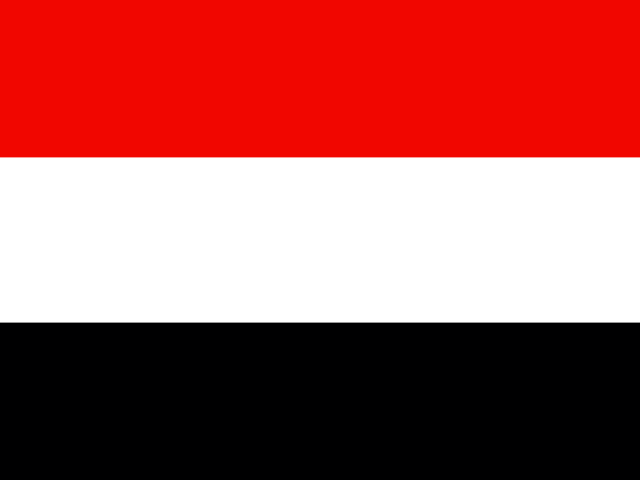
The Flag of Yemen
Asia · Adopted 22 May 1990
Yemen's plain red-white-black tricolor was adopted on 22 May 1990, the day the previously separate states of North Yemen (the Yemen Arab Republic) and South Yemen (the People's Democratic Republic of Yemen) formally merged into a single Republic of Yemen after decades of division, rivalry, and periodic border conflict. Rather than combining or blending the two states' prior flags, the newly unified country adopted a fresh design stripped down to the bare three-stripe Pan-Arab palette with no emblem, star, or crest of any kind — one of the simplest national flags in the Arab world.
Both pre-unification Yemeni states had already been using flags built from the same Pan-Arab red-white-black-green color family, which traces to the 1916 Arab Revolt flag against Ottoman rule: North Yemen's flag was a red-white-black tricolor with a green star centered on the white stripe, while South Yemen's was a red-white-black tricolor with a blue triangle and red star at the hoist, reflecting its Marxist government's socialist-aligned symbolism. The 1990 unification flag essentially took the shared tricolor base both states already had and removed each side's distinguishing addition, a genuinely diplomatic design choice rather than a victory of one side's symbolism over the other's.
Because the design dropped every regime-specific emblem, the new flag also carried a deliberate message: neither North nor South Yemen's political system, symbols, or historical claims would be treated as senior to the other's in the newly unified state, even though in practice the unification process was heavily dominated by the North's government and leadership under Ali Abdullah Saleh, who became president of unified Yemen and would go on to rule for decades.
The colors follow the standard Pan-Arab symbolic readings used across the region: red for the blood and sacrifice of struggle (in Yemen's case tied to both the North's 1962 revolution against the Zaidi imamate and South Yemen's own independence struggle against British colonial rule, which ended in 1967), white for a hoped-for peaceful and bright future, and black for the dark periods of colonial and autocratic rule the country had endured before both unification movements succeeded.
Yemen's civil war, which escalated dramatically from 2014 onward pitting the internationally recognized government against Houthi rebel forces (who also claim separate territorial and political legitimacy) and, at various points, southern separatist movements seeking to revive an independent South Yemen, has not produced an official change to the national flag; the plain red-white-black tricolor remains the internationally recognized flag of Yemen, used by the government based (as of recent years) largely out of Aden and internationally recognized institutions, even as competing political and military factions on the ground sometimes display older regional or factional banners.
Because it is one of the simplest possible tricolors within the Pan-Arab palette, Yemen's flag closely resembles Syria's flag as Syria's was configured from 1980 until early 2025 (also red-white-black, though Syria's carried two green stars during that period) and Egypt's flag minus its central eagle emblem, making it one of the more visually ambiguous flags in the region when reduced to a small icon or seen without additional context.
Yemen's constitution and subsequent legislation formalize the flag's exact proportions and color specifications, and Unity Day, 22 May, is observed annually to mark both the 1990 unification and the flag's adoption on the same date — one of relatively few countries where the national flag's founding anniversary is identical to the country's own founding anniversary, since both events happened simultaneously rather than the flag being designed separately before or after statehood.
South Yemen's brief post-independence history is itself distinctive within the Arab world: it was the only Arab state to adopt an explicitly Marxist-Leninist government, closely aligned with the Soviet Union from 1967 until unification in 1990, and its blue-triangle-and-star flag before 1990 was a deliberate departure from the more religiously and monarchically inflected symbolism used by many of its neighbors — context that makes the 1990 decision to strip away both sides' distinguishing emblems entirely, rather than picking one, a genuinely notable diplomatic choice.
Southern separatist movements that have gained territorial control in parts of southern Yemen amid the post-2014 civil war have, at various points, revived or referenced South Yemen's pre-1990 flag as a symbol of their aspirations for renewed southern independence, meaning that, much like in Syria, more than one flag currently carries active political meaning within Yemen's borders even though only the 1990 tricolor holds official international recognition.
North Yemen's own pre-1990 flag had already gone through several versions before the 1962 revolution against the Zaidi imamate settled on the red-white-black tricolor with a green star, including earlier plain-red and other imamate-era banners used by the ruling dynasty; the star itself was dropped from the design entirely when the two Yemens merged in 1990, meaning the modern unified flag's stripped-down simplicity is the product of two separate national symbol traditions each ultimately giving up their own distinguishing emblem for the sake of unification.
The 1990 unification and its shared flag came only four years before Yemen's brief 1994 civil war, when southern leaders attempted to secede and restore an independent South Yemen; that attempt was defeated by northern-led forces within a few months, and the unified red-white-black flag remained the country's sole official flag throughout, even as the underlying political tensions between the former North and South that the flag's stripped-down design had been meant to paper over persisted and would resurface again in the far larger conflict that began in 2014.
Three bands and nothing else
- Sewn three-band flag — With no emblem, star or crest anywhere on the cloth, the only thing a maker can get wrong is the band widths, so a stitched flag with three equal panels is the whole specification.
As an Amazon Associate we earn from qualifying purchases made through these links, at no extra cost to you.
Often confused with
- Syria — Syria's flag under Ba'athist rule (1980–2025) was the same red-white-black tricolor with two green stars added on the white stripe; Yemen's design has never carried any stars or emblem at all. Compare side by side →
- Egypt — shares the identical red-white-black stripe order and colors, but Egypt's flag centers the Eagle of Saladin on the white stripe, an emblem Yemen's flag has never included. Compare side by side →
Yemen at a glance
- Capital
- Sana'a
- Population
- 40.6 million (2024)
- Currency
- Yemeni Rial (YER)
- Language(s)
- Arabic (official)
Population figure as of 2024, source: UN World Population Prospects (2024 revision). See methodology for how facts are sourced and kept current.