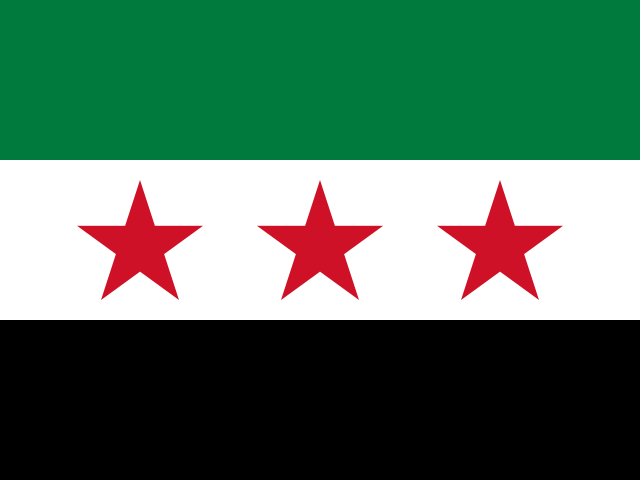
The Flag of Syria
Asia · Adopted 10 January 2025 (three-star green-white-black revived from the 1932–1958/1961–1963 flag)
Syria's current flag is not a new design at all — it is the revival of a flag Syria used twice before, first from independence-era 1932 (under French Mandate administration and then full independence in 1946) through the country's brief 1958 union with Egypt, and again from 1961 to 1963 after that union dissolved, before being replaced by the Ba'athist red-white-black flag that (with interruptions) governed Syria's official symbolism for six decades. Following the fall of the Assad government in December 2024, Syria's transitional authorities formally readopted the green-white-black three-star flag on 10 January 2025, explicitly rejecting the red flag associated with Ba'athist rule and the Assad family's 54 years in power.
This green-white-black-with-stars design belongs to the broader Pan-Arab color family — green, white, black, and red — drawn from the 1916 Arab Revolt flag against Ottoman rule, whose four colors are traditionally read as referencing different periods and dynasties of Arab history: black for the early Abbasid Caliphate, white for the Umayyad Caliphate, green for the Fatimid Caliphate (or, in some readings, for Islam and the Prophet's era generally), and red for the Hashemite dynasty and the bloodshed of Arab resistance to Ottoman rule.
The three green five-pointed stars across the white central stripe have historically been read as representing Syria, Egypt, and (in some accounts) Iraq or the aspiration toward wider Arab unity dating to the flag's original 1958–1961 use during the United Arab Republic union between Syria and Egypt, though during the 1932–1958 pre-union period the same basic tricolor was used with different star counts and the stars' meaning has shifted somewhat with each revival.
The red flag it replaced — red, white, black horizontal stripes with two green stars — was adopted in 1980 under Hafez al-Assad's government, modeled on the Ba'ath Party's own flag colors and closely resembling both Egypt's and Iraq's Ba'athist-era flags, part of a deliberate mid-20th-century pattern of Arab nationalist states adopting near-identical red-white-black tricolors to signal shared Ba'athist or Pan-Arab nationalist ideology across borders.
During Syria's civil war, which began in 2011, the green-white-black three-star flag was adopted by the Syrian opposition and various rebel factions as an explicit rejection of the Assad government's red flag, meaning that for well over a decade the two flags flew simultaneously as rival political symbols — the red flag over government-held territory and the green flag over opposition-held areas and among the Syrian diaspora — before the opposition's flag became the country's sole official flag following the government's fall in December 2024.
Because the transition happened so recently, some Syrian institutions, diaspora communities, and international bodies took months to fully switch official usage from the red flag to the green one, and residual red-flag imagery still appears in older government archives, some remaining pro-Assad-aligned areas in the immediate post-2024 period, and historical references — a reminder that Syria's flag has changed formal status five separate times since 1932 (1932, 1958, 1961, 1980, 2025), an unusually turbulent history even among Arab states whose flags have generally been more stable.
Because it draws from the same 1916 Arab Revolt color palette, Syria's flag shares its green-white-black-red vocabulary with several neighboring states' flags, even though each nation's specific striping, star count, and symbolism differ — a family resemblance rooted in shared Arab nationalist history rather than any one country copying another.
The 1932–1958 version of the tricolor was itself adopted under French Mandate administration, which had governed Syria since the League of Nations mandate system carved up former Ottoman Arab territories after World War I; even under French oversight, the local Syrian government of the period was permitted its own flag distinct from the French tricolor, a compromise typical of League of Nations mandate arrangements that formally recognized local governance while retaining ultimate French control until independence was fully achieved in 1946.
Because Syria's flag has changed formal status so many times within a single century, older Syrians and the Syrian diaspora frequently associate specific flag versions with specific eras of their own lived political history in a way citizens of more flag-stable countries rarely experience — the 1958–1961 flag with the short-lived pan-Arab union with Egypt, the 1980 red flag with over four decades of Assad family rule, and the green flag both with pre-Ba'athist independence-era Syria and, more recently, with the post-2011 opposition and the country's 2024–2025 political transition.
International recognition of the flag change was not instantaneous either: the United Nations and most foreign governments updated their official Syria flag references only gradually through the first half of 2025 as the transitional government consolidated control and sought formal diplomatic recognition, illustrating how a flag change tied to abrupt regime change can take considerably longer to fully propagate through international institutions than the domestic adoption date itself might suggest.
Syria's flag geometry itself has stayed simple across every version since 1932 — plain horizontal stripes with no more than a small number of stars, never a crest, animal, or other elaborate emblem — a relative visual restraint compared with some neighboring Arab states' flags, even as the political meaning attached to that simple design has shifted dramatically with each change of government.
Often confused with
- Yemen — shares the red-white-black horizontal tricolor Syria used from 1980–2025, though Yemen's has never carried stars — a coincidence of Pan-Arab color reuse rather than direct imitation. Compare side by side →
- Iraq — Iraq's Ba'athist-era flag (used 1963–1991 in a form nearly identical to Syria's pre-2025 flag) shared the same red-white-black stripes and green stars, both drawing on Ba'ath Party symbolism. Compare side by side →
Syria at a glance
- Capital
- Damascus
- Population
- 24.5 million (2024)
- Currency
- Syrian Pound (SYP)
- Language(s)
- Arabic (official); Kurdish, Armenian, and other minority languages spoken regionally
Population figure as of 2024, source: UN World Population Prospects (2024 revision). See methodology for how facts are sourced and kept current.