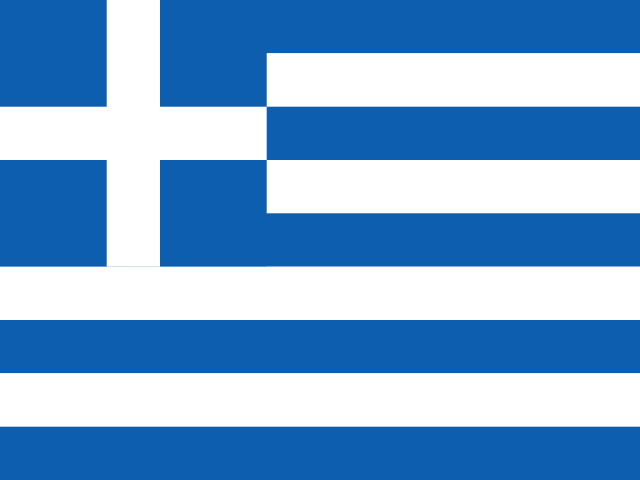
The Flag of Greece
Europe · Adopted 22 December 1978 (design dates to 13 January 1822, during the War of Independence)
Greece's flag was first formally adopted on 13 January 1822 by the First National Assembly at Epidaurus, less than a year into the Greek War of Independence against Ottoman rule that had begun in 1821 — a moment when the rebels badly needed a unifying national symbol distinct from the various local and regional banners individual insurgent bands had been flying up to that point. Nine horizontal stripes alternate blue and white, and popular tradition ties that number to the nine syllables of the Greek independence motto 'Eleftheria i Thanatos' ('Freedom or Death') — a mnemonic explanation that is widely taught in Greece today, though historians note the stripe count may also simply echo the nine letters some early accounts associated with 'Eleftheria' (freedom) itself, and no single 1822 document definitively settles which explanation the original designers intended.
A white cross sits in the canton (upper hoist corner) against a blue field, a specifically Orthodox Christian symbol referencing the Greek Orthodox Church's central role in preserving Greek identity, language, and community cohesion through nearly four centuries of Ottoman rule — during which the Church, more than any political institution, functioned as the connective tissue of Greek national identity when no independent Greek state existed at all.
For most of the 19th and 20th centuries, Greece actually flew two related but distinct flags side by side: the striped naval/state ensign used at sea and on official buildings, and a simpler plain blue field with a white cross used as the land or civil flag on Greek soil. This dual-flag system, unusual among nations, persisted for over 150 years and reflected a genuine practical distinction — the striped flag was more visible and distinguishable at sea from a distance, which mattered enormously for a maritime nation with one of the world's largest merchant shipping fleets, while the simpler cross flag sufficed on land.
The exact shade of blue has shifted over time and briefly became politically coded: the military junta that ruled Greece from 1967 to 1974 favored a lighter, brighter blue, which some Greeks after the junta's fall associated with the dictatorship years and began deliberately avoiding in favor of a darker navy shade once democracy was restored — though this was more an informal, gradually shifting popular preference than a change ever fixed precisely in law.
The dual land-and-sea flag system was formally abolished on 22 December 1978, when the government of Konstantinos Karamanlis designated the nine-striped blue-and-white flag with the canton cross as the single official flag for both land and sea use, retiring the plain cross-only civil flag — the date most commonly cited as Greece's official flag 'adoption,' even though the striped design itself long predates that decision by over 150 years.
The cross and the blue-white color pairing distinguish Greece's flag clearly from most of its Balkan and Mediterranean neighbors, though the specific blue-and-white combination is shared, coincidentally rather than by any historical connection, with several unrelated flags worldwide — a resemblance Greeks themselves rarely treat as a source of real confusion given how distinctive the striped-and-crossed design is as a whole.
Flag desecration is a criminal offense under Greek law, and the flag is flown with particular ceremony on 25 March, Greek Independence Day, which commemorates the 1821 uprising the flag itself was designed, within months, to represent.
The flag also carries real weight in Greece's modern relationship with Cyprus and the wider Greek-speaking world: variants of the same blue-and-white cross design, sometimes without the full nine stripes, have long been flown informally by Greek Cypriot communities and diaspora Greek associations abroad as a marker of shared Hellenic identity, distinct from but visually related to Cyprus's own official state flag, which deliberately avoids Greek (and Turkish) national colors altogether for its own separate political reasons.
One further wrinkle in the flag's history involves the 1967-74 military junta period specifically: the junta's government did not alter the flag's basic design but did promote its own preferred bright blue shade and used the flag heavily in state propaganda imagery, an association some older Greeks still recall when discussing why the darker navy shade became more culturally favored after democracy was restored in 1974 — a case where a flag's legal design stayed constant while its informal coloring carried real, if unofficial, political memory.
The nine-stripe pattern also distinguishes Greece's flag practically at sea and at a distance in a way a plain cross-only flag would not, a genuine functional consideration for a country whose shipping industry has long been one of the largest in the world by tonnage — Greek-owned or Greek-flagged vessels have represented a substantial share of global merchant shipping capacity for decades, giving the flag's maritime-optimized striped design an everyday practical role well beyond its symbolic one.
Modern Greek governments have occasionally revisited the flag's formal specifications purely for technical clarity, most notably issuing updated official Pantone-equivalent color guidance in later decades to standardize mass-produced flags sold commercially, which had drifted toward a wide range of blue shades once cheap synthetic dyes and overseas manufacturing became common from the late 20th century onward.
Counting the stripes
- Stripe-accurate flag — The stripe count is fixed and is the easiest check there is on a listing photograph: count the blue and white bands below the canton before buying, because reproductions do lose one.
As an Amazon Associate we earn from qualifying purchases made through these links, at no extra cost to you.
Often confused with
- Uruguay — also uses alternating blue-and-white horizontal stripes with a canton device, a resemblance that is coincidental rather than historically connected — Uruguay's design draws from the United States' stripe pattern and its own sun emblem rather than Greek influence. Compare side by side →
- Guatemala — shares no stripe pattern with Greece but is sometimes mentally grouped with other blue-and-white national flags; the resemblance is limited to the shared color pairing rather than layout. Compare side by side →
Greece at a glance
- Capital
- Athens
- Population
- 10.4 million (2024)
- Currency
- Euro (EUR)
- Language(s)
- Greek (official)
Population figure as of 2024, source: UN World Population Prospects (2024 revision). See methodology for how facts are sourced and kept current.