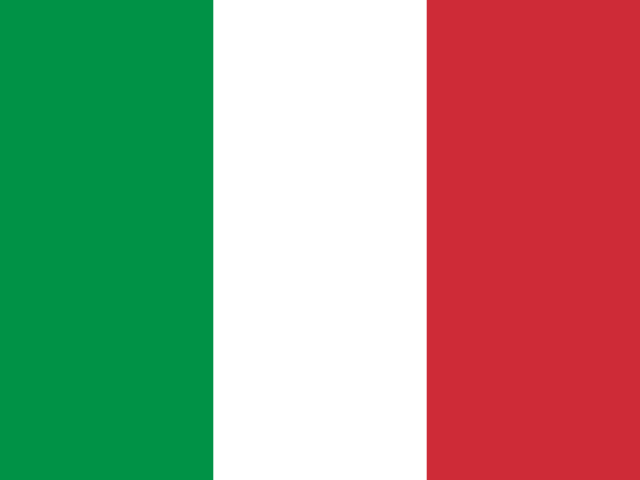
The Flag of Italy
Europe · Adopted 19 June 1946 (as flag of the Republic); original tricolor dates to 7 January 1797
Italy's tricolor is one of the oldest still-active flag designs in the world by direct lineage, dating to 7 January 1797, when the Cispadane Republic — a short-lived, French-backed republic covering parts of what is now Emilia-Romagna — formally adopted a green-white-red vertical tricolor as its official flag, making that date, rather than any moment of national unification, the flag's true origin point. The design was a deliberate, close imitation of the French Revolutionary tricolor, which the Cispadane Republic's Napoleonic-influenced founders regarded as the model banner of liberty and republican government sweeping across Europe at the time; the choice of green in particular is generally attributed to the color of the uniforms of the Milanese civic guard rather than to any older Italian symbolic tradition.
This origin directly contradicts a popular folk explanation still repeated informally today, which holds that green, white, and red were chosen to represent Italy's landscape and natural features — green for the hills and countryside, white for the snow-capped Alps, red for blood spilled in wars of unification or in some versions the fires of patriotism. That landscape story appears to be a later, retrospective gloss with no documented basis in the Cispadane Republic's actual 1797 deliberations; historians of Italian vexillology generally treat it as a folk etymology rather than the flag's real origin, in the same category as many popular but undocumented flag-color legends found elsewhere in Europe.
Through most of the 19th century, as various short-lived Napoleonic-era Italian republics rose and fell and the peninsula remained politically fragmented among competing kingdoms, the tricolor persisted as the recognized symbol of the broader Italian nationalist movement (the Risorgimento) even without a single unified Italian state to formally adopt it. When the Kingdom of Sardinia-Piedmont, under the House of Savoy, led the unification of Italy between 1859 and 1870, it added its own royal coat of arms — the white Savoy cross on a red shield — to the center of the white band, and that crowned, crested version became the flag of the unified Kingdom of Italy in 1861.
The Savoy crest remained on the flag through the kingdom's fall under Fascist rule (which kept the crested tricolor as the state flag while also flying separate Fascist Party banners) and through the Second World War, until the monarchy itself was abolished by popular referendum on 2 June 1946, when Italians voted to become a republic rather than retain the House of Savoy. The plain tricolor, with the royal emblem removed entirely, was adopted as the flag of the new Italian Republic on 19 June 1946, formally confirmed in the 1948 Republican Constitution — restoring, in effect, the unadorned 1797 Cispadane design a century and a half after it first flew.
Modern Italian law and design guidance specify the flag's exact proportions and preferred shades (a specific 'Italian green' and 'Italian red,' both deliberately somewhat darker and more muted than the brighter shades used on Ireland's, Mexico's, or Hungary's flags) precisely to help distinguish Italy's tricolor at a glance from the several other national flags that share the same three-color trio in a similar vertical layout.
Italy's tricolor is protected under national law against public desecration, and 7 January — the 1797 Cispadane adoption date, not any later unification-era date — is officially observed each year as Tricolour Day (Festa del Tricolore), a deliberate choice that anchors the flag's official commemoration to its true origin point rather than to the more commonly assumed 1861 unification date.
Because the vertical green-white-red tricolor pattern was itself directly inspired by, and structurally identical to, the French flag's layout, Italy's design sits at the head of a wider European family of tricolors that share the same basic structure while differing in specific colors — a lineage Italy shares most directly with Ireland (green-white-orange) and Mexico's later, unrelated adoption of the same three-color scheme in Latin America.
During the Fascist period (1922-1943), Mussolini's regime kept the Savoy-crested tricolor as the official state flag while promoting its own black Fascist Party banner alongside it for party functions, meaning Italy briefly flew two competing symbols in tandem, one representing the constitutional monarchy and one the ruling party — an arrangement that ended only with Mussolini's fall and, ultimately, the monarchy's own abolition in 1946.
Since 1946, Italian law has also codified a lesser-known distinction between the plain civil tricolor used by ordinary citizens and businesses and the state flag flown at government buildings and by the military, which adds a small central seal (the presidential coat of arms) not present on the everyday flag — a two-tier system that, while less visually dramatic than Germany's civil-versus-state distinction, follows a broadly similar postwar European pattern of separating simple national colors from more formal governmental emblazonment.
The Cispadane Republic that first adopted the tricolor in 1797 lasted barely a year before merging into the larger, Napoleon-backed Cisalpine Republic, which kept the same three colors but rearranged them briefly into a diagonal or differently proportioned pattern before Italian states reverted, across the following decades of political upheaval, to the vertical arrangement now recognized worldwide — meaning the flag's exact layout took a few more years after 1797 to fully stabilize even though its three colors were fixed from that first Cispadane decision onward.
Darker green and red than you expect
- Dyed-through flag — The specified shades are deliberately more muted than the bright primaries most reproductions reach for, and a flag printed in poster green and pillar-box red is visibly the wrong flag beside a correct one.
As an Amazon Associate we earn from qualifying purchases made through these links, at no extra cost to you.
Often confused with
- Mexico — uses the identical green-white-red vertical layout, a resemblance that is coincidental rather than historically connected — Mexico's flag adds a central coat of arms (an eagle on a cactus) that Italy's plain tricolor lacks, the clearest visual distinguisher between the two at a glance. Compare side by side →
- Ireland — shares the same green-and-white portion of Italy's tricolor and the identical vertical three-band structure descended from the same French Revolutionary tricolor tradition, but replaces Italy's red with orange, tied to entirely different national symbolism specific to Irish history. Compare side by side →
Italy at a glance
- Capital
- Rome
- Population
- 59.0 million (2024)
- Currency
- Euro (EUR)
- Language(s)
- Italian (official)
Population figure as of 2024, source: UN World Population Prospects (2024 revision). See methodology for how facts are sourced and kept current.