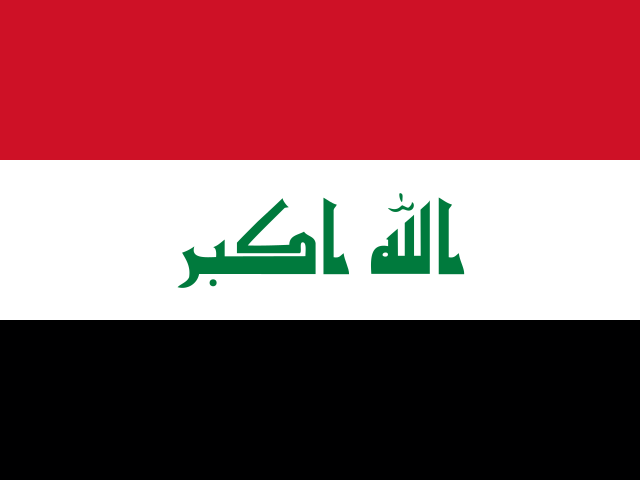
The Flag of Iraq
Asia · Adopted 22 January 2008
Iraq's current flag — a red-white-black horizontal tricolor with green Arabic script reading 'Allahu Akbar' (God is greatest) centered in the white band — was adopted on 22 January 2008, but it's the product of a longer and more politically fraught sequence of changes than almost any other national flag redesigned this century.
The base tricolor dates to 1963, when Iraq adopted the Pan-Arab colors used by several Arab nationalist states of the period, originally with three green five-pointed stars in the white band representing a hoped-for union of Iraq, Syria, and Egypt that never actually materialized. Those stars stayed on the flag for decades even after the union plan collapsed, simply as an inherited design element.
Saddam Hussein added the Takbir script to the flag in his own handwriting, according to widely repeated accounts, in January 1991 during the Gulf War — a move read at the time as an attempt to frame the conflict in religious terms and rally domestic and regional support. The three stars remained alongside the new script through the rest of Saddam's rule and the 2003 invasion.
After the 2003 fall of the Ba'athist government, Iraq's Governing Council proposed a genuinely new flag in 2004 — a light blue crescent and a blue stripe on a plain white field, designed by the Iraqi-American artist Rifat Chadirji — intended to break entirely with the Ba'athist-era design. The proposal was withdrawn almost immediately after it drew sharp public criticism for resembling Israel's flag in color and for abandoning the Pan-Arab colors and Islamic script entirely, and Iraq continued using the 1991 Saddam-era tricolor, stars included, for several more years by default.
The 2008 compromise, passed by Iraq's parliament under significant time pressure ahead of a planned Arab League summit in Baghdad, kept the red-white-black tricolor and the Takbir script but removed the three Ba'athist stars and restyled the script itself into a more standardized, uniform Kufic calligraphy rather than Saddam's personal handwriting — explicitly framed by lawmakers as a temporary, one-year fix pending a permanent design that, in practice, was never adopted, leaving the 2008 version as Iraq's flag ever since.
The choice to keep rather than remove the religious inscription made the 2008 flag more contested domestically than internationally; some Iraqi Kurdish and secular political factions objected to a national flag carrying explicit Islamic religious text, an objection that resurfaced periodically in parliament without ever producing a new redesign that could command enough political consensus to pass.
Because Iraq shares the same red-white-black Pan-Arab palette with several neighboring countries' flags, the Takbir script is now the fastest visual distinguisher of Iraq's flag from others using the same three colors in a similar horizontal arrangement, even though the script itself reads clearly only at close range.
Iraq's semi-autonomous Kurdistan Region, in the country's north, flies its own distinct regional flag — a red-white-green tricolor with a golden sun disc — alongside, and in some Kurdish government buildings in place of, the Iraqi national flag, a visible marker of the region's constitutionally recognized autonomy and a point of periodic friction between Erbil and Baghdad over which flag is displayed where.
The 2008 law that produced the current design was explicitly passed as a one-year interim measure meant to be replaced once Iraq's parliament could agree on a permanent post-Ba'athist flag; no such permanent redesign has passed in the years since, so what is officially still described in Iraqi law as a temporary compromise has instead become, by simple default and the absence of any successor legislation, Iraq's flag for well over a decade and a half.
Iraq's very first national flag, adopted in 1921 when the Kingdom of Iraq was established under British mandate, looked nothing like today's design: it used the black-white-green Arab Revolt tricolor with a red hoist triangle, closely related to Jordan's flag, since both states were founded around Hashemite rulers descended from Sharif Hussein's family. That monarchy-era flag was discarded entirely after the 1958 revolution that overthrew Iraq's Hashemite monarchy, at which point the country switched to the red-white-black Pan-Arab palette that, with modifications, has remained the basis of every Iraqi flag since.
Between 1963 and the 1991 addition of Saddam Hussein's Takbir script, Iraq's flag went through several minor emblem changes reflecting the country's shifting Pan-Arab political alliances and ambitions, including brief periods experimenting with a Federation of Arab Republics-style hawk emblem in the 1970s before settling back onto the plain three-star tricolor that lasted into the Gulf War era.
Iraq's flag law requires the tricolor's exact red, white, and black shades and the Kufic script's proportions to be reproduced consistently on government buildings, military uniforms, and diplomatic missions, though in practice, given the country's years of institutional disruption since 2003, enforcement of precise manufacturing specifications has been considerably less consistent than in more stable neighboring states.
Iraq marks its Republic Day on 14 July, commemorating the 1958 revolution that overthrew the Hashemite monarchy and, by extension, the moment Iraq abandoned its original black-white-green Arab Revolt-style flag for the red-white-black Pan-Arab palette that, despite several emblem changes since, has remained the basis of every Iraqi flag for well over six decades.
The flag continues to fly over Iraq's parliament building in the Green Zone and over Iraqi diplomatic missions abroad, and versions of it, alongside Kurdistan Region flags, are commonly displayed together at joint federal-regional events in northern Iraq, a visual pairing that reflects the country's constitutionally recognized federal structure rather than a rejection of the national flag by Kurdish authorities.
Often confused with
- Syria — uses the same Pan-Arab red-white-black palette in a horizontal tricolor, but with two green stars in the white band rather than Arabic script, making the two easy to conflate from a distance despite the different central symbol. Compare side by side →
- Yemen — uses the identical red-white-black band order, but leaves the white middle band empty rather than filling it with the Takbir script Iraq's flag carries. Compare side by side →
Iraq at a glance
- Capital
- Baghdad
- Population
- 45.5 million (2024)
- Currency
- Iraqi Dinar (IQD)
- Language(s)
- Arabic and Kurdish (both official)
Population figure as of 2024, source: UN World Population Prospects (2024 revision). See methodology for how facts are sourced and kept current.