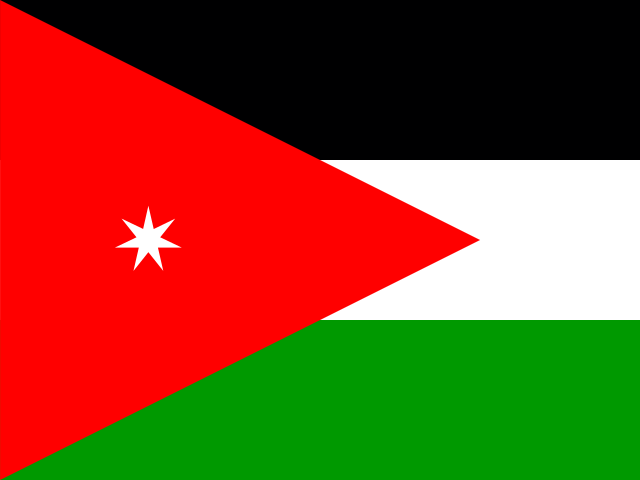
The Flag of Jordan
Asia · Adopted 16 April 1928
Jordan's flag was formally adopted on 16 April 1928, while the country was still the British-administered Emirate of Transjordan under Emir Abdullah I, and it is a near-direct descendant of the flag of the 1916 Great Arab Revolt, the uprising led by Abdullah's father, Sharif Hussein bin Ali of Mecca, against Ottoman rule during World War I.
The three horizontal bands — black on top, white in the middle, green at the bottom — plus the red chevron running from the hoist are read as representing four historic Arab dynasties: black for the Abbasid Caliphate, white for the Umayyad Caliphate, green for the Fatimid Caliphate, and red for the Hashemite dynasty itself, of which Abdullah I and Jordan's current royal family are direct descendants. That four-dynasty color scheme wasn't unique to Jordan; the same Arab Revolt flag, in different arrangements, also fed directly into the modern flags of several other Arab states that trace their own revolutionary or national narratives back to 1916.
The seven-pointed white star set inside the red chevron was added specifically for Transjordan's 1928 flag and is not present on the original 1916 Arab Revolt banner. It is generally explained as representing unity among Arab peoples, and it is also commonly linked to the seven verses of Al-Fatiha, the opening chapter of the Quran — an association repeated often enough in Jordanian civic and educational material that it functions as the standard explanation, even though the star's exact intended meaning wasn't spelled out with full precision in the original 1928 decree.
Jordan's flag has not changed in any structural way since 1928, surviving the country's 1946 transition from British-administered emirate to fully independent kingdom and its 1949 renaming from Transjordan to the Hashemite Kingdom of Jordan without any redesign — the flag's continuity across those constitutional changes reflects that it was already tied to the ruling Hashemite family rather than to the specific administrative status of the territory.
Jordan is also home to what is officially recognized as the world's largest freestanding flagpole for a time after its 2003 construction, at the Raghadan Flagpole in Amman, part of a wave of monumental national flagpole projects several countries built in the 2000s and 2010s partly to outdo each other's height records, though Jordan's has since been surpassed by taller flagpoles built elsewhere.
Because Jordan's black-white-green tricolor with a red hoist triangle shares its basic structure and its Arab Revolt lineage with a handful of other regional flags, the position and shape of the star, along with the specific arrangement of colors, are what distinguish Jordan's flag from its closest relatives rather than the color palette alone.
The flag is flown constantly across Jordan on government buildings and increasingly on private homes and vehicles, particularly around Independence Day on 25 May, and it carries additional weight domestically as a visible marker of the monarchy's continuity, given how directly its colors and symbolism tie back to the ruling family's own origin story.
The original 1928 legal text establishing the flag, issued under the Emirate of Transjordan's Organic Law, specified the flag's proportions and the exact geometry of the chevron and star in more technical detail than many other flags formalized around the same period, reflecting how closely the design was treated as a legal state emblem from the outset rather than left to evolve informally.
Jordan's armed forces and the wider Jordanian scouting movement both make heavy ceremonial use of the flag and its associated Arab Revolt symbolism, and a large-scale monument and museum complex near Aqaba, built around a 130-meter flagpole raising a version of the original 1916 revolt flag, commemorates the revolt's centenary and draws an explicit visual line between that founding uprising and the modern Jordanian state's continued use of its colors.
The 1916 Arab Revolt flag that Jordan's design descends from is generally attributed in design terms to Sir Mark Sykes, a British diplomat involved in coordinating support for the revolt against the Ottomans (and, separately, a co-author of the 1916 Sykes-Picot Agreement dividing postwar Ottoman territory between Britain and France); the flag's Western involvement in its origin is a detail rarely emphasized in Jordanian civic material, which instead foregrounds the revolt's Arab leadership and the flag's four-dynasty color symbolism.
Jordan's flag law sets its official ratio at 1:2 and specifies the chevron's exact geometry as extending across one-quarter of the flag's length, details that distinguish the precise Jordanian version from other Arab Revolt-descended flags in the region that use similar colors but different chevron proportions or star counts.
Jordanian civil aviation, the country's diplomatic missions, and its military each maintain flag-display protocols governed by the same 1928 legal framework as amended, and Jordanian law treats desecration of the flag as a criminal offense, a provision consistent with how several other Middle Eastern states with Hashemite or Arab Revolt-descended flags legally protect their own national symbols.
The star's seven points are sometimes explained in a second, complementary way in Jordanian civic material — as representing the seven hills upon which historic Amman was traditionally said to be built — alongside the more commonly cited Al-Fatiha reference, an example of a national symbol carrying more than one accepted explanation depending on the source consulted.
The seven-pointed star
- Detail-accurate printed flag — The star has seven points rather than the far commoner five, and its size and position inside the chevron are specified, so both the count and the placement are checkable before buying.
As an Amazon Associate we earn from qualifying purchases made through these links, at no extra cost to you.
Often confused with
- Palestine — was adopted by the Palestine Liberation Organization in 1964 and later confirmed in the 1988 Declaration of Independence — decades after Jordan's — and its plain triangle, with no star, is the fastest way to tell the two apart. Compare side by side →
- Kuwait — uses the same three Pan-Arab colors plus a shape at the hoist, but Kuwait's hoist shape is a solid black trapezoid rather than a red triangle bearing a star, and its bands are ordered green-white-red rather than black-white-green. Compare side by side →
Jordan at a glance
- Capital
- Amman
- Population
- 11.5 million (2024)
- Currency
- Jordanian Dinar (JOD)
- Language(s)
- Arabic (official)
Population figure as of 2024, source: UN World Population Prospects (2024 revision). See methodology for how facts are sourced and kept current.