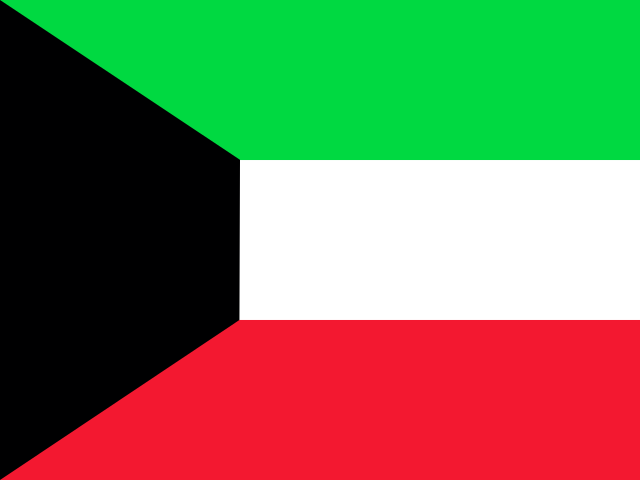
The Flag of Kuwait
Asia · Adopted 24 November 1961
Kuwait adopted its current flag on 24 November 1961, several months after gaining independence from Britain in June that year, replacing an earlier flag that had been mostly plain red with the word 'Kuwait' written in white Arabic script — a design that had grown increasingly out of step with the Pan-Arab color schemes other newly independent Arab states were adopting around the same period.
The new flag's four colors — green, white, red, and black — are the same Pan-Arab palette drawn from the 1916 Arab Revolt flag that also shaped Jordan's, Palestine's, and several other regional flags, but Kuwait arranges them differently: a green-white-red horizontal tricolor with a black trapezoid running the full height of the flag along the hoist, rather than a triangle or chevron.
Kuwaiti civic material commonly explains the four colors through a 13th-century verse attributed to the poet Safi al-Din al-Hilli, describing Arab qualities in exactly this order: white deeds, black battles, green fields, and red swords. Under that reading, green represents Kuwait's fertile land, white stands for the purity of Kuwaiti deeds and conduct, red for the blood on the swords of those who defended the country, and black for the battles fought and, in some tellings, for the darkness left behind by defeated enemies.
The black trapezoid shape at the hoist is Kuwait's most visually distinct departure from other Pan-Arab-color flags in the region; where Jordan and Palestine use a triangular chevron reaching partway across the flag, Kuwait's black block runs the entire height of the flag and comes to a point extending into the tricolor, a shape unique enough that it functions as Kuwait's clearest visual signature even from a distance.
Kuwait's flag has not been redesigned since 1961, and its adoption predates the discovery-driven transformation of the Kuwaiti economy by only a couple of decades — oil had been discovered in 1938 and exports began in earnest in 1946, so the flag was adopted at independence into a country already reshaped by oil wealth rather than one that later grew into it.
The flag flies prominently over Kuwait City and, notably, over the Kuwait Towers and other national landmarks built during the country's postwar development boom, and it was a visible rallying symbol during and after the 1990–1991 Iraqi invasion and occupation, displayed widely by Kuwaitis both in exile and after liberation as a marker of restored sovereignty.
Because several Gulf and Arab states use overlapping segments of the same green-white-red-black palette, Kuwait's flag is most reliably distinguished from its neighbors' by the shape and proportion of that black hoist trapezoid rather than by color alone, since the specific tricolor ordering it uses is shared closely enough with others in the region that color recognition alone isn't always sufficient.
Kuwait's flag law was further codified in later legislation setting the official 1:2 ratio and precise dimensions of the black trapezoid relative to the tricolor bands, part of a broader pattern across Gulf states of tightening flag specifications well after initial independence-era adoption rather than at the moment of adoption itself.
26 February is marked in Kuwait as Liberation Day, commemorating the end of the 1990–1991 Iraqi occupation, and it is one of the two national flag-focused holidays, alongside National Day on 25 February the day before it, when the flag is displayed with particular intensity across Kuwait City and the rest of the country.
Kuwait's pre-1961 flag, plain red with 'Kuwait' written across it in white Arabic script, had itself replaced an even earlier plain red flag used broadly across the Gulf region under informal Ottoman and British-protected-state arrangements in the late 19th and early 20th centuries; the shift to the modern Pan-Arab four-color design in 1961 was as much a statement of full independence from that older regional flag tradition as it was an alignment with newly independent Arab neighbors' color choices.
Kuwait's 1980 flag law consolidated and formalized regulations that had accumulated informally since 1961, spelling out specific rules for flag disposal, the criminal penalties for desecration, and correct display protocol during both national holidays and periods of official mourning, bringing Kuwait's flag legislation into closer alignment with the more detailed statutory codes several neighboring Gulf states had adopted around the same period.
The flag is flown at half-mast during official periods of national mourning, a practice that received significant public attention during the 2020 death of Emir Sheikh Sabah Al-Ahmad Al-Jaber Al-Sabah, whose funeral was marked by nationwide flag lowering, underscoring how closely Kuwaiti flag protocol is tied to the ruling Al Sabah family's own life events alongside its use for purely national commemorations.
Kuwait Airways carries the flag's colors into its livery, and the flag itself has appeared in a highly publicized capacity during Kuwait's periodic hosting of Gulf Cooperation Council summits, which bring together the flags of Kuwait and its five fellow GCC member states for joint ceremonial display.
Because Kuwait was among the first Gulf states to formalize a modern Pan-Arab-style flag after full independence, its 1961 design is sometimes cited by regional historians as an influence on the general four-color palette several other small Gulf states drew from when designing their own flags in the years that followed, even though each state's specific arrangement and symbolism developed independently.
The shape of the black trapezoid
- Geometry-accurate flag — The page says the trapezoid's shape and proportion are what distinguish this flag from its neighbours', which makes the angle of that sloping edge the thing to look at in a listing photograph.
As an Amazon Associate we earn from qualifying purchases made through these links, at no extra cost to you.
Often confused with
- Sudan — uses the same four Pan-Arab colors, but as a horizontal tricolor with a plain black triangle at the hoist rather than the taller black trapezoid Kuwait uses, and in a different color order overall. Compare side by side →
- United Arab Emirates — also pairs green-white-black bands with a red hoist shape, but the UAE's red section is a solid vertical band rather than Kuwait's black trapezoid, and the colors are arranged in a different order. Compare side by side →
Kuwait at a glance
- Capital
- Kuwait City
- Population
- 4.3 million (2024)
- Currency
- Kuwaiti Dinar (KWD)
- Language(s)
- Arabic (official); English widely used in business
Population figure as of 2024, source: UN World Population Prospects (2024 revision). See methodology for how facts are sourced and kept current.