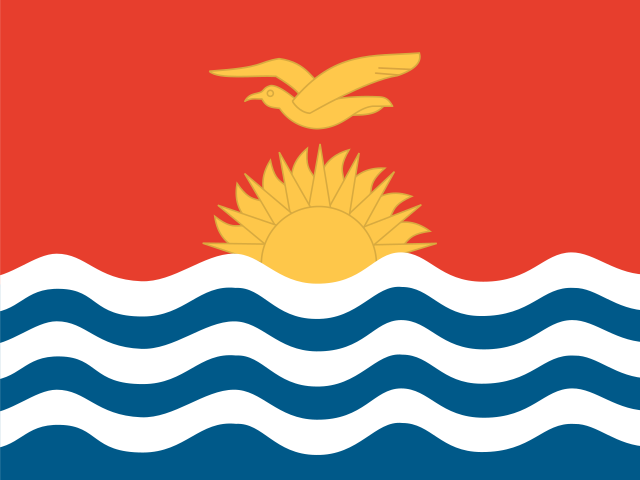
The Flag of Kiribati
Oceania · Adopted 12 July 1979 (independence day)
Kiribati's flag was adopted on 12 July 1979, the day the country gained independence from Britain as the Gilbert Islands became the Republic of Kiribati — a name that is simply the local rendering of 'Gilberts' in Gilbertese pronunciation. Rather than design something new from scratch, the new government adapted a coat of arms that had already been granted to the colony by the British College of Arms in 1937, making Kiribati's flag one of the few in the Pacific to carry a genuinely pre-independence design straight through into statehood almost unchanged.
The central image is a golden frigatebird in flight over a rising sun, set against a red upper field, above three wavy bands of blue and white representing the Pacific Ocean. The frigatebird was chosen for its real significance in Gilbertese seafaring culture: it is a bird capable of staying airborne for extended periods and was traditionally read by navigators as a sign of nearby land, a practical maritime symbol rather than a purely decorative one, and it carries connotations of strength, freedom, and authority in local tradition.
The sun's seventeen rays are the detail most often explained differently across sources: some describe them as representing the sixteen islands of the Gilbert group plus Banaba (Ocean Island), which was administered together with the Gilberts under British rule despite being ethnically and geographically distinct; other accounts describe the count more loosely as marking the historical Gilbert Island group as a whole. Kiribati today spans a far larger area than the original Gilbert group alone — it also includes the Phoenix Islands and the Line Islands, communities that were not part of the 1937 coat of arms' original frame of reference and are not individually represented in the ray count.
The wavy blue-and-white bands beneath the sun represent the Pacific Ocean itself, a fitting emphasis for a nation whose 33 atolls and islands are scattered across roughly 3.5 million square kilometers of ocean, one of the most geographically dispersed countries on Earth relative to its tiny total land area of about 811 square kilometers.
Because the flag is adapted so directly from a 1937 British colonial coat of arms, it has an unusually clean, heraldic look compared to many other Pacific independence-era flags that were purpose-designed through 1970s-era public competitions — Kiribati kept the shield-like framing of a coat of arms even after independence rather than replacing it with a more conventional rectangular flag layout built from stripes or a canton.
Banaba (Ocean Island), whose people were folded into the Gilbert group under British administration and are still represented in the flag's ray count by tradition, has its own separate and difficult history: British Phosphate Commissioners mined the island's rich phosphate deposits from 1900 until the deposits were essentially exhausted by the 1970s, and most Banabans were relocated to Rabi Island in Fiji during the Second World War and its aftermath, a displacement whose descendants today still identify as both Banaban and, in many cases, Fijian citizens — a genuinely separate national story that the flag's ray count gestures toward without depicting directly.
Kiribati holds an unusual distinction in world geography: after a 1995 decision to redraw its portion of the International Date Line so that the whole country, spread across three widely separated island groups straddling the equator and the 180th meridian, would share the same calendar date, Kiribati became the first inhabited place on Earth to greet each new day. The easternmost Line Islands group even renamed its largest island Millennium Island ahead of the year 2000 specifically to mark this claim, a piece of modern national branding built on the same distinctive Pacific geography the flag's wavy ocean bands represent.
Kiribati has become one of the most visible faces of Pacific climate-change advocacy internationally, since its low-lying atolls sit only a few meters above sea level and are considered among the most vulnerable places on Earth to sea-level rise; the government under President Anote Tong purchased land in Fiji in 2014 as a long-term contingency, a decision that made international headlines and tied the flag's frigatebird — a symbol of a people who read the sky and sea for survival — to a very contemporary set of national concerns.
Kiribati's flag is constructed to a 1:2 ratio, longer and narrower than the more common 2:3 proportion, a shape inherited directly from the rectangular framing the 1937 coat of arms was adapted into rather than a deliberate post-independence design choice. Government reference specifications describe the upper field as a specific scarlet rather than a generic red, and the wavy ocean bands alternate a deep ultramarine blue with white, colors carried over unchanged from the original heraldic grant.
Because the flag predates the 1979 addition of the Phoenix and Line Islands to full national territory, some contemporary Kiribati civics material reinterprets the three wavy bands as representing the country's three constituent island groups — Gilbert, Phoenix, and Line — even though the 1937 design that produced those bands was drawn up decades before Kiribati's current territorial extent existed, an example of a symbol's popular meaning shifting to fit a nation that grew well beyond the borders it was originally designed to represent.
The flag remains unchanged since 1979, and Independence Day on 12 July continues to be the year's central occasion for flag ceremonies across the scattered island groups that make up the republic.
A bird over wavy bands
- High-resolution printed flag — A bird in flight over alternating wave lines is all curved detail with no straight edges to hide behind, so the print either holds the wing shape and the wave crests or it does not.
As an Amazon Associate we earn from qualifying purchases made through these links, at no extra cost to you.
Often confused with
- Solomon Islands — not commonly mixed up in practice, but both are Pacific-nation flags built around a rising sun/land motif over horizontal ocean bands — Kiribati's frigatebird-and-sun sits on solid red above wavy blue-and-white water bands, while Solomon Islands uses a diagonal yellow stripe dividing plain blue and green fields with five stars, a fundamentally different structure once compared side by side. Compare side by side →
Kiribati at a glance
- Capital
- Tarawa
- Population
- 133,000 (2024)
- Currency
- Australian Dollar (AUD), alongside the Kiribati dollar in coin form
- Language(s)
- English and Gilbertese (both official)
Population figure as of 2024, source: UN World Population Prospects (2024 revision). See methodology for how facts are sourced and kept current.