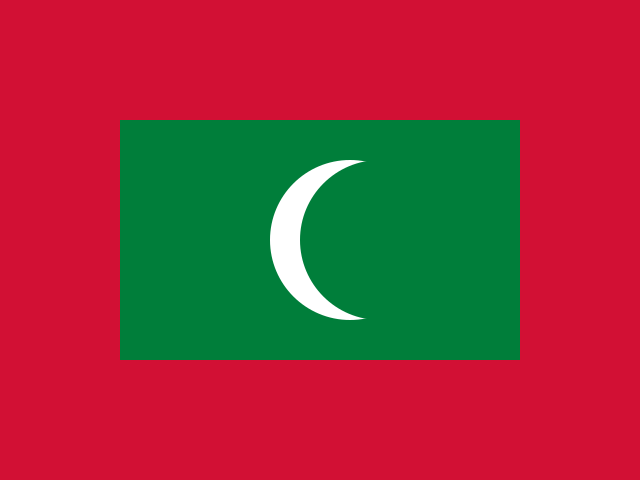
The Flag of Maldives
Asia · Adopted 26 July 1965
The Maldives raised its current flag on 26 July 1965, the day the archipelago's sultanate secured full independence from Britain, but the red-and-green design had already been evolving for more than sixty years by that point. Maldivian ships and forts had flown a plain red flag for centuries before that, a color common across Indian Ocean sultanates and used simply to mark a vessel's home port at a glance from a distance.
The design took its first real detour under Sultan Muhammad Shamsuddin III in the early 1900s, when a black-and-white striped border was added along the hoist side of the plain red field, apparently to distinguish Maldivian ships more clearly from other red-flagged vessels working the same shipping lanes. That striped version lasted roughly two decades before a further reform, associated with the same sultan's later modernization efforts, replaced the stripes with a plain green rectangle bearing a white crescent — the layout that, with only minor proportion changes, became the independence-era national flag in 1965. Sources differ on the exact year the green panel first appeared, with some placing it as early as the mid-1920s and others tying it to the brief First Republic period under Muhammad Amin Didi in the early 1950s, whose government looked to Egypt's modern Arab nationalism as a design influence.
Each element carries a meaning most Maldivians would recognize without needing it explained. The red field stands for the blood of the national heroes who defended the islands from foreign invaders across the sultanate's long history, including repelled Portuguese and Malabar incursions in earlier centuries. The green rectangle represents the archipelago's coconut palms, along with peace and prosperity. The white crescent is Islam, the sole state religion under Maldivian law — the constitution requires citizenship to be restricted to Muslims, which makes the crescent something closer to a description of the state's legal identity than a general cultural reference.
Unlike many crescent flags in the Islamic world, the Maldives' crescent opens toward the fly rather than upward, and it sits centered on the green panel rather than paired with a star, a combination that distinguishes it at a glance from flags like Pakistan's or Turkey's even though all three draw on the same broad symbolic vocabulary.
The flag has not changed since 1965 beyond minor standardization of its proportions and exact shades for official reproduction, giving the modern republic (the sultanate was abolished by referendum in 1968) a national symbol that predates its current system of government by three years. That continuity through the transition from sultanate to republic is unusual; many former sultanates and monarchies-turned-republics redesigned their flags specifically to mark the break with monarchy, but the Maldives kept its existing design and simply retired the sultan's separate personal standard instead.
Because the general color pairing of green and red with an Islamic symbol recurs across several Indian Ocean and Middle Eastern flags, the Maldives is occasionally confused with countries whose flags share only a surface resemblance rather than any shared design lineage — the specific combination of a red field bordering a distinct green panel is not duplicated exactly anywhere else.
The flag is flown daily above government buildings and resorts across the atolls, and it is especially prominent on Independence Day, 26 July, and Republic Day, 11 November, when official ceremonies mark both the end of British protection and the 1968 vote that abolished the sultanate.
Maldivian law treats the flag as a formal state symbol with specific display rules, including its mandatory presence on all registered vessels and government vehicles, a practical continuation of the centuries-old maritime habit of marking ships by their flag long before the modern republic existed to codify the rule.
The 1965 independence the flag now commemorates was, in one sense, a formal correction rather than a dramatic break: the Maldives had never been fully absorbed into the British Empire the way many colonies were, instead existing as a British protectorate from 1887 to 1965 under which the sultan retained internal self-government while Britain controlled external affairs and defense. That arrangement meant the flag flown through most of the protectorate period was already, in essence, the modern national flag rather than a colonial ensign, which is part of why 1965 marked a change in sovereignty more than a change in national symbol.
A separate national emblem, distinct from the flag itself, was also adopted around independence and depicts a coconut palm — a plant central to the traditional Maldivian economy and diet — flanked by the national flag's crescent and star, along with two crossed ceremonial silver staffs called 'ranfolhi' historically carried by the sultan's attendants during formal state occasions, showing how much of the country's pre-republican court symbolism was folded into modern state iconography rather than discarded when the sultanate ended in 1968.
Not every part of the archipelago accepted Malé's authority quietly during this period. Between 1959 and 1963, the southern Suvadive atolls broke away and declared themselves an independent republic, flying their own separate flag distinct from the sultanate's, before the secession was suppressed and the southern atolls were reincorporated under Malé's rule a few years before national independence — a reminder that the red-and-green flag now representing a unified Maldives once had a genuine, if short-lived, domestic rival.
Which way the crescent opens
- Double-sided flag — The crescent opens toward the fly, so printed through a single layer it opens toward the pole from behind. On a flag whose only device is that crescent, the reversal is the whole design.
As an Amazon Associate we earn from qualifying purchases made through these links, at no extra cost to you.
Often confused with
- Pakistan — also pairs a green field with a white crescent, but Pakistan's crescent is paired with a star and sits within a solid green field with a separate white hoist stripe, not centered inside a smaller green panel set against red. Compare side by side →
- Mauritania — shares the general green-field-plus-crescent Islamic symbolism, but Mauritania's flag is entirely green with a gold crescent and star and red border stripes added in 2017 — there is no red field or separate green panel as in the Maldives' design. Compare side by side →
Maldives at a glance
- Capital
- Malé
- Population
- 521,000 (2024)
- Currency
- Maldivian Rufiyaa (MVR)
- Language(s)
- Dhivehi (official)
Population figure as of 2024, source: UN World Population Prospects (2024 revision). See methodology for how facts are sourced and kept current.