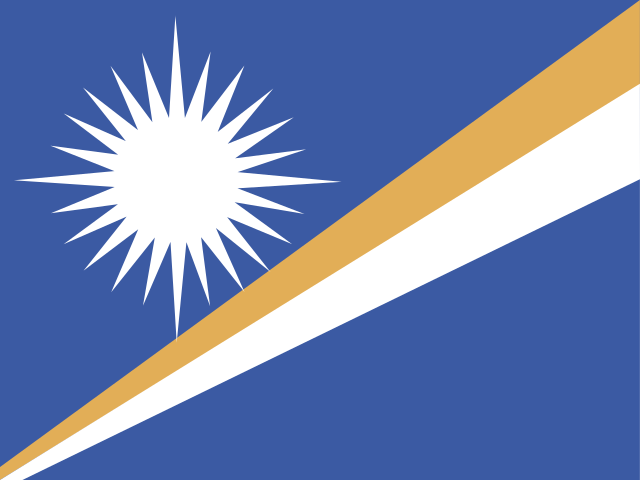
The Flag of Marshall Islands
Oceania · Adopted 1 May 1979
The Marshall Islands adopted its flag on 1 May 1979, the day the country's constitution took effect and it became a self-governing entity under the Compact of Free Association it would later sign with the United States in 1986. The design was created by Emlain Kabua, wife of Amata Kabua, the country's first president, making it one of relatively few national flags in the world credited to a named individual designer working outside a public competition process.
The blue field represents the Pacific Ocean that surrounds and connects the Marshall Islands' 29 atolls and 5 individual islands, spread across two roughly parallel island chains — the Ratak ('sunrise') chain and the Ralik ('sunset') chain — a geographic division still used in everyday reference to the country's own layout.
Two diagonal stripes, orange above white, rise from the lower hoist corner to the upper fly corner. The stripes are read as representing the equator, since the Marshall Islands sits just north of it, and their widening as they rise is often described as symbolizing the growth and increasing status of the nation. Orange stands for courage and for the wealth of the islands' resources; white stands for peace.
In the canton sits a white, 24-pointed star. Four of the points are elongated into a cross shape, understood to represent Christianity, which arrived through 19th-century missionary activity and remains the majority religion across the islands today. The remaining points are read as representing the country's 24 municipalities — the local government districts into which the scattered atolls are organized — making the star a fairly literal map of the nation's administrative geography rather than a purely decorative motif.
The Marshall Islands endured one of the most severe legacies of Cold War-era nuclear testing of any nation: the United States conducted 67 nuclear tests in the islands between 1946 and 1958, including the 1954 Castle Bravo detonation on Bikini Atoll, the largest nuclear device the US ever tested, which contaminated a far wider area than planners had predicted and displaced residents of Bikini and Rongelap Atolls, some of whom have never been able to permanently resettle their home islands. That history is not depicted directly on the flag, but it remains central to the Marshall Islands' national identity and its ongoing negotiations with the United States over compensation and environmental remediation.
The flag has not been redesigned since 1979, and it is flown alongside the flag of the United States at many official functions given the close relationship established by the Compact of Free Association, under which the US retains defense responsibility for the Marshall Islands in exchange for financial assistance and Marshallese citizens' right to live and work in the US without a visa.
Bikini Atoll itself, the site of the Castle Bravo test, gave its name inadvertently to the swimsuit — French designer Louis Réard named his 1946 two-piece design after the atoll just days after the first postwar nuclear tests there, reportedly hoping the design would prove as explosive to public attention as the bomb, a strange piece of unrelated pop-culture trivia that still surprises many Marshallese today when they encounter it.
Traditional Marshallese navigation adds a layer of meaning to the flag's ocean symbolism beyond the generic Pacific-blue used by several neighboring flags: Marshallese navigators historically used stick charts, woven lattice frameworks of palm ribs and shells that mapped swell patterns and wave refraction between islands, a wayfinding system sophisticated enough that it is still taught and studied today as one of the more advanced pre-modern navigation traditions documented anywhere in the Pacific.
Constitution Day, 1 May, remains the primary annual occasion tied directly to the flag's adoption, alongside Nuclear Victims Remembrance Day on 1 March, which commemorates the anniversary of the Castle Bravo test rather than the flag itself but is treated with comparable national solemnity.
The flag's proportions are fixed at an unusual 10:19 ratio rather than the more common 2:3 used by most national flags — the same non-standard ratio the United States flag itself uses, a detail that is less a coincidence than a holdover from the islands' decades as a US-administered UN trust territory, when American flag-manufacturing conventions and bunting suppliers shaped the practical standards later carried into the Marshallese flag law. The two diagonal stripes are specified to rise at a precise angle from the lower hoist corner to the upper fly corner, wide enough at the fly end to leave clear separation between the blue field above and below them.
Kwajalein Atoll, the Marshall Islands' largest by land area, hosts the US Army's Ronald Reagan Ballistic Missile Defense Test Site, a live missile-testing range that the United States has leased under successive versions of the Compact of Free Association since the 1980s; the lease payments and associated infrastructure spending are one of the country's largest sources of government revenue, alongside direct Compact grant funding. The Compact itself was renewed for a further 20 years in 2023 after lengthy renegotiation, extending the financial-assistance and defense arrangement first signed in 1982 and now central to the Marshall Islands' national budget.
Four points longer than the rest
- Geometry-accurate flag — The star's points are not all the same length: four are extended and the rest are not, and a reproduction that evens them out has drawn a plain star instead.
As an Amazon Associate we earn from qualifying purchases made through these links, at no extra cost to you.
Often confused with
- Micronesia — both use a plain blue Pacific field with white stars and no red, a pattern common across former US-administered Pacific trust territories — but Micronesia's four stars sit in a simple horizontal cross arrangement on solid blue, while the Marshall Islands' single 24-point star sits above rising orange-and-white diagonal stripes, a much busier design overall. Compare side by side →
Marshall Islands at a glance
- Capital
- Majuro
- Population
- 42,000 (2024)
- Currency
- United States Dollar (USD)
- Language(s)
- Marshallese and English (both official)
Population figure as of 2024, source: UN World Population Prospects (2024 revision). See methodology for how facts are sourced and kept current.