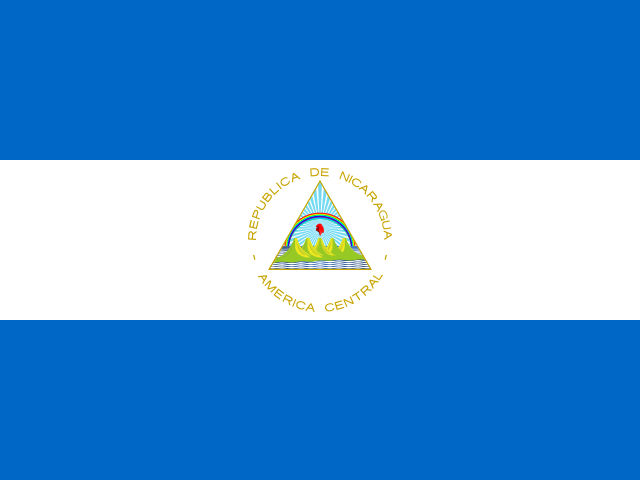
The Flag of Nicaragua
North America · Adopted 27 August 1971 (current design); pattern dates to 1823
Nicaragua's flag, like Honduras's and El Salvador's, descends from the blue-white-blue horizontal tricolor flown between 1823 and 1841 by the short-lived union of five former Spanish colonies that briefly governed the isthmus jointly after independence from Spain and a brief annexation by the Mexican Empire. When that federal union collapsed, Nicaragua — like its neighbors — kept the basic color pattern rather than discarding it, treating the shared banner as a regional inheritance worth preserving rather than a failed project to be erased.
What distinguishes Nicaragua's flag from Honduras's and El Salvador's is its coat of arms: a triangle enclosing five volcanoes rising from the sea between two oceans, capped by a rainbow, with a Phrygian cap (a Cap of Liberty) radiating light above the triangle's apex, and the words "REPUBLICA DE NICARAGUA" and "AMERICA CENTRAL" arranged around the border. The five volcanoes are read as representing the five original federation states, an explicit visual echo of the same lost union that Honduras marks instead with five stars — two countries commemorating the identical historical event with completely different symbols.
The rainbow and Cap of Liberty carry their own distinct meaning: the rainbow is generally read as a symbol of peace following the wars of independence, and the Phrygian cap — a symbol with roots in ancient Rome, where it was given to freed slaves, and later adopted widely across Latin American independence movements as shorthand for liberty — appears on several other Central and South American coats of arms for the same reason, a symbol imported through the shared revolutionary vocabulary of the era rather than invented locally.
Nicaragua's current flag law dates to 27 August 1971, though the underlying blue-white-blue-with-coat-of-arms pattern is far older; the 1971 law mainly fixed precise proportions and the exact rendering of the coat of arms rather than introducing a new design from scratch. Earlier 20th-century Nicaraguan governments had used variant renderings of the same basic emblem, and the country briefly flew other designs during periods of political upheaval in the 19th century before the blue-white-blue tricolor with coat of arms became the settled standard.
Nicaragua's history includes a period, during the Sandinista government of the 1980s, when the flag itself was not replaced but was flown alongside a separate, widely displayed red-and-black Sandinista party flag at government events — a practice that meant, for over a decade, Nicaraguan state ceremonies routinely featured two banners rather than one, a detail specific to Nicaragua among its Central American neighbors and one that still shapes how the country's flag is discussed in relation to its more recent political history.
Because Honduras, El Salvador, and Nicaragua all fly blue-white-blue tricolors rooted in the same 1823 federal banner, the three are routinely mixed up outside the region; Nicaragua's is distinguished in practice by its more elaborate coat of arms — volcanoes, rainbow, and radiating cap together — which is visually busier than either Honduras's simple five-star pattern or El Salvador's more compact circular emblem.
The five volcanoes depicted are not a generic mountain motif but a specific reference to the real volcanic chain running through western Nicaragua, a country that sits directly on the Central American volcanic arc and has more active volcanoes than any of its immediate neighbors; Nicaraguan civic material sometimes points to this literal geographic grounding, alongside the symbolic five-states reading, as a second, equally valid layer of meaning behind the emblem.
Nicaragua's use of the coat of arms directly on the flag's white stripe, rather than leaving the stripe plain the way Honduras does, has itself shifted in official emphasis over the 20th century — earlier renderings under different governments sometimes rendered the emblem smaller or with different lettering styles around its border, and the 1971 codification was in part an effort to fix a single, consistent version after decades of minor inconsistency in how the coat of arms was printed on government material and military flags.
Nicaragua briefly experienced its own annexation to the First Mexican Empire in the early 1820s along with the rest of the isthmus, before that empire's 1823 collapse allowed the five Central American provinces to regroup as the independent federation whose flag pattern Nicaragua still carries; Nicaraguan and Honduran textbooks both teach this shared two-stage independence story — from Spain, then from Mexico, then the federation's own later breakup — as the common backdrop behind both countries' blue-white-blue flags, even though the two nations settled on very different central emblems to mark it. Nicaragua's own 20th-century political turbulence added a further layer that Honduras never experienced in quite the same way: the decades-long Somoza family dictatorship (1936–1979), the subsequent Sandinista revolution, and the 1980s Contra war all played out under the same unaltered blue-white-blue flag, meaning the symbol has had to represent sharply opposed and mutually hostile governments across less than half a century without the flag itself ever changing to mark any of those transitions. Nicaraguan opposition movements and government supporters alike have continued to fly the identical blue-white-blue flag at rival rallies in more recent political disputes, meaning the same unaltered national symbol is regularly claimed by both sides of the country's contemporary political divide rather than serving as shorthand for any single faction.
A rainbow a few centimetres wide
- Full-colour printed flag — The emblem puts a full rainbow above five volcanoes inside a small triangle, which means several colours in an arc a few centimetres across and no room for a coarse screen.
As an Amazon Associate we earn from qualifying purchases made through these links, at no extra cost to you.
Often confused with
- Honduras — descends from the 1823 federation tricolor just as Nicaragua's does, which is why the banding matches almost exactly; the split shows in what each country put at the center — Honduras chose five stars arranged in an X, while Nicaragua retained the federation's own triangular device and layered a rainbow and volcanoes into it. Compare side by side →
- El Salvador — also descends from the same federal tricolor and carries its own coat of arms centered on the white stripe, but El Salvador's emblem is a more compact circular design distinct from Nicaragua's triangular volcano scene. Compare side by side →
Nicaragua at a glance
- Capital
- Managua
- Population
- 7.1 million (2024)
- Currency
- Nicaraguan Córdoba (NIO)
- Language(s)
- Spanish (official); Miskito and other indigenous and Creole languages recognized regionally on the Caribbean coast
Population figure as of 2024, source: UN World Population Prospects (2024 revision). See methodology for how facts are sourced and kept current.