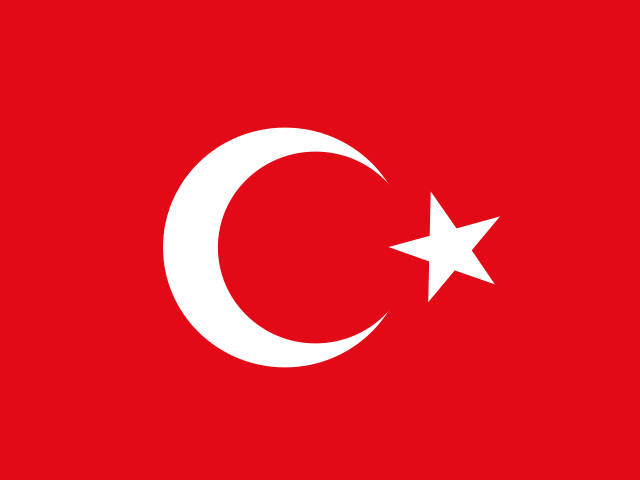
The Flag of Turkey
Asia · Adopted 5 June 1936 (design formalized; red flag with star and crescent used since Ottoman era)
Turkey's flag — the Ay Yıldız, 'moon star' — is often popularly explained through a folk legend involving Sultan Osman I seeing a vision of a crescent moon and star reflected in a pool of blood after a battle, a story with genuine emotional resonance in Turkish national memory but no historical documentation supporting it as fact; vexillologists and Ottoman historians instead trace the flag's real origins to the late 18th century, when the Ottoman navy and later the empire more broadly adopted a red flag bearing a white crescent and star, formalized under a series of 18th- and 19th-century sultans rather than emerging fully formed at the empire's founding centuries earlier.
The crescent-and-star combination itself predates the Ottomans by centuries and was not originally an Islamic symbol at all: it appears on coins and civic emblems from ancient Byzantium (later Constantinople, then Istanbul) going back to the pre-Christian era, likely linked to the city's patron goddess Artemis/Diana, and only became associated with Ottoman and broader Islamic identity gradually after the Ottoman conquest of Constantinople in 1453, as the symbol was absorbed into the empire's own visual language rather than invented as a religious emblem from the start.
The modern republic's flag descends directly from the late Ottoman naval and state ensign, standardized in its current proportions and exact star-and-crescent geometry during the reforms of the 1930s under Mustafa Kemal Atatürk's secularizing republic, with the precise legal specification — including the exact positioning ratio of the crescent's horns and the star's distance from it — fixed by the 1936 Turkish Flag Law, which remains the governing legal document today.
Red as the field color has no single settled official explanation but is generally linked in popular and some scholarly accounts to Ottoman-era naval and military tradition and to the historic blood of soldiers in Turkish military campaigns, a symbolic reading Turkish civic education generally repeats without claiming a precisely documented origin, distinct from the more folkloric Osman legend.
Turkey's flag is one of the most legally protected national symbols in the world: the 1936 Turkish Flag Law and subsequent legislation criminalize flag desecration, mandate specific manufacturing and display standards, and even regulate how private citizens may fly the flag on buildings — a level of legal formality that reflects both the flag's deep tie to Atatürk-era republican nationalism and its continuous use as a state symbol since Ottoman times, an unusually long institutional lineage for a national flag.
Turkey's star-and-crescent is frequently compared with Tunisia's flag, which also centers a red field with a white disc bearing a crescent and star, but the two symbols arrived at similar imagery through entirely separate histories — Tunisia's design was formalized under the Beylik of Tunis in 1831, independently of direct Ottoman state flag design even though Tunisia was nominally an Ottoman vassal at the time, and the two flags differ clearly in layout: Turkey's crescent and star float directly on the red field, while Tunisia's sit inside a large white circular disc.
Because the crescent-and-star also appears on the flags of Pakistan, Algeria, Mauritania, Azerbaijan, and several other Muslim-majority nations, each having adopted the symbol independently during its own 19th- or 20th-century nation-building process rather than copying Turkey directly, Turkey's flag is sometimes mistakenly treated as the 'original' from which all the others derive — an oversimplification, since the underlying crescent-star motif long predates any of these individual national flags and reached each country through its own distinct historical route.
Northern Cyprus, whose independence is recognized only by Turkey, uses a flag directly modeled on Turkey's design with the colors reversed (a red crescent and star on a white field with red border stripes) — a deliberate visual statement of the close political relationship between Ankara and the self-declared Turkish Republic of Northern Cyprus, and one of the clearest direct derivatives of Turkey's flag design used anywhere.
The number eight is embedded in the flag's official geometry in a way few citizens are aware of: the Turkish Flag Law defines the crescent as an arc constructed using a precise ratio relative to the flag's width, and the star's exact size and position are similarly fixed by mathematical formula rather than left to artistic discretion, part of the broader early-republican project of standardizing and rationalizing state symbols after centuries of more loosely regulated Ottoman practice.
Turkey's 1936 Flag Law was passed at a moment when Atatürk's government was systematically overhauling nearly every layer of state symbolism and public life — replacing the Arabic script with a new Latin-based Turkish alphabet in 1928, abolishing the caliphate in 1924, and secularizing legal and educational institutions — so the flag's precise legal codification that same decade fits a broader pattern of the young republic formalizing and modernizing inherited Ottoman-era symbols rather than discarding them outright, keeping the crescent and star while stripping away the wider Ottoman religious and dynastic apparatus around them.
Turkish national identity places unusually strong emphasis on flag reverence in everyday civic life: the flag appears on a very high proportion of public and private buildings, is a common motif in patriotic songs and school ceremonies, and its unauthorized alteration or destruction remains a criminal matter, a level of legal and cultural weight some historians link to the flag's dual role as both a modern republican symbol and, through the crescent and star, a visible thread of continuity back to centuries of Ottoman state identity.
The gap between crescent and star
- Geometry-accurate flag — The star sits clear of the crescent's inner curve at a specified offset, and the usual fault in a loose copy is a star pushed into the crescent's opening until the two shapes touch.
As an Amazon Associate we earn from qualifying purchases made through these links, at no extra cost to you.
Often confused with
- Tunisia — shares a red field with a white crescent-and-star, but Tunisia's crescent and star sit inside a large white circular disc rather than floating directly on the red field as in Turkey's design. Compare side by side →
- Algeria — also uses a red crescent and star, but on a green-and-white split field rather than an all-red field, and Algeria's crescent horns are drawn more widely open than Turkey's. Compare side by side →
Turkey at a glance
- Capital
- Ankara
- Population
- 87.7 million (2024)
- Currency
- Turkish Lira (TRY)
- Language(s)
- Turkish (official)
Population figure as of 2024, source: UN World Population Prospects (2024 revision). See methodology for how facts are sourced and kept current.