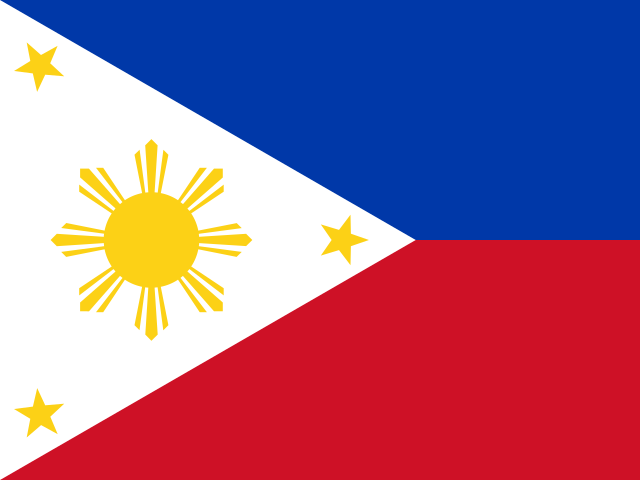
The Flag of Philippines
Asia · Adopted 12 June 1898 (original design); current legal form fixed by Republic Act 8491, 1998
The Philippine flag was first unfurled on 12 June 1898 in Kawit, Cavite, when General Emilio Aguinaldo declared the country's independence from Spanish colonial rule after more than 300 years of Spanish control — a declaration made in the middle of the Spanish-American War, while Spain's grip on the islands was collapsing but before the United States, which would take control of the Philippines that same year, had any presence on the ground.
The flag itself had been sewn shortly before that ceremony, in exile in Hong Kong, by Marcela Agoncillo, working with her daughter Lorenza and with Delfina Herbosa de Natividad, a niece of the executed national hero José Rizal. Aguinaldo reportedly brought the design and specifications with him from earlier revolutionary planning, and the finished flag was smuggled back into the Philippines in time for the June 1898 declaration.
The design layers several distinct symbols. A white equilateral triangle at the hoist represents equality and fraternity and directly references the Katipunan, the secret revolutionary society that had launched the armed uprising against Spain in 1896; inside the triangle, an eight-rayed golden sun represents the eight provinces that were first to rise in revolt against Spanish rule, while three five-pointed gold stars at the triangle's corners represent the country's three main island groups — Luzon, Visayas, and Mindanao. The two horizontal fields flanking the triangle are blue, for peace, truth, and justice, and red, for patriotism and valor.
American colonial authorities banned the flag's display outright for over a decade under the 1907 Flag Law, a prohibition that lasted until 1919 and reflected Washington's early ambivalence about tolerating an explicit symbol of the independence movement the US had itself fought during the Philippine-American War of 1899–1902 — a war that began only months after the flag's first raising and ended any near-term prospect of the independence Aguinaldo had declared.
The Philippines is the only country in the world whose national flag is designed to be flown upside down deliberately, and with legal meaning attached to doing so: when the red stripe is on top instead of the blue, the flag signals that the nation is in a state of war, a provision written into the country's flag law (most recently Republic Act 8491, passed in 1998) and reportedly used during periods of the Japanese occupation in the Second World War when Filipino resistance forces flew the flag inverted as a coded signal of continued fighting.
The flag's exact legal specifications — proportions, the precise shades of blue and red, and the geometry of the sun and stars — were codified comprehensively in Republic Act 8491, which also formalized rules around flag display, disposal, and required daily flag ceremonies in schools and government offices, replacing a patchwork of earlier, less detailed regulations dating back to the immediate post-independence period after 1946.
Because triangle-and-stars flags combining blue, white, and red are relatively common worldwide, the Philippine flag's specific combination — a white triangle with sun and three stars beside blue and red fields — has no close national lookalike; the flag it gets mistaken for most often is Cuba's, which reaches for the same three colors and also sets a star against a triangle — but Cuba stops at one star and no sun, and lays its stripes horizontally across the whole field rather than splitting it into two solid bands.
The date the Philippines celebrates as Independence Day was itself a later flag-adjacent decision: the country initially marked independence on 4 July, the date in 1946 the United States formally granted sovereignty, but President Diosdado Macapagal moved the official holiday to 12 June in 1962, restoring the date of Aguinaldo's original 1898 declaration and the flag's first raising as the more historically meaningful founding moment, even though the Philippines would spend nearly another half-century under American and then Japanese control after that first 1898 declaration before independence actually took lasting effect.
The flag became a prominent symbol of peaceful resistance again in February 1986, when millions of Filipinos filled Manila's EDSA highway waving the flag during the People Power Revolution that ended Ferdinand Marcos's two-decade rule, a mass display of the flag credited with helping cement its association with civic protest and democratic renewal in the national memory, alongside its older ties to the 1896–98 revolution against Spain.
Republic Act 8491 also sets out specific penalties for flag misuse or disrespect, including improper disposal, and requires most schools, government offices, and many private buildings to conduct daily flag-raising and lowering ceremonies accompanied by the national anthem, a routine embedded deeply enough into public institutional life that most Filipinos encounter formal flag protocol far more often than citizens of many other countries do.
The flag's blue has itself changed once since 1898, and the change was deliberate rather than accidental: American colonial and early post-independence versions used a dark navy blue, but Republic Act 8491 in 1998 officially shifted the specified shade to a brighter royal blue, on the reasoning — debated among Filipino vexillologists to this day — that navy blue had crept in during the American period and that the lighter blue was closer to the color actually used on Marcela Agoncillo's original 1898 flag, which survives today in the National Museum of the Philippines. The 12 June 1898 ceremony itself was more elaborate than the flag-raising alone: accounts describe the flag hoisted at Aguinaldo's ancestral home in Kawit at around 4:20 in the afternoon, accompanied by the first public performance of the Marcha Nacional Filipina (the tune that became the national anthem) played by a local band, and a public reading of the Acta de la Proclamación de Independencia, drafted by Ambrosio Rianzares Bautista, that formally declared the islands free of Spanish rule.
Eight rays and three corner stars
- Geometry-accurate flag — The sun has a fixed number of rays and three stars sit at the triangle's corners, both counts written into the flag law, so both are checkable in a listing photograph before anything is bought.
As an Amazon Associate we earn from qualifying purchases made through these links, at no extra cost to you.
Often confused with
- Cuba — predates the Philippines' flag by half a century — designed in 1849 by Narciso López and known as the 'Lone Star' banner, it later inspired Puerto Rico's flag, which simply swaps Cuba's blue and red fields. Compare side by side →
Philippines at a glance
- Capital
- Manila
- Population
- 117 million (2024)
- Currency
- Philippine Peso (PHP)
- Language(s)
- Filipino and English (official); Cebuano and numerous other regional languages widely spoken
Population figure as of 2024, source: UN World Population Prospects (2024 revision). See methodology for how facts are sourced and kept current.