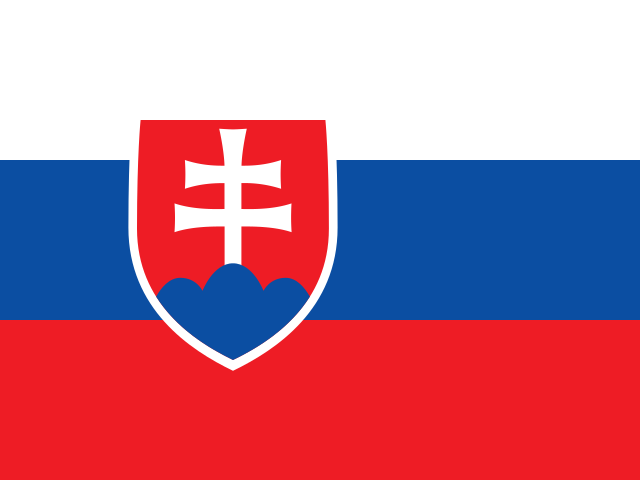
The Flag of Slovakia
Europe · Adopted 1 September 1992
Slovakia's white-blue-red horizontal tricolor descends from the same source as Serbia's and Slovenia's: the pan-Slavic congress convened in Prague in June 1848, where Slavic delegates across the Austrian Empire settled on Russia's white-blue-red as a shared color scheme. Slovak national activists, then living under Hungarian administration within the Habsburg lands with no state of their own to fly a flag over, adopted the colors as a badge of Slavic identity decades before there was a Slovak state to formalize them on.
The coat of arms — a red shield bearing a white double cross standing on three blue hills, set off-center toward the hoist and overlapping the stripes — is what makes the flag specifically Slovak rather than generically pan-Slavic, and it was added to the flag by law on 1 September 1992, the day the constitution of the about-to-be-independent Slovak Republic was adopted, months ahead of the actual 1 January 1993 split from the Czech Republic that ended Czechoslovakia.
The double cross itself is far older than 1992: it echoes the patriarchal cross associated with Saints Cyril and Methodius, the ninth-century Byzantine missionaries credited with bringing Christianity and a Slavic liturgical script to Great Moravia, the early medieval state historians treat as an ancestor of both Slovak and Czech national identity. The same double-cross-on-hills motif also appears in Hungary's coat of arms, a resemblance that is not coincidental — Slovakia's territory was part of the Kingdom of Hungary for roughly a thousand years, and both nations drew on overlapping heraldic traditions from that shared history, which occasionally fuels good-natured (and sometimes less good-natured) cross-border arguments over which country's claim to the symbol is older.
The three blue hills beneath the cross are conventionally explained as representing three historic mountain ranges — Tatra, Fatra, and Matra — though only two of those, the Tatras and the Fatra, lie within modern Slovak territory; the Matra range is in present-day Hungary, a geographic mismatch that traces back to the arms' older use as a symbol of the wider historical Kingdom of Hungary's Slovak-inhabited highlands rather than to the borders of the post-1993 state.
Without its coat of arms, Slovakia's flag is visually indistinguishable at a glance from Slovenia's — both are plain white-blue-red horizontal tricolors in the same proportions — which is precisely why the 1992 law made the arms a mandatory, legally fixed element of the state flag rather than an optional addition: Slovak officials were explicit that the arms existed in part to prevent confusion with Russia's flag (also white-blue-red, in the same stripe order) and with Slovenia's, both live diplomatic and vexillological concerns given how many white-blue-red tricolors exist among Slavic nations.
Slovakia briefly used a different flag design during the interwar and wartime periods — the short-lived Slovak Republic of 1939–1945, a Nazi client state, flew its own version of the white-blue-red tricolor with arms, a history that makes some older Slovaks sensitive to how closely any new design echoes that era; the post-1992 flag was deliberately built around the pre-war Cyril-and-Methodius cross imagery rather than anything associated with the wartime state.
The 1992 statute specifies the exact placement of the arms — centered vertically, its width running roughly a fifth of the flag's length, positioned so it straddles the boundary between the white and blue stripes — a level of geometric precision typical of flags finalized during a country's transition to independent statehood.
Before the 1848 pan-Slavic congress gave Slovak activists the white-blue-red palette, there was no distinct Slovak national flag tradition to draw on at all, since the territory had been administered as part of the Kingdom of Hungary since the early medieval period and had no separate crown or state apparatus of its own; this is part of why Slovak nationalists in the 19th century leaned so heavily on the Cyril-and-Methodius cross specifically — it offered a genuinely pre-Hungarian religious and cultural touchstone predating the centuries of Hungarian administration, unlike the more recently borrowed pan-Slavic tricolor itself.
The 1992 flag law was passed by the Slovak National Council only months before full independence, at a moment when Slovak and Czech negotiators were actively dividing up Czechoslovakia's shared state assets and symbols; unlike the flag, Czechoslovakia's blue-white-red tricolor with its hoist-side blue triangle was retained afterward by the Czech Republic alone under a 1992 agreement, meaning Slovakia's white-blue-red-with-cross design and the Czech Republic's blue-triangle tricolor emerged from the same 1993 split as two entirely distinct flags rather than variations on a shared post-Czechoslovak template.
Slovak civic organizations occasionally raise the question of updating the flag law's language, since the 'three hills' description sits awkwardly with modern Slovak borders that no longer include the historic Matra range, but no serious legislative push to redraw the arms has gained traction — Slovaks broadly treat the geographic imprecision as a minor historical footnote rather than grounds for changing a decades-old post-independence symbol.
Slovakia joined the European Union and NATO in 2004 and adopted the euro in 2009, milestones that Slovak civic education often frames as the practical fulfillment of the sovereignty the 1992 flag law was written to formalize — a state finally able to fly its own arms-bearing tricolor as an equal member of the same Western institutions its larger neighbors had joined years earlier.
An emblem a fifth of the length
- Placement-accurate flag — The shield is specified at about a fifth of the flag's length and positioned to cross the line between the white and blue bands, so both its size and its height on the flag are checkable.
As an Amazon Associate we earn from qualifying purchases made through these links, at no extra cost to you.
Often confused with
- Slovenia — flies the identical white-blue-red bands in the identical order; only the arms tell them apart — Slovakia's double cross rides on three hills centered on the stripes, Slovenia's Triglav-and-stars shield sits tucked in the canton corner. Compare side by side →
- Serbia — shares the same three pan-Slavic colors from the 1848 Prague congress, but Serbia reverses the order to red-blue-white and carries a very different double-headed-eagle coat of arms rather than a cross on hills. Compare side by side →
Slovakia at a glance
- Capital
- Bratislava
- Population
- 5.4 million (2024)
- Currency
- Euro (EUR)
- Language(s)
- Slovak (official)
Population figure as of 2024, source: UN World Population Prospects (2024 revision). See methodology for how facts are sourced and kept current.